

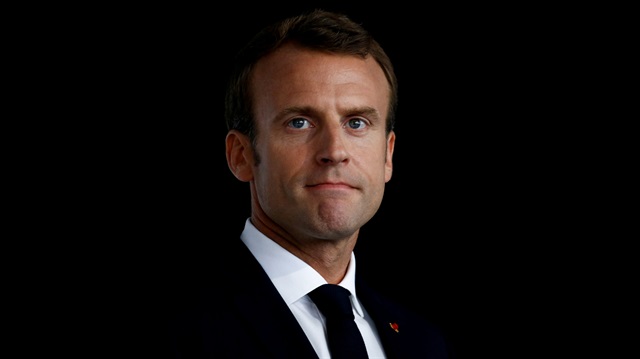
French President Emmanuel Macron
French President Emmanuel Macron's government will tackle social spending in the next wave of its reforms as weaker than expected growth puts pressure on the budget deficit, the prime minister said on Sunday.
Prime Minister Edouard Philippe said in an interview in Le Journal du Dimanche that the government would press on with its reform drive in the face of record unpopularity after little more than a year in office.
Macron has so far largely turned a deaf ear to criticism of his reforms, with detractors dubbing him the president of the rich after cuts to taxes on capital income during his first year in office, which he said encouraged investment.
His government has sold its pro-business reforms on promises that they will boost growth and jobs, but Philippe said that growth would be weaker than expected next year.
The U.S., UK, and France on Tuesday once again condemned the use of chemical weapons by Bashar al-Assad regime in Syria.In a joint statement on the occasion of the fifth anniversary of Ghouta sarin gas attack in Damascus that killed hundreds, the three countries said that since 2012, the regime has resorted to the use of chemical weapons during military offensives, not only in Ghouta but also in Khan Sheikhoun, Ltamenah, Saraqib, and Douma.At least 100 people were killed and hundreds of others injured in the chemical attack in April 2017 in Khan Sheikhoun in western Idlib province."As Permanent Members of the Security Council, we reaffirm our shared resolve to preventing the use of chemical weapons by the Syrian regime, and for holding them accountable for any such use," said the statement.The U.S., UK and France said their position on the regime’s use of chemical weapons is unchanged."As we have demonstrated, we will respond appropriately to any further use of chemical weapons by the Syrian regime, which has had such devastating humanitarian consequences for the Syrian population," according to the statement.The three governments also welcomed a decision by the Organization for the Prohibition of Chemical Weapons (OPCW) in June to name those behind toxic arms attacks in Syria, saying it "will help ensure that the perpetrators of chemical weapons use in Syria cannot escape identification."We remain committed to securing justice for victims of chemical weapons use," they said.They also voiced grave concern about reports of a military offensive by the Syrian regime against civilians in Idlib, and the resulting humanitarian consequences."We urge supporters of the Assad regime to use their influence to uphold the global norm against chemical weapons use." They also called on the international community to support efforts to end Syria’s use of chemical weapons.Displaced Syrians in Idlib mark Eid despite hardshipsSyriac leader slams US, European support to YPG/PKK47,000 more Syrians in Turkey back home for Eid al-AdhaYPG/PKK detain Arab candidates for Assad regime polls
US, UK, France vow response to Syria chemical attacks
Philippe told Le Journal du Dimanche that the 2019 budget would be based on a growth forecast of 1.7 percent rather than the 1.9 percent forecast in April.
The prime minister acknowledged that the lower growth is likely to weigh on the public budget deficit, which is already under pressure from plans to make a payroll tax credit scheme permanent.
"But that does not prevent us from sticking to our commitments on reducing taxes while reining in public spending and debt," he added.
The slower growth outlook raises the chances that when the government produces its 2019 budget at the end of September it may need to change its public deficit target, previously pegged at 2.3 percent of economic output.
The Turkish finance minister and his French counterpart on Friday agreed over the phone to conduct a joint action against U.S. sanctions targeting Turkey, according to the ministerial sources.Turkish Treasury and Finance Minister Berat Albayrak and French Economy and Finance Minister Bruno Le Maire discussed economic cooperation, the Turkish Treasury and Finance Ministry said in a statement.Albayrak and Le Maire agreed to improve bilateral cooperation, the statement said, adding delegations from both countries would meet in Paris on Aug. 27.The Turkish minister also thanked his counterpart and French President Emmanuel Macron for their support.Turkey and the U.S. are currently experiencing rocky relations after Washington imposed sanctions on two Turkish Cabinet ministers for not releasing Brunson.President Donald Trump last week ramped up his attack on Turkey by doubling U.S. tariffs on Turkish aluminum and steel imports.On Wednesday, in retaliation, Turkey increased tariffs on several U.S.-origin products, including alcohol and tobacco products and cars.
Turkey, France to act against US sanctions
However, business daily Les Echos reported that the government could be aiming at a deficit close to 2.6 percent this year -- the same as in 2017 -- and as much as 3 percent next year.
"Sure, it's a higher than expected number, but choices had to be made," Les Echos quoted an unnamed government source as saying.
FISCAL SQUEEZE
The government has been under pressure from Brussels and the International Monetary Fund to detail plans to rein in public spending. France is among the global frontrunners in the spending stakes.
Philippe said the government is particularly keen on reducing spending on what he described as ineffective policies such as housing or subsidised jobs.
He said that housing allowances, family welfare benefits and pension payouts would increase by only 0.3 percent in 2019 and 2020. That is far less than the 1.5 percent average inflation rate economists polled by Reuters expect next year and the 1.8 percent expected in 2020.
Meanwhile, the government would consider reducing unemployment benefits over time, Philippe said.
Criticisms of Macron's aloof leadership style and a summer scandal over his top body guard beating May Day protesters helped to push his approval ratings to a record low of only 34 percent in August, according to an Ifop poll for Le Journal du Dimanche.
Philippe also responded to criticism saying that the government's policies were designed to reward workers and discourage unmeasured increases in welfare handouts.
Philippe said that tax on overtime pay would be axed from September 2019 on top of plans do away with worker contributions to financing health and unemployment benefits while also getting rid of housing tax.
Efforts to shrink France's vast public sector would be maintained, he added, with plans to cut 4,500 state jobs in 2019 and more than 10,000 in 2020.
"This is going to be a real bloodbath for the state and the public services," far-left leader Jean-Luc Melenchon told reporters in response to Philippe's comments.