

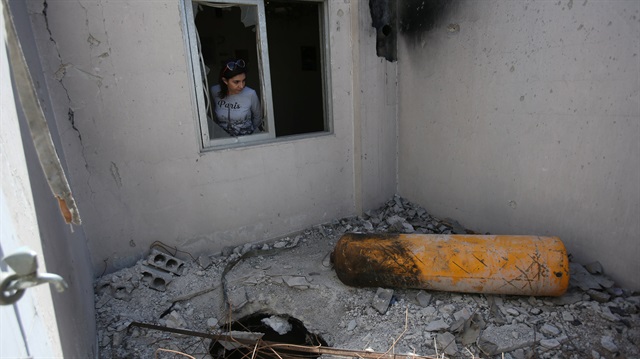
File photo: A journalist looks on during a media tour of a damaged house where Organisation for the Prohibition of Chemical Weapons (OPCW) inspectors are belived to have visited in Douma near Damascus, Syria
The U.S., UK, and France on Tuesday once again condemned the use of chemical weapons by Bashar al-Assad regime in Syria.
In a joint statement on the occasion of the fifth anniversary of Ghouta sarin gas attack in Damascus that killed hundreds, the three countries said that since 2012, the regime has resorted to the use of chemical weapons during military offensives, not only in Ghouta but also in Khan Sheikhoun, Ltamenah, Saraqib, and Douma.
At least 100 people were killed and hundreds of others injured in the chemical attack in April 2017 in Khan Sheikhoun in western Idlib province.
"As Permanent Members of the Security Council, we reaffirm our shared resolve to preventing the use of chemical weapons by the Syrian regime, and for holding them accountable for any such use," said the statement.
The U.S., UK and France said their position on the regime’s use of chemical weapons is unchanged.
"As we have demonstrated, we will respond appropriately to any further use of chemical weapons by the Syrian regime, which has had such devastating humanitarian consequences for the Syrian population," according to the statement.
The three governments also welcomed a decision by the Organization for the Prohibition of Chemical Weapons (OPCW) in June to name those behind toxic arms attacks in Syria, saying it "will help ensure that the perpetrators of chemical weapons use in Syria cannot escape identification.
"We remain committed to securing justice for victims of chemical weapons use," they said.
They also voiced grave concern about reports of a military offensive by the Syrian regime against civilians in Idlib, and the resulting humanitarian consequences.
"We urge supporters of the Assad regime to use their influence to uphold the global norm against chemical weapons use."
They also called on the international community to support efforts to end Syria’s use of chemical weapons.
Civilians in Syria’s northwestern Idlib province, where refugees have sought shelter during the country’s protracted conflict, welcomed the arrival of the Eid al-Adha holiday on Tuesday despite their difficult circumstances.Held by anti-regime opposition factions, Idlib is currently home to some four million Syrians who fled their homes earlier amid attacks by the Assad regime.Mohammed Kaddor, chairman of Idlib’s Ahli refugee camp, told Anadolu Agency that only a limited number of camp residents were able to take part in Eid festivities.“Some have enough money to buy new goods, but most rely on second-hand shops,” he said. “Meanwhile, those without family or money don't leave the camp.”“Orphans and the families of martyrs can’t buy the kinds of food associated with Eid, nor can they buy new clothes,” he added.Noting that the Assad regime had recently deployed troops to opposition-held Idlib, Kaddor said that camp residents feared a possible regime attack on the area.Um Mahmoud, a Turkmen mother who lost her husband earlier to a regime airstrike, said that she -- along with her seven children -- was depending on charitable organizations for her Eid requirements.“If it wasn't for these charitable organizations, we wouldn’t have anything to eat now,” she said gratefully.“I don't have an income or anyone to bring money home,” she added.Um Mahmoud went on to lament the fact that she could not afford any of the items her children wanted.“In line with tradition, all my children want new clothes to wear for the Eid,” she said.Omar Abu Nahla, a resident of Idlib’s Kafr Lusin refugee camp, for his part, said that Idlib had recently seen a fresh influx of refugees from central and southern parts of the country.“My children want new clothes and shoes, but I can't afford this,” he said.“They don’t understand our difficult circumstances; they just want to be happy,” he added.Another camp resident, Samar Sallum, said that he had bought used clothes for his children at a local flea market.Sallum, too, pointed out that camp populations had recently increased due to a fresh refugee influx from Syria’s Homs and Daraa provinces.“It’s always nice to celebrate Eid, but we still need help more than ever,” Sallum told Anadolu Agency.Video: Eid al-Adha celebration in Gaza
Displaced Syrians in Idlib mark Eid despite hardships
The support of YPG/PKK terrorist groups by the U.S. and European countries has led to more deaths and destruction in Syria, head of a Syriac non-governmental organization said."The time has come for Americans and Europeans to realize that supporting the YPG, with its current separatist agenda, does not lead to peace and security in Syria, but in fact cause more death and destruction, with the potential of a spill-over effect to neighboring regions," said Johny Messo, president of World Council of Arameans (Syriacs), in an exclusive interview with Anadolu Agency."Among the victims of such an irresponsible policy are Syria's indigenous Aramean people, who have been and continue to be threatened, intimidated and occasionally even eliminated (intellectually and physically) by the YPG," Messo added.Messo said YPG/PKK terrorists have demanded the closure of Aramean and Armenian schools in the Derik and Darbasiyah regions of Syria."Essentially, they do this because the native Arameans reject their ongoing demands," he said.Messo said these demands include the Kurdish language and textbooks to be incorporated in the school curriculum and YPG/PKK also expect the Arameans to ask for a permit or license for their schools to exist."The fact that the Aramean Christians and other vulnerable minorities in the region do not recognize the separatist PYD/YPG as the rulers of Northeast Syria is a thorn in the eye for them," he said."Threatening to shut down the schools of the remaining native Arameans of Northeast Syria is outrageous, scandalous and shameful," Messo stressed.- YPG/PKK shutting down schools of ArameansHe said the World Council of Arameans "strongly condemns such acts of terror", and will do whatever it takes to prevent such developments."Shutting down independent schools of vulnerable minorities, such as the Arameans, exposes the exclusivist and destructive ideology, agenda and objectives of the YPG," Messo said.YPG/PKK detain Arab candidates for Assad regime pollsTerrorist YPG/PKK suffers heavy blow in Turkey, abroadLast week the YPG/PKK terror group shut down three Assyrian schools in parts of northeastern Syria under its control on grounds that the targeted schools did not have a license.Messo said in the recent years, Syria's indigenous Arameans (Syriacs) were deliberately targeted in a number of ways by the YPG/PKK.He said the terrorists have threatened, intimidated, oppressed and even killed Arameans in the region."Forcing the closure of independent intellectual institutions, which had already been recognized by the state, flies by all means in the face of international law and reveals the double-speak of the YPG with regard to human rights, civil liberties and especially a so-called free, democratic and pluralistic region they continue to promote," Messo added.According to map calculations made by Anadolu Agency, the Bashar al-Assad regime controls about 59 percent of Syria, while the YPG/PKK terror group controls 27.7 percent of the country.The YPG/PKK is Syrian branch of the PKK -- recognized as a terror group by the U.S., EU, and Turkey.In its more than 30-year terror campaign against Turkey, the PKK has claimed some 40,000 lives, including many women and children.
Syriac leader slams US, European support to YPG/PKK
As many as 47,000 more Syrians have left Turkey to celebrate Muslim festival of Eid al-Adha with their relatives in Syria.The Syrians went back to their country through the border gate in the southern Turkish province of Hatay, Anadolu Agency correspondent said on Monday.At first, they made appointments on the internet, then they left Turkey after showing their passports and other official documents at the border gate.They will start returning to Turkey from Aug. 27.This year's Muslim festival of Eid al-Adha is set to be celebrated on Aug. 21.On Saturday, it was reported that over 35,000 Syrians, including children, have left Turkey since early August via the Oncupinar Border Gate in the southeastern province of Kilis.Qasim al-Qasim, an official at the Syrian side of the border gate, told Anadolu Agency on Saturday that 35,840 Syrians went back to their country to celebrate the Eid.Kasim noted that peace has returned in the region after Turkey's counter-terror operations in northwestern Syria.The Syrian people, who used the border gate in Kilis province, will start returning to Turkey from Sept. 3, he added.
47,000 more Syrians in Turkey back home for Eid al-Adha
The YPG/PKK terror group has detained Arabs in northeastern Syrian city of Qamishli who announced their candidacy for the Assad regime's general elections in September, sources in Syria told Anadolu Agency. Qamishli remains under occupation of the terror group.According to the sources, the Assad regime had formed an election bureau in Qamishli in coordination with the YPG/PKK terror group. A total of 17 independent Arab candidates, known for their closeness to the regime, then applied to the bureau for candidacy; however, the YPG/PKK raided their homes and detained them despite the fact that their candidacy had been approved.The Assad regime recently announced it would hold general elections for the first time since the start of the civil war. For this reason, the regime and YPG/PKK terror group expedited their talks that had been continuing for a while.In their previous meeting last week, the YPG/PKK and the Assad regime were unable to agree on the terror group's demands for autonomy.In July, the YPG/PKK terrorist group agreed to hand responsibility for several of Syria’s most lucrative oilfields over to the regime, wrapping up several weeks of negotiations. Later, ties between the regime and the organization began to strengthen.According to map calculations made by Anadolu Agency, the Assad regime controls about 59 percent of Syria, while the YPG/PKK terror group controls 27.7 percent of the country.
YPG/PKK detain Arab candidates for Assad regime polls