

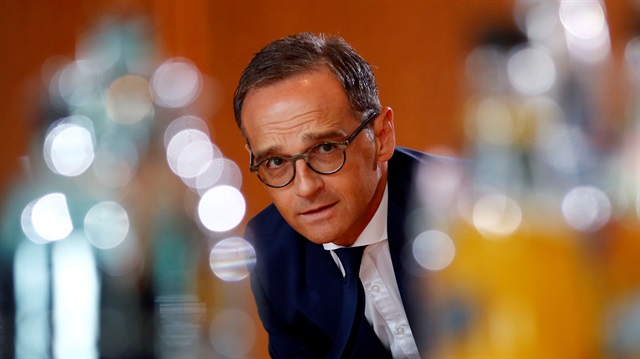
German Foreign Minister Heiko Maas
Germany’s foreign minister on Monday heavily criticized U.S. President Donald Trump for abruptly and unilaterally imposing sanctions against trade partners like Turkey, China and Russia.
Speaking at the annual Ambassadors' Conference in Berlin, Heiko Maas vowed to take measures to protect European firms from such unilateral sanctions.
“Washington’s sanctions policy forces us Europeans to formulate a response. Because it is affecting us, Germany and Europe, when the U.S. abruptly and unilaterally imposing often unspecified sanctions against Russia, China, Turkey and maybe in the future against our other important trading partners," he stressed.
Maas argued that the European Union member states should take joint steps against the U.S. dominance in global finance, and proposed a European alternative to the U.S.-dominated SWIFT payment system.
“We have to further strengthen the autonomy and sovereignty of Europe in the fields of trade, economy and finance policies,” he stressed.
“It’s not going to be easy but we have already started working on it. We are working on proposals to establish independent payment channels and creating a European Monetary Fund,” he added.
The foreign minister of Canada, which is embroiled in a diplomatic row with Saudi Arabia, called for German support on Monday in Ottawa's campaign to promote human rights around the world.The German government, trying to repair its own strained relationship with Riyadh, has been silent on the spat between Canada and Saudi Arabia, drawing criticism from some politicians and rights groups.Chrystia Freeland, speaking at an annual gathering of German ambassadors in Berlin, did not specifically mention Saudi Arabia in her address. However, she touched indirectly on the row which was triggered by her tweet demanding the release of jailed human rights activists in the kingdom.In response, Riyadh has frozen new trade with Canada, expelled the Canadian ambassador and ended state-backed educational and medical programmes in Canada.Freeland said Canada would always stand up for human rights "even when we are told to mind our own business ... and even when speaking up brings consequences".She added: "We count on and hope for Germany's support."Ties between Berlin and Riyadh have been strained since former foreign minister Sigmar Gabriel denounced "adventurism" in the Middle East in November of last year, comments that were seen as criticism of Riyadh's actions in the region.Saudi Arabia withdrew its ambassador to Berlin and, since early 2018, has excluded German healthcare companies from public tenders.Riyadh is at loggerheads with many European countries which have criticised its intervention in Yemen's civil war and support dialogue with its arch-enemy Iran.German Foreign Minister Heiko Maas stressed at the conference Europe and Canada's shared interest in preserving a "rules-based international order" in the face of U.S. President Donald Trump's unilateralism."It hits Europe and Germany when the United States, suddenly and without consulting, introduces random sanctions against Russia, China, Turkey and in the future perhaps more of our important trading partners," he said.Europe needed to become more autonomous in order to defend its commercial and trade interests, Maas said. "It won't be easy," he added. 
Canada appeals for German backing amid Saudi rights row
Iranian lawyers asked the International Court of Justice on Monday to order the United States to lift sanctions imposed by the Trump administration against Tehran, but Washington described the suit as meritless.At the start of a week of hearings in The Hague, the court's president asked the United States to respect the outcome of the case that Iran filed in July. During their decades of animosity, both countries have ignored some rulings at the court.Tehran's suit says the U.S. sanctions, which are damaging the already weak Iranian economy, violate terms of a little-known friendship treaty between the two countries."The U.S. is publicly propagating a policy intended to damage as severely as possible Iran's economy and Iranian national companies, and therefore inevitably Iranian nationals," said Mohsen Mohebi, representing Iran. "This policy is plainly in violation of the 1955 Treaty of Amity."Video: World Court hears Iran suit to have US sanctions liftedHe said Iran had sought a diplomatic solution to the countries' dispute but was rejected.U.S. Secretary of State Mike Pompeo described Iran's suit as "an attempt to interfere with the sovereign rights of the United States to take lawful actions, including re-imposition of sanctions, which are necessary to protect our national security"."We will vigorously defend against Iran’s meritless claims this week in The Hague," he said in a statement.A ruling is expected within a month, though no date has been set.US vows to fight Iran world court actionThe ICJ is the United Nations tribunal for resolving international disputes. Its rulings are binding, but it has no power to enforce them.U.S. President Donald Trump pulled out of a 2015 pact between Iran and major world powers under which sanctions were lifted in return for Tehran accepting curbs on its nuclear programme. The Trump administration then announced unilateral plans to restore sanctions against Tehran.Although Washington's European allies protested against Trump's move, most Western companies intend to adhere to the sanctions, preferring to lose business in Iran than be punished by the United States or barred from doing business there.Iran shuts down scores of military-run companiesThe United States and Iran have clashed at the court in the past since they became enemies after Iran's 1979 Islamic Revolution. Iran ignored a 1980 U.S. suit at the ICJ over the seizure of American diplomats in Tehran, which the court found to be illegal.In another suit and countersuit, the ICJ found that the 1955 treaty was still valid even though it was signed before the revolution. However, the court found in 2003 that neither actions by the United States against Iranian oil platforms nor Iranian attacks on American shipping violated the treaty. Iran says it has full control of Gulf and US navy does not belong there
World Court hears Iran lawsuit to have US sanctions lifted
Germany’s economy minister voiced support on Sunday for Turkey amid market worries after U.S. President Donald Trump slammed sanctions and raised tariffs on Turkey.Responding to questions by citizens during an open house event of his ministry, Peter Altmaier underlined Turkey’s importance for Germany and for the European Union.“We can have no interest in the destabilization of a country like Turkey with 80 million population, which also hosts around 4 million refugees,” he said.Political tensions between Ankara and Washington had sparked worries in markets early this month, after Trump threatened to use economic pressure over the prosecution of an American pastor who faces terrorism-related charges in Turkey.The Turkish lira declined but staged a recovery recently, after positive messages from European capitals and Qatar’s decision to invest $15 billion in Turkey. Altmaier did not totally rule out possibility of assistance to Turkey, if Ankara would ask for support from its European partners.But he stressed that the situation has not come to such a point.“I do not think that at the moment we are in a situation where we have to take concrete decisions on financial or economic assistance,” he said.Altmaier, a close ally of Chancellor Angela Merkel, acknowledged political differences between Berlin and Ankara on a number of issues, but also expressed his hope for overcoming them through dialogue.Political relations between Turkey and Germany suffered several setbacks in the past two years, but both sides took steps in the recent months towards normalization of ties.Turkish President Recep Tayyip Erdogan is expected to pay an official visit to Berlin on Sept. 28-29.Germany is home to more than 3 million people with Turkish roots. Many of them are second or third-generations of Turkish families who migrated to Germany in the 1960s.EU heavyweight Germany is Turkey’s main economic and trade partner, and more than 7,500 German companies are active in the country. In 2017, the bilateral trade volume reached €37.6 billion ($43.6 billion).
Germany says Turkey’s stability important for Europe
German Chancellor Angela Merkel rejected on Sunday a proposal, floated by the European Commission last month, of setting new, stricter emissions cuts targets, saying EU countries should focus on meeting the targets they have already set themselves.The Commission's climate change chief, Miguel Arias Canete, said last month he was considering increasing from 40 to 45 percent the size of cuts to harmful carbon dioxide emissions that EU countries should target by 2030 in response to evidence that climate change was gathering pace."I'm not particularly happy about these new proposals," Merkel told ARD public television. "I think we should first stick to the goals we have already set ourselves. I don't think permanently setting ourselves new goals makes any sense." Germany's public debt could fall below EU ceiling this yearGerman CEO sees rebound in Turkish tourism sectorGerman foreign minister to visit Turkey next monthState spending, investments drive German Q2 growth
Merkel rejects EU proposal for sharper emissions cuts targets