

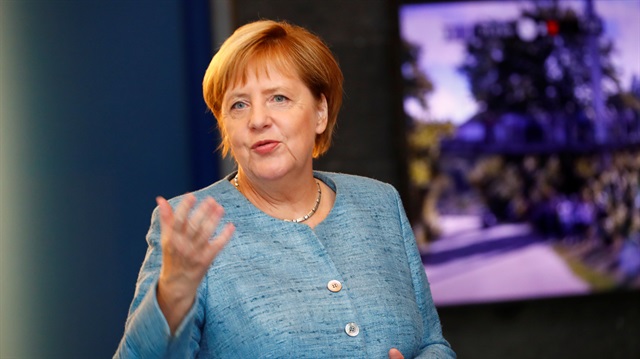
German Chancellor Angela Merkel
German Chancellor Angela Merkel rejected on Sunday a proposal, floated by the European Commission last month, of setting new, stricter emissions cuts targets, saying EU countries should focus on meeting the targets they have already set themselves.
The Commission's climate change chief, Miguel Arias Canete, said last month he was considering increasing from 40 to 45 percent the size of cuts to harmful carbon dioxide emissions that EU countries should target by 2030 in response to evidence that climate change was gathering pace.
"I'm not particularly happy about these new proposals," Merkel told ARD public television. "I think we should first stick to the goals we have already set ourselves. I don't think permanently setting ourselves new goals makes any sense."
Germany's public sector debt could fall below the European Union's debt ceiling before the end of the year, Finance Minister Olaf Scholz said on Sunday, after figures this week showed a booming economy was generating a record surplus.Speaking at the annual open day at which Berlin's ministries open their doors to the public, Scholz said that Germany's debt levels could fall below 60 percent of economic output earlier than the originally planned target of 2019.The plummeting debt levels are helped by the robust health of Europe's largest economy, which grew 0.5 percent in the second quarter, driving the public sector surplus for the first half of the year to a record 48.1 billion euros ($55 billion).That towering surplus has drawn increasingly urgent calls from lobbyists and other governments for Germany to invest more, prompting even the ultra-cautious Scholz to concede that the shower of cash offered "further possibilities".But on Sunday, Scholz reaffirmed Germany's commitment to meeting the so-called Maastrict criteria, the public debt element of which has been breached by most participants since the 2008 financial crisis, implying that Germany's debt could fall even further."In 1990 debt was about 40 percent of social product," he said, referring to the time immediately before West Germany took on the the ageing industries and weak currency of formerly Communist East Germany, seeking to overturn 40 years of relative decline with one of the biggest investment programmes in history.The EU's Maastricht Treaty requires member states to run a deficit of no more than 3 percent of gross domestic product each year. The 60 percent public debt threshold has been violated by many member states for years, with Germany last keeping under the threshold 17 years ago. 
Germany's public debt could fall below EU ceiling this year
The attractiveness of Turkey rebounded especially for European tourists in 2018, the CEO of Turkish-German carrier SunExpress says."We clearly see that there is a big rebound in Turkish tourism and the attractiveness of Turkey, especially in the eyes of European tourists is clearly coming up and very strong again," Jens Bischof told Anadolu Agency.He added that the number of passengers the company carried to [the southern holiday resort city of] Antalya rose 30-35 percent year-on-year in the first half of 2018."So 2017 was the record year [for SunExpress] and 2018 is going even better," he said. "And also if we look into the early stages of tourism in 2019, so my prospects are very positive for the upcoming period."Recalling that 2016/2017 was a challenging year for the Turkish tourism sector, Bischof said the company had full confidence in not only the development but also in the recovery of the sector."Despite all the uncertainties and challenges, 2017 was a record breakout year for SunExpress," he noted.The company carried 8.8 million passengers last year, the majority of whom traveled to Turkey's touristic destinations, Bischof said.He added that the company has a great confidence in the market therefore had already ordered 50 aircraft in 2014."We will place majority of these aircraft here in the country," he said.Commending Turkey's "extremely well developed" infrastructure, Bischof said business opportunities in the country were vast and rich."I like the business mentality and business environment that I found here. One major contributing factor is that you find a very young population in Turkey, the labor force is very well educated," he said.Bischof said investors can be successful when they understand the market well."And also have to live little bit with the volatility and the cycles which we experienced in the market. But if you happen to do so, it can be very successful and certainly very exciting to work in Turkey," he noted.Bischof recommended that investors who are interested in Turkey not place their investment decision in the hands of desktop research.“Come here, look at this country, environment, infrastructure and create your own perspective. Because I believe if you do so you will gain trust to place investments in Turkey,” he said.Antalya-based SunExpress was founded as a joint venture of Turkish Airlines and Germany's Lufthansa in 1989. The carrier flies to around 80 destinations in more than 20 countries in Europe, Asia and North Africa.In terms of capacity, SunExpress is the biggest leisure carrier serving touristic parts of Turkey and Anatolia, Bischof stated.He said that the airline was named 5th best leisure airline in the world and best leisure airline in Turkey by Skytrax in 2018.
German CEO sees rebound in Turkish tourism sector
Germany’s foreign minister is scheduled to visit Turkey next month to discuss bilateral ties and regional issues, diplomatic sources said on Friday.During his two-day visit on Sept. 5-6, Heiko Maas will meet his Turkish counterpart Mevlut Cavusoglu and other senior officials in the capital Ankara.Later the two top diplomats will travel to Istanbul for a celebration at the city’s German School marking its 150th anniversary.Maas’ trip to Turkey comes ahead of Turkish President Recep Tayyip Erdogan’s key visit to Germany on Sept. 28-29.Over the past two years political relations between Ankara and Berlin have suffered setbacks, but in recent months both sides have taken steps towards improving ties.EU heavyweight Germany remains Turkey’s main economic and trade partner, despite political disagreements between the governments on a number of issues.Germany's Merkel has made no decision on next ECB chiefAfter Trump attack on Russia ties, Merkel eyes Azeri gas
German foreign minister to visit Turkey next month
State spending, investments and private consumption drove German economic growth between April and June, detailed data showed on Friday, confirming a preliminary reading of a 0.5 percent expansion in the second quarter.The Federal Statistics Office said exports rose by 0.7 percent on the quarter and imports edged up by 1.7 percent, which resulted in net trade deducting 0.4 percentage points from growth.State spending rose twice as much as household consumption, the data showed.German military turns to under 18s to boost recruitmentBaltic pipeline won't make us energy-dependent on Russia: Merkel
State spending, investments drive German Q2 growth