

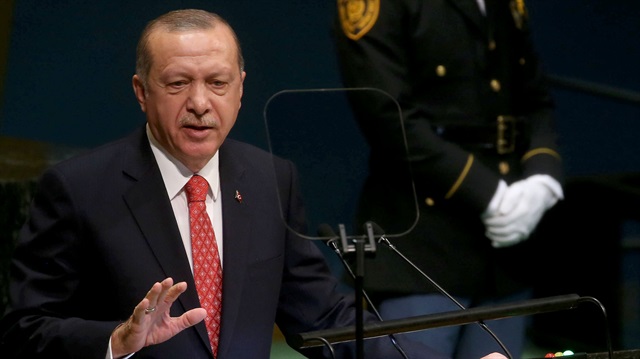
Recep Tayyip Erdoğan
Turkey will continue to purchase Iranian natural gas, Reuters reported Wednesday quoting President Recep Tayyip Erdoğan.
In a late Tuesday interview with Reuters in New York on the sidelines of the annual United Nations General Assembly meeting, Erdoğan said the U.S. threats to punish countries doing business with Iran would not deter Turkey from purchasing Iranian natural gas.
“We need to be realistic ... How can I heat my people’s homes if we stop purchasing Iran’s natural gas?,” Reuters quoted Erdoğan as saying.
The first round of the U.S. pre-nuclear deal sanctions on Iran, largely targeting the country’s banking sector, came into effect in August.
In November, a second phase of U.S. sanctions banning the purchase of Iranian oil and gas is expected to come into effect.
The sanctions target Tehran's acquisition of U.S. dollars, precious metals trade, transactions related to Iran's rial currency, activities related to Iran's sovereign debt, and the country's automotive sector.
If U.S. President Donald Trump wants the price of oil to stop going up, he should stop interfering in the Middle East, Iranian oil minister Bijan Zanganeh said on Wednesday, according to the Iranian Students' News Agency (ISNA)."Mr. Trump is trying to seriously reduce exports of Iran's oil and also ensure the price of oil does not go up, but these two cannot happen together," Zanganeh said, according to ISNA."If he wants the price of oil not to go up and the market not to get destabilized, he should stop unwarranted and disruptive interference in the Middle East and not be an obstacle to the production and export of Iran's oil."Iran says oil to rise as Saudi, Russia do 'little and late'Oil at four-year high after OPEC rebuffs Trump, fails to raise outputIran oil minister says hopes OPEC will not follow US orders
'If Trump wants oil price to stop going up, he should stop interfering in Middle East'
Syria crisis
Regarding the ongoing Syria crisis, Erdoğan reiterated that “it was impossible for Syrian peace efforts to continue with Syrian President Bashar al-Assad in power.”
He added that the withdrawal of “radical groups” already started from a new demilitarized zone in Syria’s Idlib region.
Last week, Turkey and Russia agreed to establish a demilitarized zone in Idlib, Syria’s last opposition stronghold, following a meeting in Sochi between Turkish President Recep Tayyip Erdoğan and Russian counterpart Vladimir Putin.
Ankara and Moscow also signed a memorandum of understanding calling for the “stabilization” of Idlib's de-escalation zone, in which acts of aggression are expressly prohibited.
According to the MoU, opposition groups in Idlib will remain in areas in which they are already present, while Russia and Turkey will conduct joint patrols in the area with a view to preventing renewed fighting.
A Syrian man with a cardiac condition unable to get the treatment he needed in Syria was brought to a Turkish hospital to receive a life-saving operation.Originally from Tal Rifaat, Syria, three years ago Ahmed al-Ahmed had to move to Azaz due to persecution of YPG/PKK terrorists in Tal Rifaat, the patient told reporters on Tuesday.Suffering from atherosclerosis, al-Ahmed sought out treatment in Azaz -- an area liberated by Turkey from the threat of terrorism -- but the treatment was inadequate.So the hospital, founded with Turkish support, transported al-Ahmed to Kilis State Hospital, in southern Turkey near the Syrian border.There al-Ahmed had a bypass operation and was able to make a recovery.He told reporters that after the operation he is now fine and that he prays for Turkish doctors.Operation Euphrates Shield, which began on August 2016 and ended in March 2017, eliminated the terrorist threat along Turkey’s border in the northern Syrian regions of Jarabulus, Al-Rai, Al-Bab, and Azaz with the use of the Free Syrian Army, backed by Turkish artillery and air cover.
Turkish doctors save Syrian patient's life
Pastor Brunson case
Also speaking on the detention of pastor Andrew Brunson who is under house arrest in Turkey for terrorism charges, Erdoğan said Turkish justice, not politicians, will decide the fate of American pastor.
“This is a judiciary matter. Brunson has been detained on terrorism charges ... On Oct. 12, there will be another hearing and we don’t know what the court will decide and politicians will have no say on the verdict,” he told Reuters.
As the Turkish president, Erdoğan has no right to order the release of Brunson, he emphasized, saying: “Our judiciary is independent. Let’s wait and see what the court will decide.”
Turkish President Tayyip Erdoğan said a Turkish court, not politicians, will decide the fate of an American pastor whose detention on terrorism charges has hit relations between Ankara and Washington.U.S. Secretary of State Mike Pompeo said on Monday he was hopeful Turkey would release evangelical pastor Andrew Brunson this month. The preacher was moved to house arrest in July after being detained for 21 months.In an interview with Reuters late on Tuesday while he was in New York for the United Nations General Assembly meetings, Erdoğan said any decision on Brunson would be made by the court."This is a judiciary matter. Brunson has been detained on terrorism charges ... On Oct. 12 there will be another hearing and we don't know what the court will decide and politicians will have no say on the verdict," Erdoğan said.If found guilty, Brunson could be jailed for up to 35 years. He denies the charges. "As the president, I don't have the right to order his release. Our judiciary is independent. Let's wait and see what the court will decide," Erdoğan said.U.S. President Donald Trump, infuriated by Brunson's detention, authorized a doubling of duties on aluminum and steel imported from Turkey in August. Turkey retaliated by increasing tariffs on U.S. cars, alcohol and tobacco imports.Trumpian chaos and Turkish-American relations"The Brunson case is not even closely related to Turkey's economy. The current economic challenges have been exaggerated more than necessary and Turkey will overcome these challenges with its own resources," Erdoğan said."It shows the central bank is independent. As the president, I am against high interest rates and I am repeating my stance here again," he said, adding that high rates "primarily scare away investors"."This was a decision made by the central bank ... I hope and pray that their expectations will be met because high rates lead to high inflation. I hope the other way around will happen this time."Erdoğan to inaugurate mosque in Germany on SaturdayIn an effort to boost the economy and attract investors, Erdogan will travel on Sept. 28 to Germany, a country that is home to millions of Turks."We want to completely leave behind all the problems and to create a warm environment between Turkey and Germany just like it used to be," Erdoğan said, adding that he will meet Chancellor Angela Merkel during his visit.Erdoğan: UNSC 'standing idle to oppressions in world'On Syria, Erdoğan said it was impossible for Syrian peace efforts to continue with President Bashar al-Assad in power.Earlier this month, Turkey and Russia reached an agreement to enforce a new demilitarized zone in Syria's Idlib region."This part of Syria will be free of weapons which is the expectation of the people of Idlib ... who welcomed this step," he said. The demilitarized zone will be patrolled by Turkish and Russian forces.Close to 3 million people live in Idlib, around half of them displaced by the war from other parts of Syria.Erdoğan said Turkey will continue to buy natural gas from Iran in line with its long-term supply contract despite Trump's threats to punish countries doing business with Iran."We need to be realistic ... Am I supposed to let people freeze in winter? ...Nobody should be offended. How can I heat my people's homes if we stop purchasing Iran's natural gas?," he said.Trump pulled the United States out of a 2015 multinational nuclear deal with Iran and in August Washington reimposed sanctions on Tehran, lifted in 2016 under the pact. U.S. sanctions on Iran’s energy sector are set to be re-imposed in November. 
Turkey's Erdoğan says court will decide fate of detained US pastor
Turkey and the U.S. experience rocky relations following Washington’s imposition of sanctions over the detention of Brunson.
Brunson's charges include spying for the PKK -- listed as a terrorist group by both the U.S. and Turkey -- and the Fetullah Terrorist Organization (FETÖ), the group behind the defeated coup attempt in Turkey of July 2016.
Political tensions between the two countries had sparked worries in markets this month, after U.S. President Donald Trump threatened to use economic pressure over the American pastor who faces terrorism-related charges in Turkey.