

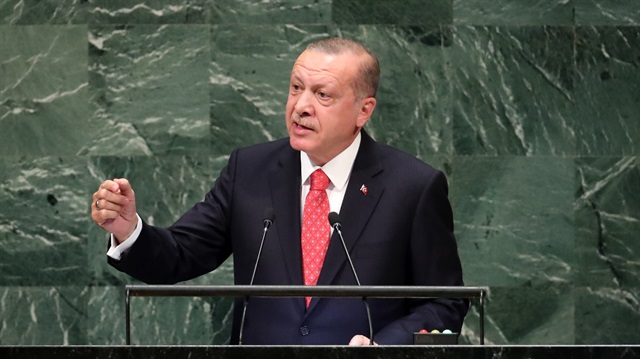
Turkey's President Recep Tayyip Erdogan
Turkish President Tayyip Erdoğan said a Turkish court, not politicians, will decide the fate of an American pastor whose detention on terrorism charges has hit relations between Ankara and Washington.
U.S. Secretary of State Mike Pompeo said on Monday he was hopeful Turkey would release evangelical pastor Andrew Brunson this month. The preacher was moved to house arrest in July after being detained for 21 months.
In an interview with Reuters late on Tuesday while he was in New York for the United Nations General Assembly meetings, Erdoğan said any decision on Brunson would be made by the court.
"This is a judiciary matter. Brunson has been detained on terrorism charges ... On Oct. 12 there will be another hearing and we don't know what the court will decide and politicians will have no say on the verdict," Erdoğan said.
If found guilty, Brunson could be jailed for up to 35 years. He denies the charges. "As the president, I don't have the right to order his release. Our judiciary is independent. Let's wait and see what the court will decide," Erdoğan said.
U.S. President Donald Trump, infuriated by Brunson's detention, authorized a doubling of duties on aluminum and steel imported from Turkey in August. Turkey retaliated by increasing tariffs on U.S. cars, alcohol and tobacco imports.
As the United States’ November midterm elections draw near, President Trump becomes more and more attuned to the domestic news cycle. For that reason, Trump’s preoccupation with the Turkish government and the Turkish judiciary’s continuing detention of Pastor Brunson lasted no more than a fortnight, as should have been predictable. Once it became clear that he would have no success bullying the Turkish leadership, and that Turkey’s economy would weather an overt political attempt to cripple its currency, Trump speedily turned to other matters.Over the past eighteen months, Trump has tended to jump from topic to topic when politically expedient. If a certain issue does not provide the desired political or media results, a more promising topic will be quickly thrust onto the public -- often by early morning tweets. In the end, the chaos that the Trump Administration is enveloped in meant that if Turkish officials remained calm and took measured steps to protect Turkey’s economy, the storm would soon pass. They did, and it did. But that same chaos also means that Trump could launch another impetuous attack with little or no warning, especially when we can be sure that Trump’s National Security Advisor John Bolton and Vice President Mike Pence continue to whisper in his ear about Turkey.Turkey slams US decision to close Palestine Liberation OrganizationJohn Bolton and the Neoconservatives are backThe upcoming polls are not the only reason that Trump has suddenly become more antagonistic towards Turkey. There can be little doubt that Bolton is a prime factor spurring Trump on. As late as the July NATO conference, commentators were either gushing or complaining about the rapport that Trump and Turkish President Recep Tayyip Erdoğan apparently enjoyed. But even then Trump’s interactions with President Erdoğan did not display convincing sincerity. The idea that Trump, whose understanding of foreign societies is extremely limited and whose administration has routinely displayed contempt for foreigners in general and Muslims in particular, could found a meaningful working relationship with President Erdoğan always required one to suspend rational expectations. Bolton’s influence, as malign as expected, has simply brought this reality to the forefront.Many observers anticipated the worst when Bolton, an arch neoconservative left over from the George W. Bush Administration, managed to regain access to the White House. Trump originally considered Bolton for the Secretary of State position, but the position he eventually procured may be more to Bolton’s liking. The National Security Advisor is not subject to Congressional approval, has no bureaucracy to wrangle with, participates in the National Security Council, and possesses direct access to the President.Ultimately, Trump’s political inexperience is what enabled Bolton to win a political appointment. When Trump entered the presidential race, he had no political experience and no political base other than the “alt right,” which is the extreme right side of the American political spectrum. Choosing Mike Pence as his running mate added the evangelical community, but neither voting block could provide a network, built up over time spent as an elected official, that a president-elect normally arrives with in Washington D.C. That network provides many candidates with specific skills and experience for political appointments.Obama criticizes Trump's policiesAs feared, Trump’s lack of a political network resulted in disastrous personnel choices, and the most direct consequence has been unprecedented turnover in his administration. Many of his choices turned out to be incompetent and were fired, or corrupt enough to be immediately exposed and dismissed. Others clashed with Trump over policy and were defenestrated. Trump’s revolving personnel door is the direct symptom of his lack of a political base and network.The second result was that established elements of the Republican Party network in Washington eventually found opportunities to reappear on the scene once Trump’s initial personnel choices faltered and exited. This is how John Bolton found a place at Trump’s right hand, and we can be sure that the Washington D.C. neoconservative community is now doing its best to take advantage. I warned of this in the 2016 election’s immediate aftermath.“Deep State” coup not likelyDespite all of the chaos, however, no one should expect President Trump’s departure anytime soon. The latest turmoil to strike Washington took the form of an anonymous letter published by the New York Times. The letter was written by someone claiming to be in the Trump Administration’s highest levels, and who explained that most members of the administration know Trump is incompetent, so they either limit and stifle his attempts to make policy, or ignore him altogether.This letter provoked energetic reactions from all sectors of the American chattering classes, including claims that an American “deep state” was in the process of carrying out a coup against Trump. In Turkey, that claim found ready proponents. The same newspaper also published advance excerpts from Bob Woodward’s new book on the Trump Administration, which added heaps of fuel to the already blazing controversies engulfing the administration. All in all, the past week sparked another wave of expectation that Trump’s disgrace and fall from power were nigh.But looking beyond the hysteria and hyperbole, Trump’s departure from the White House does not appear imminent. If the Republican Party maintains control of both houses of Congress in November, Trump will essentially be assured of serving his entire term.The essence of the matter is that the Republican Party is able to carry out its agenda through Congress. Trump is a distraction, an embarrassment even, but in the end he is on their side. And despite loud claims of liberal bias in the American mainstream media, the reality is that Trump receives favorable treatment from the media that the Republican Party voting constituency reads or watches. For those reasons, even if the Democrats win control of one or even both houses of Congress, it will be extremely difficult for them to impeach Trump. And even if Trump were impeached and eventually removed, Vice President Pence, who is close to the American evangelical community, would become the President. The Democrat Party may decide that enabling Pence to become president would be even worse than having Trump remain in office.'Turkey to no longer send students to study in US'Furthermore, the ongoing legal inquiries into various aspects of the Trump Administration are not guaranteed to result in charges against Trump, even when some of his closest collaborators are now being given prison sentences. Debate continues about whether a sitting president can be put on trial, and whether any of the charges that might materialize against Trump would warrant trying to put him on trial.Likewise, there is no “deep state” in the U.S. planning to carry out some sort of coup against Trump. The anonymous author of the NYT letter referred to a “steady state” instead of a “deep state”. What the author means is political appointees and career bureaucrats, and this is something that every president in the past 100 years has confronted. Any modern state is immense, and career bureaucrats also, rightly, feel invested in the policies that they are charged with developing and/or carrying out. Competition for influence over policy between political appointees and career bureaucrats is the norm because career bureaucrats may see political appointees as interlopers.Political appointees themselves have a tendency to feel independent and more knowledgeable on their particular field of interest than the President. The political and bureaucratic infighting common to modern bureaucracies was the reason President Harry Truman, 75 years ago, complained that, “There are more Prima Donnas per square foot in public life...in Washington than in all the opera companies ever to exist.” He also complained about “Potomac fever” (a reference to the river that provides Washington D.C.’s southwest border), an ailment that he thought afflicts people who come to Washington for government careers. Every administration features friction among career bureaucrats, political appointees, and the president.In other words, the “steady state” is something entirely different than what Turkish people refer to when they use the term “derin devlet”. That sort of “deep state” is an extra-legal, unaccountable crime and violence network based partially in multiple state institutions but also having links to intelligence, military, paramilitary, and organized crime structures. Certainly, nothing of the sort exists in the U.S.Finally, the same anonymous author also referred to the 25th Amendment to the United States Constitution. That amendment contains a clause that states how the president may be removed by the principal members of his administration through a petition to Congress. That clause has never been invoked, and was intended for situations in which the President might be gravely injured, or incapacitated by health problems or disease. Such a move would also have to be carried out by members of the Republican Party, and would precipitate one of the most serious political crises in U.S. history. Because the Republican Party already enjoys control of Congress and is still able to pursue its agenda, purposefully triggering a major political crisis with unforeseeable results would clearly be an unnecessary and extreme step.Expect continuityBecause Trump will, in all likelihood, be president for at least two more years, we cannot expect dramatic shifts in U.S. policy towards Turkey. Mike Pompeo’s appointment as Secretary of State has not changed the State Department’s diminished stature and irrelevance to policy formation towards Turkey. A U.S. Ambassador to Turkey still has not been nominated. James Jeffrey’s appointment as Special Representative for Syria Engagement is the lone ray of hope in an otherwise dismal situation. Jeffrey served uneventfully as Ambassador to Turkey in 2008-2010, and his recent comments have displayed good understanding of the region and of Turkey’s worries.On the other hand, U.S. policy in Syria still is under the control of the U.S. military. Turkish-American cooperative patrolling in Manbij continues, but Turkish officials have recently indicated that they perceive American foot-dragging. Possibly, this is related to new developments in U.S. plans: despite Trump’s openly stated desire to hastily wrap up U.S. operations in Syria, the U.S. military now seems to be preparing for an extended stay.Overall, the U.S. long ago lost influence over the flow of events in Syria. Russia and Iran, though often disagreeing on how to collaborate, remain the main powers in Syria, openly propping up the Assad regime. Turkey negotiates with both, and is sometimes able to obtain concrete results, while U.S. influence is limited to the small regions it maintains forces in, but even there it cannot exercise complete control over the behavior of its ally, the PKK/PYD.
Trumpian chaos and Turkish-American relations
"The Brunson case is not even closely related to Turkey's economy. The current economic challenges have been exaggerated more than necessary and Turkey will overcome these challenges with its own resources," Erdoğan said.
"It shows the central bank is independent. As the president, I am against high interest rates and I am repeating my stance here again," he said, adding that high rates "primarily scare away investors".
"This was a decision made by the central bank ... I hope and pray that their expectations will be met because high rates lead to high inflation. I hope the other way around will happen this time."
President Recep Tayyip Erdoğan will inaugurate in the German city of Cologne one of the largest mosques in Europe on Saturday.The Cologne Central Mosque, built by Turkish-Islamic Union for Religious Affairs (DITIB) after eight years of construction work, has a capacity of 1,200 people.“It will be the most important and one of the largest mosques in Europe and Germany. It has a symbolic meaning for our Muslim brothers living here,” Nevzat Yasar Asikoglu, chairman of the DITIB, told reporters.“Our mosque also symbolizes peace, brotherhood as well as the culture of co-existence,” he said.Turkish president meets UN chief in New YorkAsikoglu said those who visit the mosque are impressed by interior adornment of the mosque in which Seljuk motif was predominantly used.The mosque has nine entrances and there is a crescent and a star in the middle of its dome.The 17,000 square-meter mosque complex also has a shopping center, an exhibition and a seminar hall, a 600-people capacity conference hall, a library, working offices and a car park on the ground floor.Video: Erdoğan to inaugurate one of Europe’s largest mosques in GermanyGermany, a country of over 81 million people, has the second-largest Muslim population in Western Europe after France.Among the country’s nearly 4.7 million Muslims, three million are of Turkish origin. Many of them are second or third-generations of Turkish families who migrated to Germany in the 1960s, and are said to be well integrated in the country.Erdoğan meets Japanese, Iranian leaders
Erdoğan to inaugurate mosque in Germany on Saturday
In an effort to boost the economy and attract investors, Erdogan will travel on Sept. 28 to Germany, a country that is home to millions of Turks.
"We want to completely leave behind all the problems and to create a warm environment between Turkey and Germany just like it used to be," Erdoğan said, adding that he will meet Chancellor Angela Merkel during his visit.
The UN Security Council currently serves the interests of five permanent members holding veto rights, Turkish President Recep Tayyip Erdogan said Tuesday.The five members of the Council, the U.S, Russia, China, France and Britain, are “standing idle to the oppressions in other parts of the world," Erdogan said in his address to the 73rd session of UN General Assembly.The Turkish president has long advocated for reforming the structure of the Security Council, pushing the motto, "The world is bigger than five."Erdogan said the UN has carried out work and achieved considerable successes over its 73-year history."However, it is also a fact that over time the United Nations moved away from meeting the expectations of humanity for peace and welfare," he added.Erdogan said past "massacres" in Bosnia, Rwanda and Somalia, recent ones in Myanmar and ongoing ones in Palestine, have all taken place before the eyes of the Security Council."Those who do not raise their voices against the oppression of the Palestinians, their efforts even to reduce assistance for them, are only increasing the courage of the oppressors," he added, referring to the recent U.S. decision to cut aid to the UN agency for Palestinian refugees.Turkey will continue to stand with the "oppressed" Palestinians and will protect the historical and legal status of Jerusalem, Erdogan said.He underscored there needs to be "comprehensive reform" in the structure and functioning of the UN, particularly the Security Council. - 'World bigger than 5'"And we believe that when we say ‘the world is bigger than five,’ we become the voice of the common conscience of humanity," Erdogan said.Limiting the reform of the UN to the budget only will neither contribute to the solution of real problems nor make anybody happy, he said.The president added there is a need for increasing UN efficiency "which I find very important for the future of the world, on its fundamental areas of duty which are security, development and social equality.""When the assets of the wealthiest 62 people in the world amount to the assets of the half of world’s population of 3.6 billion people, this means there is a problem," Erdogan said.He called for establishing a new global system at the UN that will be the voice of implementer of humankind’s expectation for justice.- 'More abundant, flexible support'Erdogan said Turkey continues its efforts towards a fairer world while implementing a global humanitarian diplomacy.He recalled that Turkey hosts 4 million refugees, 3.5 million of which are Syrian, and provides them with services that are "incomparable" elsewhere in the world.The total amount Turkey has spent for Syrian refugees alone is at $32 billion."However, so far, the external support we have received is $600 million from international organizations and €1.7 billion from the EU until now," Erdogan said.Erdogan said he expects "more abundant and flexible support" for Turkey, which has prevented a large refugee influx to spill over elsewhere in the world, foremost to Europe, thanks to the opportunities the country has provided to refugees.- Turkey's efforts within UNErdogan said Turkey has contributed substantially to UN in regards to the Gulf crisis, people in Arakan (northern Rakhine State, Myanmar), racism, xenophobia and Islamophobia and also Syria.He said Turkey tries to make Syria a peaceful country again by means of support for Geneva and Astana talks that aim to find a peaceful solution to the Syrian crisis."By clearing the Jarabulus and al-Rai regions from Daesh, and Afrin region from PKK/PYD/YPG terrorist organizations, we have turned an area of 4,000 kilometers [2,485 miles] into a safe and peaceful place for millions of Syrians," Erdogan said.He added Turkey has prevented the Bashar al-Assad regime's "bloody assaults" against the deescalation area in Idlib with Sochi deal signed with Russia."I call on all the parties to support a just and sustainable political solution in Syria with a constructive approach. We wish to see a principled approach against terrorist organizations.Hinting at U.S. support for PYD/YPG, the Syrian affiliate of the PKK terror organization, Erdogan said: "Those who equip terrorists with tens of thousands of trucks and thousands of cargo planes load of arms for the sake of their tactical interests will most definitely feel sorrow in the future."- FETO 'exports terror to world'Erdogan said all terrorist organizations do not obtain their power from their armed actions, rather some hide behind "glossy concepts" such as education, welfare and dialogue, and continues operations as NGOs or businesses."Through the support of our people to our resolute struggle over the last five years, we have eliminated the majority of FETO [terrorist organization] in our country.FETO and its U.S.-based leader Fetullah Gulen are accused of orchestrating the defeated coup July 15, 2016, which left 251 people martyred and nearly 2,200 injured.Ankara also accuses FETO of being behind a long-running campaign to overthrow the state through the infiltration of Turkish institutions, particularly the military, police and judiciary.He said countries have heeded Turkey’s warnings and learned from its lessons and are deciphering the organization and expelling it from their lands. However, some states, including the U.S. and European countries, "have not understood the danger"."For instance, the amount of funds that the FETO terrorist organization receives in 27 U.S. states from the government budget solely by charter schools is $763 million," he added.Erdogan said FETO leader Gulen "exports terror" to 160 countries from his residence in the U.S. state of Pennsylvania and urged world nations to be watchful and take action against the terror group.- Turkey backs constructive dialogueErdogan said trade wars have harmed humanity in every period."None of us can remain silent to the arbitrary cancellation of commercial agreements, the spreading prevalence of protectionism and the use of economic sanctions as weapons."The negative effects of these twisted developments will eventually affect all countries," he added.The president called on countries to work together to prevent damage to the world trade regime as a result of such unilateral decisions."Today, some countries are persistently trying to create chaos. There is no bigger danger than a world order that has lost mercy, conscience, truth and hope," Erdogan added.Turkey is in favor of solving problems through conducting a constructive dialogue on equal terms and expects responsible action in matters of economy, he said.And he called for an institution within the UN for the youth."As Turkey, we propose establishing a UN Youth Organization as soon as possible and suggest Istanbul, one of the symbolic cities of the world history, as its headquarters," he added.
Erdoğan: UNSC 'standing idle to oppressions in world'
On Syria, Erdoğan said it was impossible for Syrian peace efforts to continue with President Bashar al-Assad in power.
Earlier this month, Turkey and Russia reached an agreement to enforce a new demilitarized zone in Syria's Idlib region.
"This part of Syria will be free of weapons which is the expectation of the people of Idlib ... who welcomed this step," he said. The demilitarized zone will be patrolled by Turkish and Russian forces.
Close to 3 million people live in Idlib, around half of them displaced by the war from other parts of Syria.
Erdoğan said Turkey will continue to buy natural gas from Iran in line with its long-term supply contract despite Trump's threats to punish countries doing business with Iran.
"We need to be realistic ... Am I supposed to let people freeze in winter? ...Nobody should be offended. How can I heat my people's homes if we stop purchasing Iran's natural gas?," he said.
Trump pulled the United States out of a 2015 multinational nuclear deal with Iran and in August Washington reimposed sanctions on Tehran, lifted in 2016 under the pact. U.S. sanctions on Iran’s energy sector are set to be re-imposed in November.