

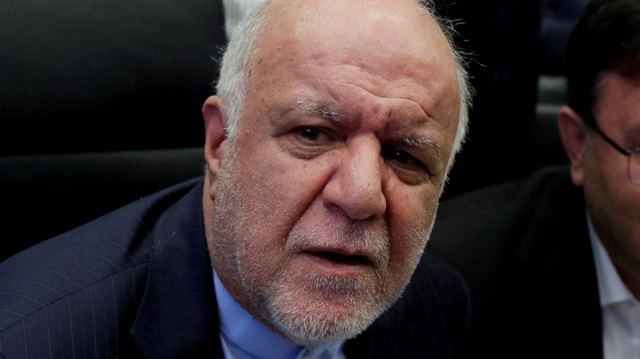
Iran Oil Minister Bijan Zanganeh
If U.S. President Donald Trump wants the price of oil to stop going up, he should stop interfering in the Middle East, Iranian oil minister Bijan Zanganeh said on Wednesday, according to the Iranian Students' News Agency (ISNA).
"Mr. Trump is trying to seriously reduce exports of Iran's oil and also ensure the price of oil does not go up, but these two cannot happen together," Zanganeh said, according to ISNA.
"If he wants the price of oil not to go up and the market not to get destabilized, he should stop unwarranted and disruptive interference in the Middle East and not be an obstacle to the production and export of Iran's oil."
Saudi Arabia and Russia won't add significantly more oil to the market because of a lack of capacity, a top Iranian official said on Monday, predicting prices will probably rise further.On Sunday, ministers and officials from the Organization of the Petroleum Exporting Countries plus Russia and other allies ruled out an immediate oil-output boost, in effect rebuffing U.S. President Donald Trump's calls for action.The move helped push crude prices to a four-year high near $81 a barrel on Monday. Also underpinning the market is the prospect of lower exports from Iran, OPEC's third-largest producer, due to U.S. sanctions.Iran's OPEC governor, Hossein Kazempour Ardebili, said in comments to Reuters that Saudi Arabia and Russia were unable and unwilling to add more production at short notice."They are doing little and late, to get prices higher," he said. "They got prices higher and they are going to get them higher still.""There is no spare capacity. They cannot deliver the extra capacity that they claim."Saudi Arabia, OPEC's biggest producer, says it can add an extra 1.5 million barrels per day - about 1.5 percent of world demand - to the market. But Energy Minister Khalid al-Falih said on Sunday such a move was not needed at the moment.Sunday's meeting appeared to leave unresolved a disagreement which flared up in June between Saudi Arabia and Iran over whether OPEC members are allowed to pump more oil to make up shortfalls elsewhere.Under pressure from Trump, OPEC and allies agreed in June to boost production, after months of undersupply by OPEC countries including Venezuela and Angola and the prospect of the Iran sanctions.Saudi Arabia said the deal allowed countries able to produce more, such as itself, to go ahead and do so, to make up for shortfalls. Iran disagreed and Kazempour maintained that position on Monday."Extra production beyond OPEC quotas requires permission of the conference," he said. "Assignment of OPEC share to non-OPEC requires conference approval."The next meeting of the conference - the full group of OPEC and non-OPEC ministers, is not until December. The OPEC governor is typically the second most senior post in a country's OPEC delegation after the oil minister.Iran's minister, Bijan Zanganeh, was quoted on Monday as saying the meeting did not give a positive response to Trump.Oil at four-year high after OPEC rebuffs Trump, fails to raise output
Iran says oil to rise as Saudi, Russia do 'little and late'
Oil prices jumped more than 2 percent to a four-year high on Monday after OPEC declined to announce an immediate increase in production despite calls by U.S. President Donald Trump for action to raise global supply.Benchmark Brent crude hit its highest since November 2014 at $80.94 per barrel, up $2.14 or 2.7 percent, before easing back to around $80.65 by 0915 GMT. U.S. light crude was $1.50 higher at $72.28.OPEC leader Saudi Arabia and its biggest oil-producer ally outside the group, Russia, on Sunday ruled out any immediate extra increase in output, effectively rebuffing a call by Trump for action to cool the market."I do not influence prices," Saudi Energy Minister Khalid al-Falih told reporters as OPEC and non-OPEC energy ministers gathered in Algiers for a meeting that ended with no formal recommendation for any additional supply boost.Trump tweeted last week that OPEC "must get prices down now!". Iranian Oil Minister Bijan Zanganeh said on Monday OPEC had not responded positively to Trump's demands.Commodity traders Trafigura and Mercuria said on Monday that Brent could rise to $90 per barrel by Christmas and pass $100 in early 2019, as markets tighten once U.S. sanctions against Iran are fully implemented from November.J.P. Morgan said U.S. sanctions on Iran could lead to a loss of 1.5 million bpd, while Mercuria warned that as much as 2 million bpd could be knocked out of the market.The Organization of the Petroleum Exporting Countries as well as top producer Russia has been discussing raising output to counter falling supply from Iran, although no decision has been made public yet.A source familiar with OPEC discussions told Reuters on Friday that OPEC and other producers have been discussing the possibility of raising output by 500,000 bpd."We expect that those OPEC countries with available spare capacity, led by Saudi Arabia, will increase output but not completely offset the drop in Iranian barrels," said Edward Bell, commodity analyst at Emirates NBD bank.J.P. Morgan said in its latest market outlook, published on Friday, that "a spike to $90 per barrel is likely" for oil prices in the coming months due to the Iran sanctions.
Oil at four-year high after OPEC rebuffs Trump, fails to raise output
Iranian Oil Minister Bijan Zanganeh said on Sunday he hoped decisions taken by the OPEC and non-OPEC ministerial committee would not be affected by U.S. President Donald Trump's tweets on oil producers."I hope (Trump's) threats will not scare my OPEC colleagues and encourage them to carry out America's orders," Zanganeh was quoted by the oil ministry's SHANA news website as saying.Zanganeh was referring to a tweet by Trump in which he linked U.S. support for Middle Eastern countries to oil prices on Thursday and again urged OPEC to lower prices. 
Iran oil minister says hopes OPEC will not follow US orders