

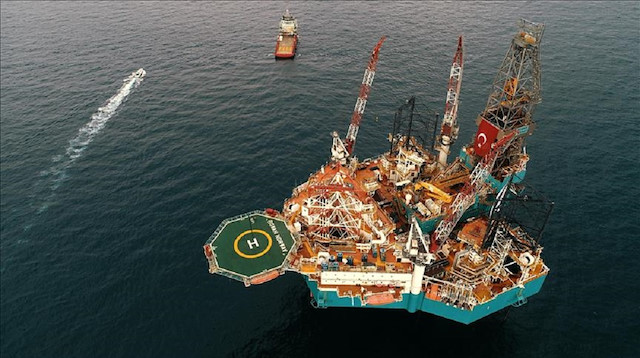
Turkey has started preparatory works on Monday for shallow water drilling in the Mediterranean sea off the coast of Mersin in southern Turkey.
Turkey has started preparatory works on Monday for shallow water drilling in the Mediterranean sea off the coast of Mersin in southern Turkey, Turkey's Energy Minister Fatih Dönmez confirmed.
Speaking at the launch ceremony in Mersin, on the Mediterranean coast, Dönmez said the country would continue its drilling activities for the exploration of natural gas and oil sources in the region as part of Turkey's aim to be energy independent.
He also stated that based on the country's current exploration licenses, Turkish engineers initially plan to open two shallow sea wells.
In the scope of this shallow well project that will run for two months, the first well will be drilled off the North Erdemli location, 119 sea miles from land and at a depth of around 101 meters.
Turkey has started preparatory works on Monday for shallow water drilling in the Mediterranean sea off the coast of Mersin in southern Turkey, Turkey's Energy Minister Fatih Dönmez confirmed.Speaking at the launch ceremony in Mersin, on the Mediterranean coast, Dönmez said the country would continue its drilling activities for the exploration of natural gas and oil sources in the region as part of Turkey's aim to be energy independent.He also stated that based on the country's current exploration licenses, Turkish engineers initially plan to open two shallow sea wells.In the scope of this shallow well project that will run for two months, the first well will be drilled off the North Erdemli location, 119 sea miles from land and at a depth of around 101 meters.Turkey starts shallow water drilling in Med. SeaTurkey and Qatar prove to be true friends, says ErdoğanHe explained that Turkey also would like to diversify its energy portfolio with new projects in different energy fields."Through these drilling activities, and based on these [diversification] strategies, not only will Turkey benefit from the outcomes, but also regional energy markets will fundamentally be affected," he said.On Oct. 30, Turkey's first drilling vessel, Fatih, started conducting its first deep drilling in offshore Antalya on the county's southern Mediterranean coast.Dönmez said that Turkey would conduct deep drilling works with its own vessel for the deep-water well Alanya-1 as part of its efforts to utilize its domestic resources."Our aim is to open two drilling wells on average a year with the Fatih vessel," Dönmez said, adding that the first drilling in Alanya-1 is planned for a period of nearly 150 days.Turkish FM says Saudi journalist’s killers did not act alone
Turkey starts shallow water drilling in Med. Sea
Turkish President Recep Tayyip Erdoğan said Monday that his country and Qatar have supported one another in hard times, and proved to be a true friend many times.“Turkish nation showed intense efforts to break the blockade and sanctions targeting its Qatari brothers,” Erdoğan said during the 4th meeting of Turkey-Qatar High Strategic Committee in Istanbul.In June of last year, Saudi Arabia, Egypt, the United Arab Emirates and Bahrain collectively severed ties with Qatar, accusing it of supporting terrorist groups.The Saudi-led axis also imposed a land, sea and air blockade on Qatar, with Riyadh sealing the Abu Samra border crossing linking the two Gulf states.Video: President Erdoğan, Qatari emir sign agreements in IstanbulErdoğan added that Doha was the strongest international supporter of Turkey after the July 15, 2016 defeated coup attempt by Fetullah Terrorist Organization (FETO), which left 251 people martyred and nearly 2,200 injured.The meeting held at the Vahdettin Pavilion was jointly presided over by Erdoğan and Qatari Emir Sheikh Tamim bin Hamad Al-Thani.Erdoğan also said he was proud by the level of cooperation between the two countries on the 45th anniversary of diplomatic relations.“[Qatar] has stood with us in front of the speculative initiatives targeting our economy in the recent months,” he said and thanked Qatar on behalf of the Turkish nation and himself.Al-Thani, for his part, also voiced pleasure for the level of bilateral relations and expressed his will to boost cooperation in every field.Following the meeting Turkish and Qatari ministers signed a strategic cooperation protocol in the fields including transportation, culture, trade and economy.Turkey’s Foreign Minister Mevlut Cavusoglu, National Defense Minister Hulusi Akar, Transport and Infrastructure Minister Mehmet Cahit Turhan, Treasury and Finance Minister Berat Albayrak, Trade Minister Ruhsar Pekcan, Presidential spokesman Ibrahim Kalin were also present at the meeting along with Qatari officials.
Turkey and Qatar prove to be true friends, says Erdoğan
He explained that Turkey also would like to diversify its energy portfolio with new projects in different energy fields.
"Through these drilling activities, and based on these [diversification] strategies, not only will Turkey benefit from the outcomes, but also regional energy markets will fundamentally be affected," he said.
On Oct. 30, Turkey's first drilling vessel, Fatih, started conducting its first deep drilling in offshore Antalya on the county's southern Mediterranean coast.
Dönmez said that Turkey would conduct deep drilling works with its own vessel for the deep-water well Alanya-1 as part of its efforts to utilize its domestic resources.
"Our aim is to open two drilling wells on average a year with the Fatih vessel," Dönmez said, adding that the first drilling in Alanya-1 is planned for a period of nearly 150 days.
Ankara does not believe that those who murdered Jamal Khashoggi acted alone, Turkey’s foreign minister told a German daily Monday.In an interview with Suddeutsche Zeitung, Mevlut Çavuşoğlu assessed Khashoggi’s killing and relations between Turkey and the European Union.Khashoggi, a Saudi journalist and columnist for The Washington Post, went missing after entering the Saudi Consulate in Istanbul on Oct. 2.After initially saying he had left the consulate alive, the Saudi administration admitted weeks later that he was killed there.While underscoring that definitive evidence was required before making accusations, Çavuşoğlu said many held Saudi Crown Prince Mohammed bin Salman responsible for the murder.Noting that bin Salman had requested an audience with Turkish President Recep Tayyip Erdogan at the two-day G20 summit in Argentina, which begins this Friday, Çavuşoğlu said Erdogan would consider such a meeting."At this point, there is no reason not to meet the crown prince," he said.Tunisia activists to protest against Saudi Crown prince visitTurkey-EU relationsAsked about last week’s visit to Ankara by EU foreign policy chief Federica Mogherini and Johannes Hahn, the bloc’s commissioner for enlargement negotiations and neighborhood policy, Çavuşoğlu said it had been the "best and most productive" meeting with EU representatives in several years.Citing recent protests in France over rising fuel taxes, Çavuşoğlu said the EU regarded the French government’s reaction to demonstrators as "unacceptable”."However, Europeans in the past tried to school us during the Gezi incidents,” he added, referring to a nationwide wave of protests against the Turkish government in the summer of 2013.He reiterated that Turkey continues to aim to be a full member of the bloc while noting that the EU did not hold up its side of the 2016 refugee deal with Ankara by failing to open negotiations regarding any of the five chapters for accession to which it had vowed.Çavuşoğlu also highlighted the "fallacy" of the EU in seeking to school Turkey in judicial independence, citing the case of Can Dundar, a former editor-in-chief of a Turkish daily who was convicted of espionage charges.Dundar was arrested in November 2015 following the publication of images purporting to show arms being transported to Syria in trucks belonging to Turkey’s National Intelligence Organization, also known as the MIT.He was held in prison until Feb. 26, 2016, when Turkey's Constitutional Court ruled that his rights had been violated and ordered his release.Turkey’s Supreme Court of Appeals ruled on March 9 that Dundar should be convicted and handed down a prison sentence of 15 to 20 years on a charge of "espionage".In May 2016, the 14th High Criminal Court in Istanbul convicted Dundar.Saudi crown prince begins second leg of Arab tourECHR ruling On a recent ruling by the European Court of Human Rights (ECHR) ordering the release of a Turkish opposition leader facing terror charges, Çavuşoğlu said there are "many EU countries that do not execute ECHR decisions".He added that Turkey would apply to the grand chamber of the ECHR to appeal against the ruling.YPG/PKK terror group Referring to a recent decision by the U.S. to place bounties on the heads of senior figures in the PKK, Çavuşoğlu said that while recognizing the YPG as a direct affiliate of the PKK, Washington continued to work with the group in Syria."The Europeans know this as well. These are double standards,” he said.The YPG is the Syrian offshoot of the PKK, a terrorist group recognized by Turkey, the U.S. and the EU, which in its 30-year terror campaign has taken some 40,000 lives.The U.S. has claimed that the YPG/PKK is an “ally” in the fight against Daesh over Turkey’s objections that one cannot use a terrorist group to fight another.Turkey has repeatedly cited evidence that the YPG is no different from the PKK.PKK terrorists abuse, rape female members
Turkish FM says Saudi journalist’s killers did not act alone