

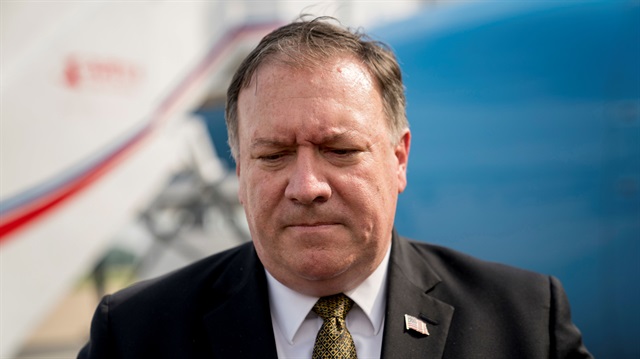
U.S. Secretary of State Mike Pompeo
Secretary of State Mike Pompeo admonished his predecessor Friday for holding meetings with senior Iranian officials about the Iran nuclear accord, saying John Kerry is "actively undermining U.S. policy."
"What Secretary Kerry has done is unseemly and unprecedented," Pompeo told reporters at the State Department. "He was telling them to wait out this administration. You can't find precedent for this in U.S. history and Secretary Kerry ought not to engage in that kind of behavior."
Kerry said earlier this week he met Iranian Foreign Minister Javad Zarif "three or four times” since he left office in early 2017, describing the meetings as normal activities for former top diplomats. He said the meetings focused on the Iran deal and other matters.
"What I have done is tried to elicit from him what Iran might be willing to do in order to change the dynamic in the Middle East for the better,” he said during a radio news interview with Hugh Hewitt.
The former top diplomat did not deny in remarks to Fox News he counseled Iranian officials to "wait out” the Donald Trump administration.
Kerry's comments drew a stern rebuke from the U.S. president late Thursday when Donald Trump issued a tweet calling Kerry's meetings "illegal."
"John Kerry had illegal meetings with the very hostile Iranian Regime, which can only serve to undercut our great work to the detriment of the American people," Trump said.
Pompeo declined to say whether Kerry's meetings are legal, saying he would leave such determinations to others.
Trump unilaterally pulled the U.S. out of the 2015 Joint Comprehensive Plan of Action in May after the Obama administration spearheaded efforts to broker the accord, which saw Iran accept unprecedented curbs on its nuclear programs in exchange for billions of dollars in sanctions relief.
The move rattled close U.S. allies in Europe who negotiated the agreement alongside Washington, and are seeking to salvage its nuclear restrictions.
U.S. Secretary of State Mike Pompeo announced Wednesday he has certified Saudi Arabia and the United Arab Emirates are working to prevent civilian casualties in their bombing campaign in Yemen.Pompeo said he notified Congress on Tuesday of the determination, which allows for continued U.S. military aid."The Trump Administration has been clear that ending the conflict in Yemen is a national security priority," he said in a statement."We will continue to work closely with the Saudi-led coalition to ensure Saudi Arabia and the UAE maintain support for UN-led efforts to end the civil war in Yemen, allow unimpeded access for the delivery of commercial and humanitarian support through as many avenues as possible, and undertake actions that mitigate the impact of the conflict on civilians and civilian infrastructure," he added.War-weary Yemenis lament deteriorating economyImpoverished Yemen has remained wracked by conflict since 2014, when Shia Houthi rebels overran much of the country, including the capital of Sanaa.The conflict escalated the following year when Saudi Arabia and its Sunni-Arab allies launched a wide-ranging air campaign aimed at rolling back Houthi gains in Yemen.The Saudi-led air campaign has been dogged by rights concerns, which were renewed Aug. 9 when a devastating airstrike on a school bus killed 40 children aged 6 - 11. Eleven other people were killed.Bachelet takes on China, EU, US and Saudi-led coalition in first speechThat was the latest in a series of attacks that stirred international outrage.Representative Ro Khanna, a fierce opponent of U.S. military aid to Riyadh's coalition, called Pompeo's certification a "farce" shortly after it was made public."The Saudis deliberately bombed a bus full of children. There is only one moral answer, and that is to end our support for their intervention in Yemen. If this executive will not do it, then Congress must pass a War Powers Resolution," he said.But U.S. defense chief James Mattis concurred with Pomeo, saying Riyadh and Abu Dhabi "are making every effort to reduce the risk of civilian casualties and collateral damage to civilian infrastructure."
Pompeo approves ongoing military aid to Saudi coalition
As the United States’ November midterm elections draw near, President Trump becomes more and more attuned to the domestic news cycle. For that reason, Trump’s preoccupation with the Turkish government and the Turkish judiciary’s continuing detention of Pastor Brunson lasted no more than a fortnight, as should have been predictable. Once it became clear that he would have no success bullying the Turkish leadership, and that Turkey’s economy would weather an overt political attempt to cripple its currency, Trump speedily turned to other matters.Over the past eighteen months, Trump has tended to jump from topic to topic when politically expedient. If a certain issue does not provide the desired political or media results, a more promising topic will be quickly thrust onto the public -- often by early morning tweets. In the end, the chaos that the Trump Administration is enveloped in meant that if Turkish officials remained calm and took measured steps to protect Turkey’s economy, the storm would soon pass. They did, and it did. But that same chaos also means that Trump could launch another impetuous attack with little or no warning, especially when we can be sure that Trump’s National Security Advisor John Bolton and Vice President Mike Pence continue to whisper in his ear about Turkey.Turkey slams US decision to close Palestine Liberation OrganizationJohn Bolton and the Neoconservatives are backThe upcoming polls are not the only reason that Trump has suddenly become more antagonistic towards Turkey. There can be little doubt that Bolton is a prime factor spurring Trump on. As late as the July NATO conference, commentators were either gushing or complaining about the rapport that Trump and Turkish President Recep Tayyip Erdoğan apparently enjoyed. But even then Trump’s interactions with President Erdoğan did not display convincing sincerity. The idea that Trump, whose understanding of foreign societies is extremely limited and whose administration has routinely displayed contempt for foreigners in general and Muslims in particular, could found a meaningful working relationship with President Erdoğan always required one to suspend rational expectations. Bolton’s influence, as malign as expected, has simply brought this reality to the forefront.Many observers anticipated the worst when Bolton, an arch neoconservative left over from the George W. Bush Administration, managed to regain access to the White House. Trump originally considered Bolton for the Secretary of State position, but the position he eventually procured may be more to Bolton’s liking. The National Security Advisor is not subject to Congressional approval, has no bureaucracy to wrangle with, participates in the National Security Council, and possesses direct access to the President.Ultimately, Trump’s political inexperience is what enabled Bolton to win a political appointment. When Trump entered the presidential race, he had no political experience and no political base other than the “alt right,” which is the extreme right side of the American political spectrum. Choosing Mike Pence as his running mate added the evangelical community, but neither voting block could provide a network, built up over time spent as an elected official, that a president-elect normally arrives with in Washington D.C. That network provides many candidates with specific skills and experience for political appointments.Obama criticizes Trump's policiesAs feared, Trump’s lack of a political network resulted in disastrous personnel choices, and the most direct consequence has been unprecedented turnover in his administration. Many of his choices turned out to be incompetent and were fired, or corrupt enough to be immediately exposed and dismissed. Others clashed with Trump over policy and were defenestrated. Trump’s revolving personnel door is the direct symptom of his lack of a political base and network.The second result was that established elements of the Republican Party network in Washington eventually found opportunities to reappear on the scene once Trump’s initial personnel choices faltered and exited. This is how John Bolton found a place at Trump’s right hand, and we can be sure that the Washington D.C. neoconservative community is now doing its best to take advantage. I warned of this in the 2016 election’s immediate aftermath.“Deep State” coup not likelyDespite all of the chaos, however, no one should expect President Trump’s departure anytime soon. The latest turmoil to strike Washington took the form of an anonymous letter published by the New York Times. The letter was written by someone claiming to be in the Trump Administration’s highest levels, and who explained that most members of the administration know Trump is incompetent, so they either limit and stifle his attempts to make policy, or ignore him altogether.This letter provoked energetic reactions from all sectors of the American chattering classes, including claims that an American “deep state” was in the process of carrying out a coup against Trump. In Turkey, that claim found ready proponents. The same newspaper also published advance excerpts from Bob Woodward’s new book on the Trump Administration, which added heaps of fuel to the already blazing controversies engulfing the administration. All in all, the past week sparked another wave of expectation that Trump’s disgrace and fall from power were nigh.But looking beyond the hysteria and hyperbole, Trump’s departure from the White House does not appear imminent. If the Republican Party maintains control of both houses of Congress in November, Trump will essentially be assured of serving his entire term.The essence of the matter is that the Republican Party is able to carry out its agenda through Congress. Trump is a distraction, an embarrassment even, but in the end he is on their side. And despite loud claims of liberal bias in the American mainstream media, the reality is that Trump receives favorable treatment from the media that the Republican Party voting constituency reads or watches. For those reasons, even if the Democrats win control of one or even both houses of Congress, it will be extremely difficult for them to impeach Trump. And even if Trump were impeached and eventually removed, Vice President Pence, who is close to the American evangelical community, would become the President. The Democrat Party may decide that enabling Pence to become president would be even worse than having Trump remain in office.'Turkey to no longer send students to study in US'Furthermore, the ongoing legal inquiries into various aspects of the Trump Administration are not guaranteed to result in charges against Trump, even when some of his closest collaborators are now being given prison sentences. Debate continues about whether a sitting president can be put on trial, and whether any of the charges that might materialize against Trump would warrant trying to put him on trial.Likewise, there is no “deep state” in the U.S. planning to carry out some sort of coup against Trump. The anonymous author of the NYT letter referred to a “steady state” instead of a “deep state”. What the author means is political appointees and career bureaucrats, and this is something that every president in the past 100 years has confronted. Any modern state is immense, and career bureaucrats also, rightly, feel invested in the policies that they are charged with developing and/or carrying out. Competition for influence over policy between political appointees and career bureaucrats is the norm because career bureaucrats may see political appointees as interlopers.Political appointees themselves have a tendency to feel independent and more knowledgeable on their particular field of interest than the President. The political and bureaucratic infighting common to modern bureaucracies was the reason President Harry Truman, 75 years ago, complained that, “There are more Prima Donnas per square foot in public life...in Washington than in all the opera companies ever to exist.” He also complained about “Potomac fever” (a reference to the river that provides Washington D.C.’s southwest border), an ailment that he thought afflicts people who come to Washington for government careers. Every administration features friction among career bureaucrats, political appointees, and the president.In other words, the “steady state” is something entirely different than what Turkish people refer to when they use the term “derin devlet”. That sort of “deep state” is an extra-legal, unaccountable crime and violence network based partially in multiple state institutions but also having links to intelligence, military, paramilitary, and organized crime structures. Certainly, nothing of the sort exists in the U.S.Finally, the same anonymous author also referred to the 25th Amendment to the United States Constitution. That amendment contains a clause that states how the president may be removed by the principal members of his administration through a petition to Congress. That clause has never been invoked, and was intended for situations in which the President might be gravely injured, or incapacitated by health problems or disease. Such a move would also have to be carried out by members of the Republican Party, and would precipitate one of the most serious political crises in U.S. history. Because the Republican Party already enjoys control of Congress and is still able to pursue its agenda, purposefully triggering a major political crisis with unforeseeable results would clearly be an unnecessary and extreme step.Expect continuityBecause Trump will, in all likelihood, be president for at least two more years, we cannot expect dramatic shifts in U.S. policy towards Turkey. Mike Pompeo’s appointment as Secretary of State has not changed the State Department’s diminished stature and irrelevance to policy formation towards Turkey. A U.S. Ambassador to Turkey still has not been nominated. James Jeffrey’s appointment as Special Representative for Syria Engagement is the lone ray of hope in an otherwise dismal situation. Jeffrey served uneventfully as Ambassador to Turkey in 2008-2010, and his recent comments have displayed good understanding of the region and of Turkey’s worries.On the other hand, U.S. policy in Syria still is under the control of the U.S. military. Turkish-American cooperative patrolling in Manbij continues, but Turkish officials have recently indicated that they perceive American foot-dragging. Possibly, this is related to new developments in U.S. plans: despite Trump’s openly stated desire to hastily wrap up U.S. operations in Syria, the U.S. military now seems to be preparing for an extended stay.Overall, the U.S. long ago lost influence over the flow of events in Syria. Russia and Iran, though often disagreeing on how to collaborate, remain the main powers in Syria, openly propping up the Assad regime. Turkey negotiates with both, and is sometimes able to obtain concrete results, while U.S. influence is limited to the small regions it maintains forces in, but even there it cannot exercise complete control over the behavior of its ally, the PKK/PYD.
Trumpian chaos and Turkish-American relations
U.S. Secretary of State Mike Pompeo assured Pakistan last week Washington would not try to block any request for a bailout from the International Monetary Fund (IMF), Pakistani Information Minister Fawad Chaudhry said on Tuesday.The remarks, which Chaudhry said Pompeo made during his visit to Pakistan on Wednesday, come in stark contrast to Pompeo's warnings in July that the United States had serious reservations about the IMF giving money to Pakistan due to concerns Islamabad would use the cash to pay off Chinese loans.Those comments rattled Islamabad, which is facing a currency crisis and may have no option but to turn again to the IMF for a rescue if staunch allies China and Saudi Arabia do not offer more loans to prop up its foreign currency reserves.Chaudhry told Reuters that relations between United States and Pakistan were "broken" before Pompeo's trip to Islamabad but the visit had "set many things straight" and re-invigorated ties.Wife of Pakistan's jailed ex-PM Nawaz Sharif dies in London"He assured Pakistan that...if Pakistan opted to go to IMF for any financial help, the USA will not oppose it," Chaudhry said in the capital, Islamabad.The U.S. embassy in Islamabad did not have any immediate comment.The new government of Prime Minister Imran Khan, who took office in August, is trying to avert a currency crisis caused by a shortage of dollars in an economy hit by a ballooning current account deficit and dwindling foreign currency reserves.Pakistani officials say they are discussing taking drastic measures to avert seeking a bailout from the IMF, which has come to Pakistan's rescue 14 times since 1980, including most recently in 2013.New Pakistani PM's bid to avert water crisis not the solution, say expertsPakistan's relations with the United States have soured in recent years over the war in Afghanistan and Islamabad's alleged support for militants. Ties dropped to a new low when President Donald Trump in January accused Pakistan of lies and deceit by playing a double game on fighting terrorism.Islamabad denies aiding insurgents in Afghanistan and lashed out against Trump's remarks, which were followed up by Washington suspending U.S. military aid.At the United States' urging, a group of Western countries in February convinced a global body to put Pakistan on a terrorism financing watch list, a move that triggered concerns the United States may also seek to block Islamabad in other forums.In July, Pompeo said there was "no rationale" for the IMF to bail out Pakistan. Pompeo's worries that Islamabad would use the IMF money to pay off Chinese loans echoes concerns by other U.S. officials that China is saddling many emerging market countries with too much debt. Beijing staunchly denies such claims."There's no rationale for IMF tax dollars, and associated with that American dollars that are part of the IMF funding, for those to go to bail out Chinese bondholders or China itself," Pompeo said in July, referring to a possible Pakistan bailout.But during last week's visit Pompeo said he was hopeful of "a reset of relations" long strained over the war in Afghanistan. 
Pompeo said US won't block Pakistan if it seeks IMF bailout: Pakistani minister
The U.S. will find it difficult to cut Iran's oil exports completely as the oil market is already tight and rival producers cannot make up the shortfall, a top Iranian official said on Friday.Washington is seeking to cut Iranian oil exports to zero by November as it reimposes sanctions, and is encouraging other producers such as Saudi Arabia, other OPEC members and Russia to pump more to meet the shortfall.Even so, the expected loss of Iranian oil, declining supply from another OPEC member Venezuela and other outages are boosting crude prices, which this week hit $80 a barrel, the highest since May.Iran's OPEC governor Hossein Kazempour Ardebili, said in comments to Reuters that a "supply shortage" meant that the United States would not be able to meet its zero export target."There is no spare capacity anywhere," he said.Iraqi Sunni parliament bloc chooses nominee for speakerA long-time adviser at Saudi Arabia's Energy Ministry also said last month that current U.S. sanctions on Iran were unlikely to stop Iranian oil exports completely.Under pressure from U.S. President Donald Trump to lower oil prices, the Organization of the Petroleum Exporting Countries and allies agreed in June to boost production, having participated in a supply-cutting deal in place since 2017.While OPEC production has increased since then, Saudi Arabia has added less crude than it initially indicated. Kazempour has voiced scepticism that other producers can add much more oil.The OPEC governor is typically the second most senior post in a country's OPEC delegation after the oil minister. Kazempour has represented Iran in that position for many years. Turkey is working to reach ceasefire in Syria's Idlib: FM
Iran says oil market is too tight for US zero exports target