

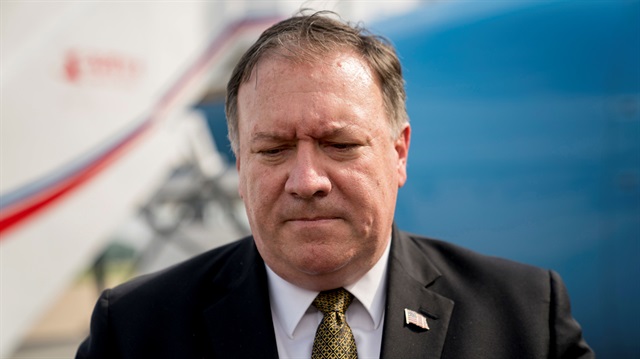
U.S. Secretary of State Mike Pompeo
U.S. Secretary of State Mike Pompeo announced Wednesday he has certified Saudi Arabia and the United Arab Emirates are working to prevent civilian casualties in their bombing campaign in Yemen.
Pompeo said he notified Congress on Tuesday of the determination, which allows for continued U.S. military aid.
"The Trump Administration has been clear that ending the conflict in Yemen is a national security priority," he said in a statement.
"We will continue to work closely with the Saudi-led coalition to ensure Saudi Arabia and the UAE maintain support for UN-led efforts to end the civil war in Yemen, allow unimpeded access for the delivery of commercial and humanitarian support through as many avenues as possible, and undertake actions that mitigate the impact of the conflict on civilians and civilian infrastructure," he added.
The people of war-torn Yemen continue to face severe hardships, especially given recent declines in the value of the country’s currency.At the beginning of 2015, the Yemeni rial had traded at roughly 215 to the U.S. dollar. It now trades at about 630 to the greenback.This has led to a major rise in commodity prices -- in some cases as much as by 300 percent -- since the country’s conflict began about four years ago.According to Amal al-Salawi, a teacher who lives in Sanaa, life in the capital -- overrun by Houthi rebels in 2014 -- has become untenable.UN envoy to go to Sanaa for talks with Yemen rebels“Even loaves of bread have shrunk to a quarter of their original size, while a single egg now costs 70 rials [roughly $0.10],” she told Anadolu Agency.“We don’t know how to get by anymore; salaries haven’t been paid for the last two years and now our currency is collapsing,” al-Salawi lamented.“The government has no presence [in Sanaa],” she added. “The Houthis have left us with nothing.”According to an Anadolu Agency correspondent based in the region, prices of many commodities have almost doubled, with the retail cost of a single chicken recently jumping from 1,200 rials (roughly $1.85) to 2,000 rials (roughly $3.10).Yemen accuses Houthis of trying to 'sabotage' peace talks, blame UN envoyBefore the conflict, per-head chicken prices had stood at about 800 rials.Traders, for their part, attribute the price hikes to the ongoing decline of the local currency’s value.Commodity retailer Ahmed al-Shamiri told Anadolu Agency that local traders were taking losses due to almost daily price fluctuations.“People blame us for the rising prices, accusing us of ‘profiteering’,” he said. “But the truth is that the rial is falling each day.”Political solution only way in Yemen: UNAccording to Abu Bakr Baabid, chairman of the Yemeni Chamber of Commerce, an acute demand for foreign currency has put downward pressure on the rial, while Yemen’s government and central bank have been largely unable to remedy the problem.“The government and central bank have failed to deal seriously with the crisis,” Baabid told Anadolu Agency.“The central bank has failed to keep its promise to help traders import goods, thus forcing them into the parallel market,” he added.On Wednesday, the government (based in the city of Aden since 2014) approved a raft of measures ostensibly aimed at shoring up Yemen’s embattled currency.It also vowed to tighten its grip on state resources while also restricting imports -- including petroleum products -- in hopes of preventing a foreign-currency outflux.“Coming days will see the national economy stabilize in coordination with the Saudi-led coalition [established in 2015 to fight the Houthi rebel group],” Prime Minister Ahmed bin Daghr was quoted as saying by state news agency SABA.Impoverished Yemen has remained wracked by conflict since 2014, when Shia Houthi rebels overran much of the country, including capital of Sanaa.The conflict escalated the following year when Saudi Arabia and its Sunni-Arab allies launched a wide-ranging air campaign in Yemen aimed at rolling back the Houthis’ territorial gains.The ongoing violence has devastated Yemen’s basic infrastructure, prompting the UN to describe the situation as “one of the worst humanitarian disasters of modern times”.
War-weary Yemenis lament deteriorating economy
Impoverished Yemen has remained wracked by conflict since 2014, when Shia Houthi rebels overran much of the country, including the capital of Sanaa.
The conflict escalated the following year when Saudi Arabia and its Sunni-Arab allies launched a wide-ranging air campaign aimed at rolling back Houthi gains in Yemen.
The Saudi-led air campaign has been dogged by rights concerns, which were renewed Aug. 9 when a devastating airstrike on a school bus killed 40 children aged 6 - 11. Eleven other people were killed.
The United Nations human rights boss Michelle Bachelet called on China on Monday to allow monitors into the country following "deeply disturbing" allegations of large re-education camps in which Uighurs are detained in far western Xinjiang province.The former Chilean president, in her maiden speech to the U.N. Human Rights Council, said that she was sending teams to Austria and Italy to look into protection of migrants. She voiced concern that 500 migrant children in the United States taken away from their parents have not yet been returned.Bachelet urged the Saudi-led military coalition in Yemen to show greater transparency in their rules of engagement and hold to account perpetrators of deadly air strikes on civilians, including that which hit a bus of children in Saada last month.Myanmar disregards ICC’s ruling over Rohingya issueMyanmar official says 'totally underestimated' economic impact of Rohingya crisisBachelet presses for new body on crimes against Myanmar RohingyaBachelet called for an international mechanism to collect evidence of crimes against Muslim Rohingya in Myanmar including murder and torture, with a view to future prosecution.Bachelet, in her first speech to the Human Rights Council since taking office on Sept. 1, said: "This mechanism would also complement and support the preliminary examination of the ICC (International Criminal Court) Prosecutor."I urge the Council to pass a resolution and refer the matter to the General Assembly for its endorsement so that such a mechanism can be established."
Bachelet takes on China, EU, US and Saudi-led coalition in first speech
That was the latest in a series of attacks that stirred international outrage.
Representative Ro Khanna, a fierce opponent of U.S. military aid to Riyadh's coalition, called Pompeo's certification a "farce" shortly after it was made public.
"The Saudis deliberately bombed a bus full of children. There is only one moral answer, and that is to end our support for their intervention in Yemen. If this executive will not do it, then Congress must pass a War Powers Resolution," he said.
But U.S. defense chief James Mattis concurred with Pomeo, saying Riyadh and Abu Dhabi "are making every effort to reduce the risk of civilian casualties and collateral damage to civilian infrastructure."