

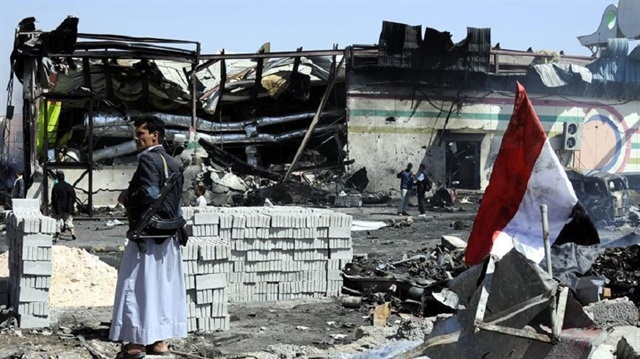
File photo
The people of war-torn Yemen continue to face severe hardships, especially given recent declines in the value of the country’s currency.
At the beginning of 2015, the Yemeni rial had traded at roughly 215 to the U.S. dollar. It now trades at about 630 to the greenback.
This has led to a major rise in commodity prices -- in some cases as much as by 300 percent -- since the country’s conflict began about four years ago.
According to Amal al-Salawi, a teacher who lives in Sanaa, life in the capital -- overrun by Houthi rebels in 2014 -- has become untenable.
UN Special Envoy to Yemen Martin Griffiths said on Saturday that he will head to Oman and Sanaa to hold talks with the Houthi rebel group as part of efforts to hold peace talks for resolving the 4-year conflict in the Arab country.Speaking in a press conference held in the UN headquarters in Geneva, Griffiths said it was premature to talk about holding a fresh round of peace talks between the Yemeni government and Houthi rebels.UN-sponsored peace talks were scheduled to be held in Geneva on Thursday, but Houthi negotiators failed to show up, citing that they did not have guarantees for safe return.Yemen accuses Houthis of trying to 'sabotage' peace talks, blame UN envoy“We just did not make it. It's not the first time that we have difficulties in a Yemeni context. Criticizing one or the other doesn't help Yemen. Things happen,” Griffiths said.He noted that he received assurances from all parties on the cessation of hostilities, especially in the western Al-Hudaydah province.The UN envoy described his consultations with Yemeni government delegation in Geneva as “fruitful”.Yemen peace talks collapse in Geneva after Houthi no-showHe added that the talks tackled the release of prisoners, the reopening of Sanaa airport and economic issues as well as the humanitarian situation especially in the central Taiz province.Impoverished Yemen has remained wracked by conflict since 2014, when Shia Houthi rebels overran much of the country, including the capital of Sanaa.The conflict escalated the following year when Saudi Arabia and its Sunni-Arab allies launched a wide-ranging air campaign aimed at rolling back Houthi gains in Yemen.The violence has devastated the country’s infrastructure, prompting the UN to describe the situation as “one of the worst humanitarian disasters of modern times.”
UN envoy to go to Sanaa for talks with Yemen rebels
“Even loaves of bread have shrunk to a quarter of their original size, while a single egg now costs 70 rials [roughly $0.10],” she told Anadolu Agency.
“We don’t know how to get by anymore; salaries haven’t been paid for the last two years and now our currency is collapsing,” al-Salawi lamented.
“The government has no presence [in Sanaa],” she added. “The Houthis have left us with nothing.”
According to an Anadolu Agency correspondent based in the region, prices of many commodities have almost doubled, with the retail cost of a single chicken recently jumping from 1,200 rials (roughly $1.85) to 2,000 rials (roughly $3.10).
Yemen's foreign minister accused the Houthi movement on Saturday of "trying to sabotage the negotiations" that ended without their attendance in Geneva and said that the U.N. envoy had not been firm enough with them.Yemen's Houthi movement failed to attend peace talks, but the U.N. Special Envoy Martin Griffiths said earlier that it did not represent a "fundamental blockage in the process" and that he would meet soon with their representatives in Sanaa and in Muscat, Oman."We want the U.N. to be firmer in bringing the other party to the negotiations", Yemeni Foreign Minister Khaled al-Yamani told a press conference before leaving the Swiss city after three days of talks with Griffiths on confidence-building measures including prisoner releases. Yemen peace talks collapse in Geneva after Houthi no-show
Yemen accuses Houthis of trying to 'sabotage' peace talks, blame UN envoy
Before the conflict, per-head chicken prices had stood at about 800 rials.
Traders, for their part, attribute the price hikes to the ongoing decline of the local currency’s value.
Commodity retailer Ahmed al-Shamiri told Anadolu Agency that local traders were taking losses due to almost daily price fluctuations.
“People blame us for the rising prices, accusing us of ‘profiteering’,” he said. “But the truth is that the rial is falling each day.”
The only way to solve the conflict in Yemen is through a political solution, the UN Security Council (UNSC) said Wednesday.In a statement, the council welcomes consultations with representatives from all parties in Yemen and supports a UN-led political process in the country.According to the statement, the council members expressed their full support the efforts of Special Envoy of the Secretary-General Martin Griffiths to bring about a political settlement."The members of the Security Council reiterated that there can only be a political solution to the conflict in Yemen," read the statement.Representatives from all parties in Yemen are scheduled to meet Thursday with Griffiths in Geneva.The council urges all parties to "seize this opportunity to de-escalate tensions" and to "take a first step towards ending a conflict that has brought severe pain and humanitarian suffering to the Yemeni people"."These initial consultations will be a necessary and important step towards the comprehensive and inclusive security and political agreements that will be required to resolve the conflict, improve the humanitarian situation, and bring peace, prosperity and security to all Yemenis," it said.The council also calls for the implementation of several resolutions including UN resolution 2216, which was adopted in 2015 and imposes an arms embargo on individuals identified by the Security Council."The members of the Security Council reaffirmed their strong commitment to the unity, sovereignty, independence and territorial integrity of Yemen," the statement added.Impoverished Yemen has remained wracked by conflict since 2014, when Shia Houthi rebels overran much of the country, including capital Sanaa.The conflict escalated the following year when Saudi Arabia and its Sunni-Arab allies launched a wide-ranging air campaign aimed at rolling back Houthi gains in Yemen.The violence has devastated the country’s infrastructure, prompting the UN to describe the situation as “one of the worst humanitarian disasters of modern times”.Yemenis continue protests amid currency plungeYemeni photojournalist shot dead in TaizUS welcomes Saudi Arabia's admission about Yemen strikeYemenis protest in Aden as local currency plungesYemen's Houthis say target a Saudi warship
Political solution only way in Yemen: UN
According to Abu Bakr Baabid, chairman of the Yemeni Chamber of Commerce, an acute demand for foreign currency has put downward pressure on the rial, while Yemen’s government and central bank have been largely unable to remedy the problem.
“The government and central bank have failed to deal seriously with the crisis,” Baabid told Anadolu Agency.
“The central bank has failed to keep its promise to help traders import goods, thus forcing them into the parallel market,” he added.
On Wednesday, the government (based in the city of Aden since 2014) approved a raft of measures ostensibly aimed at shoring up Yemen’s embattled currency.
It also vowed to tighten its grip on state resources while also restricting imports -- including petroleum products -- in hopes of preventing a foreign-currency outflux.
“Coming days will see the national economy stabilize in coordination with the Saudi-led coalition [established in 2015 to fight the Houthi rebel group],” Prime Minister Ahmed bin Daghr was quoted as saying by state news agency SABA.
Impoverished Yemen has remained wracked by conflict since 2014, when Shia Houthi rebels overran much of the country, including capital of Sanaa.
The conflict escalated the following year when Saudi Arabia and its Sunni-Arab allies launched a wide-ranging air campaign in Yemen aimed at rolling back the Houthis’ territorial gains.
The ongoing violence has devastated Yemen’s basic infrastructure, prompting the UN to describe the situation as “one of the worst humanitarian disasters of modern times”.