

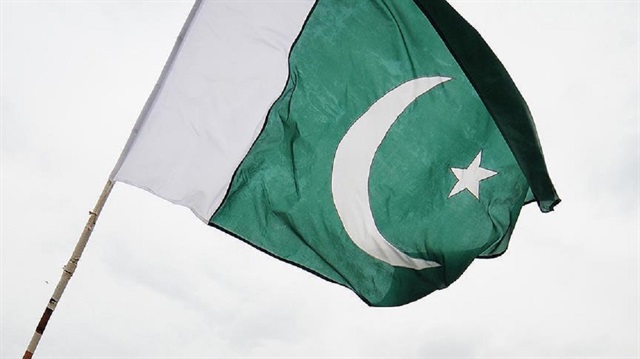
File photo
U.S. Secretary of State Mike Pompeo assured Pakistan last week Washington would not try to block any request for a bailout from the International Monetary Fund (IMF), Pakistani Information Minister Fawad Chaudhry said on Tuesday.
The remarks, which Chaudhry said Pompeo made during his visit to Pakistan on Wednesday, come in stark contrast to Pompeo's warnings in July that the United States had serious reservations about the IMF giving money to Pakistan due to concerns Islamabad would use the cash to pay off Chinese loans.
Those comments rattled Islamabad, which is facing a currency crisis and may have no option but to turn again to the IMF for a rescue if staunch allies China and Saudi Arabia do not offer more loans to prop up its foreign currency reserves.
Chaudhry told Reuters that relations between United States and Pakistan were "broken" before Pompeo's trip to Islamabad but the visit had "set many things straight" and re-invigorated ties.
Kulsoom Nawaz, wife of three-time former Prime Minister Nawaz Sharif, passed away in London on Tuesday after a long battle with cancer, her family confirmed.Shehbaz Sharif, Nawaz Sharif's younger brother and opposition leader in the National Assembly, said that the former first lady breathed her last at the hospital, local broadcaster Geo News reported.Her son Hussain Nawaz said she was shifted to the hospital last night after her condition deteriorated.Kulsoom Nawaz was diagnosed with Lymphoma last year and since then underwent several surgeries.She was born in 1950 and married Nawaz Sharif in 1971.Nawaz Sharif and his daughter Maryam Nawaz are currently serving prison sentences in Adiala Jail, Rawalpindi, after a court convicted them in a graft case in July.Kulsoom Nawaz is survived by a husband, two sons and a daughter.
Pakistan's former first lady passes away in London
"He assured Pakistan that...if Pakistan opted to go to IMF for any financial help, the USA will not oppose it," Chaudhry said in the capital, Islamabad.
The U.S. embassy in Islamabad did not have any immediate comment.
The new government of Prime Minister Imran Khan, who took office in August, is trying to avert a currency crisis caused by a shortage of dollars in an economy hit by a ballooning current account deficit and dwindling foreign currency reserves.
Pakistani officials say they are discussing taking drastic measures to avert seeking a bailout from the IMF, which has come to Pakistan's rescue 14 times since 1980, including most recently in 2013.
Pakistan’s newly elected government is facing what could be its biggest challenge as an unprecedented water shortage threatens to become a major crisis.Prime Minister Imran Khan, who was sworn-in as the country’s 22nd premier on Aug. 18, is urging some 9 million overseas Pakistanis to “donate generously” for the construction of dams to cope with the country’s growing water requirements. But experts say the move is not viable.Full-page newspaper advertisements and special broadcasts aired on local television stations are exhorting mainly overseas Pakistanis to contribute for the construction of dams in the next five years, including the long-stalled Diamer-Bhasha Dam, construction of which is in the preliminary stages on the Indus River in the northern Gilgit-Baltistan region near the border with China.Pakistan official's criticism of China's 'Silk Road' projects raises worriesKhan, who took the reins of the South Asian state in July, appealed last week in a televised message to Pakistanis working in the United States, Europe and the Middle East to wage a “dam Jihad” by donating at least $1,000 each to a Dam Fund set up by the country’s Chief Justice, Mian Saqib Nisar.Warning that the country might face a complete drought by 2025 if new dams are not built, Khan said “we have 30 days’ water storage, whereas country like Egypt, which once faced a more acute water shortage, has a storage capacity of 1,000 days”.Khan’s appeal has so far received a warm response not only from abroad but within the country, accumulating over 3 billion Pakistani rupees (nearly $30 million) in a week-long period.Chinese minister vows to back Pakistan's economyPakistan’s powerful army on Monday donated one billion rupees (over $8 million) – the highest single contribution so far.But the so-called euphoria doesn’t impress economists and water experts, who view the move as “unviable”.“Construction of big dams is a very serious matter. They cannot be built through alms and donations,” Dr. Kaiser Bengali, the country’s leading economist, told Anadolu Agency.The actual estimated cost of the project, conceived in 2006, was $12.6 billion which, according to experts, currently stands somewhere around $16 billion.Pakistan’s new president Arif Alvi sworn in“Governments are not run like that. How much will we be able to accumulate? [Maybe] 10 billion or 20 billion rupees, whereas it requires 1,600 billion. There are several ways of funding such huge projects. [The government] just needs to be innovative,” said Bengali, author of the book ‘The Politics of Managing Water’.Shahab Osto, a Karachi-based water expert, shared a similar view.“Building dams is such a costly business. Khan may have an optimistic approach mainly because of his popularity among overseas Pakistanis. But such huge and costly projects cannot be built simply on the basis of popularity and optimism,” Osto told Anadolu Agency.Pakistan, China renew commitment on economic corridorAccording to statistics from the Ministry of Water and Power, Pakistan receives 145 million acre-feet of water every year, but only 14 million acre-feet is preserved. The country wastes 25 billion rupees (around $200 million) worth of water every year.Pakistan gets most of its water from three western rivers – the Indus, Jhelum and Chenab – under a 1960 water treaty with longtime rival India brokered by the World Bank.The waters of the eastern rivers the Sutlej, Beas and Ravi have been allocated to India under the agreement.Pakistan marks ‘Defense and Martyrs day’ConservationBengali suggested that the government should allocate 20 to 25 percent of the total expenditure as seed money and hand over the project to a company or group of companies through international bidding.“The best way is to bid the project on a BOOT (build-own-operate-transfer) basis, making the successful bidder responsible for arranging the remaining amount. The project may be given to that company against revenue of power and water generation for the next 30 years,” said Bengali.In this way, he added, the government would not have to spend even a single penny on maintenance of the dam for the next 30 years.Pompeo's Pakistan visit reeks of old rhetoric: analystsHowever, he said he prefers conservation as a far better option than the construction of dams to cope with water requirements.“I want to say on record that there is no shortage of water in Pakistan. The only issue is poor water management and distribution,” Bengali said.“Almost 90 percent of our water is used for agriculture purposes, of which 40 percent is wasted because of primitive ways of cultivation. If modern-day technology and tools are used, we can save this 40 percent of water”.Osto agreed with Bengali, saying instead of building huge dams, which, according to him, are environmentally hazardous, water conservation is a much better and simpler idea.“The politics of big dams is complicated, rather a failure in Pakistan,” Osto pointed out, referring to a chronic confrontation over water-sharing between different provinces.“Therefore, the government should not waste its energies and money on the construction of big dams but focus on small dams and conservation projects.”However, he disagreed with Bengali’s contention about water abundance in the country.“There is a water dearth in Pakistan which is projected to become more severe in the next five to ten years. But yes, if we plan and carry out an effective conservation policy, a huge quantity of water can be conserved.”
New Pakistani PM's bid to avert water crisis not the solution, say experts
Pakistan's relations with the United States have soured in recent years over the war in Afghanistan and Islamabad's alleged support for militants. Ties dropped to a new low when President Donald Trump in January accused Pakistan of lies and deceit by playing a double game on fighting terrorism.
Islamabad denies aiding insurgents in Afghanistan and lashed out against Trump's remarks, which were followed up by Washington suspending U.S. military aid.
At the United States' urging, a group of Western countries in February convinced a global body to put Pakistan on a terrorism financing watch list, a move that triggered concerns the United States may also seek to block Islamabad in other forums.
In July, Pompeo said there was "no rationale" for the IMF to bail out Pakistan. Pompeo's worries that Islamabad would use the IMF money to pay off Chinese loans echoes concerns by other U.S. officials that China is saddling many emerging market countries with too much debt. Beijing staunchly denies such claims.
"There's no rationale for IMF tax dollars, and associated with that American dollars that are part of the IMF funding, for those to go to bail out Chinese bondholders or China itself," Pompeo said in July, referring to a possible Pakistan bailout.
But during last week's visit Pompeo said he was hopeful of "a reset of relations" long strained over the war in Afghanistan.