

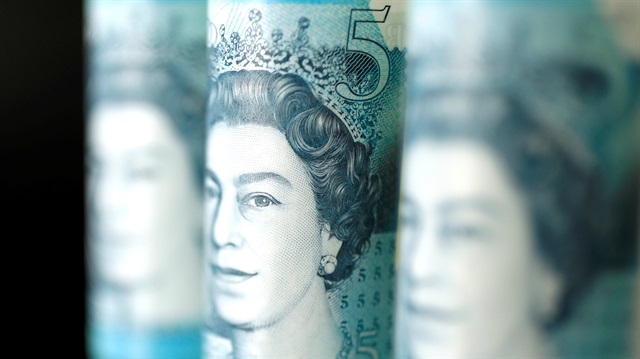
File photo: British five pound banknotes are seen in this picture illustration
The British pound rose on Friday as the dollar fell across the board and some traders saw an opportunity to buy sterling after data this week pointed to an UK economy holding up relatively well.
Ongoing worries about whether Britain can agree a trade deal with the European Union over the coming months to avoid a sudden and disorderly exit from the bloc continue to keep most investors cautious about any sustained sterling strength.
The pound this week suffered its longest losing streak against the dollar since the height of the financial crisis in 2008, hitting a near 14-month low of $1.2662 on Wednesday, but has since bounced three quarters of a cents higher.
Pro-EU campaigners seeking to establish legally that Britain alone could stop the Brexit process took an appeal to Scotland's top court on Wednesday.They want judges to ask the European Court of Justice (ECJ) to clarify whether Britain could choose to remain in the world's biggest trading bloc without permission from the other 27 members. That would require Britain's parliament to first decide that the final Brexit deal, if and when it is reached, was not good enough.The case is of renewed relevance as Britain's Conservative government works against the clock to reach agreement with Brussels on the terms of its departure ahead of the March 2019 departure date.The possibility of Brexit happening without an agreement has pummelled the value of sterling on foreign exchange markets, and the government says it has stepped up planning for that possibility.The Edinburgh Court of Session hearing, backed by British and Scottish lawmakers, is an appeal against a June ruling. Judges then said they could not refer the matter to the ECJ because Britain had not decided to overturn Brexit, and the case was therefore hypothetical.Eyeing Brexit, UK foreign secretary starts Europe tourThe Scottish court's decision, which can be appealed at Britain's Supreme Court in London, will be announced in the coming weeks, a court spokesman said.Knowing whether Article 50, the part of the European Treaty which triggers a member state leaving, can be reversed is essential to keeping Britain's options open, said Jo Maugham, a lawyer supporting this and other legal challenges to Brexit."This case - if it succeeds - means that when parliament looks again it will know whether we can just withdraw the Article 50 notice and keep all the opt-outs we presently enjoy," he said."(We) will have the option of treating Brexit as just a bad dream."The British government has argued that the question of whether Britain could unilaterally stop Brexit is irrelevant because the will of the voters was made clear in the 2016 referendum and ministers will not reverse the decision.Europe 2019 revolution: A change of political paradigmHowever, with increasing worries that Brussels and London will not reach a deal in time, a recent poll found 45 percent of voters supported holding a new referendum whatever the outcome of talks with the EU, while 34 percent opposed it.Prime Minister Theresa May has repeatedly ruled out another vote on Brexit, saying the public made their decision when they voted 51.9 percent to leave and 48.1 percent to stay in 2016.
Can Britain alone stop Brexit? Scottish court hears appeal
Retail sales data on Thursday showed that the British economy, while far from booming, has some momentum.
British shoppers spent more than expected in July, pointing to a solid start to the third quarter for the economy, although data published earlier in the week showed a disappointing rise in worker wages that has underlined the squeeze on consumers.
"The pound has had a disappointing week despite a raft of data that points to an economy that while not firing on all cylinders is by no means the worst in the G7. Once again it’s been politics that has been weighing on the currency with the increasing talk of a "no deal" Brexit keeping traders on the sidelines," CMC Markets analyst Michael Hewson.
Sterling slipped below $1.27, its weakest level since June 2017, as the dollar extended its recent rally and investors prepared for British inflation data due on Wednesday.After falling to as low as $1.2693 in Asian trading, sterling recovered to $1.2710, down 0.1 percent on the day against a broadly stronger dollar.Against the euro, the pound rose 0.2 percent to 89.05 pence per euro.Year-on-year consumer price inflation, due at 0830 GMT, for the month of July is expected to show a rise of 2.5 percent, according to a Reuters poll, up from 2.4 percent in the previous month.Sterling stuck near 2018 low on dollar strength, Brexit woes
Sterling stuck near 2018 lows ahead of inflation data
Sterling rose 0.2 percent to $1.2732, near its day's high of $1.2749.
Against the euro the pound struggled, losing 0.2 percent to 89.645 pence but still below recent lows of more than 90 pence per euro.
The pound languished near 13-month lows on Monday, as investors bet on continued dollar strength and uncertainty over whether Britain would secure a trade deal with the European Union before it exits the bloc.Sterling lost 2 percent of its value last week because of growing unease among investors that Britain was headed for a future where it lacked an established relationship with its largest trading partner, the EU.On Monday, the British currency dropped 0.3 percent to a low of $1.2735, a fraction higher than Friday's 13-month low.Turkey launches probe into suspected actions targeting economic securityThat move was roughly in line with the dollar's rise against a basket of major currencies, fueled by investors rushing into safer assets on fears of market contagion from a dramatic slide in the Turkish lira.Strong employment or inflation data -- both reports are due this week -- are unlikely to help the pound significantly, analysts said.Chinese to boycott US products if trade war intensifiesThat is because of political uncertainty over Brexit and the fact markets are not pricing in another Bank of England interest rate increase until at least next year."The uncertainly of a ‘no-deal Brexit’ is likely to weigh on the pound, and traders could remain cautious until there is more clarity around the UK’s plans post leaving the EU," said Societe Generale analyst Guy Stear.Against the euro, the pound has held up better as demand for dollars has held back the euro.The pound traded up 0.1 percent to 89.28 pence per euro , above its recent 2018 lows of 90.30 pence.Brexit: Over 100 UK seats ‘switch’ from Leave to RemainSterling has been pushed lower as investors rush to protect themselves from further weakness in the run-up to Britain's exit from the EU next March. Most investors still expect Britain to secure a trade deal with the EU, but the risk of no deal is rising.Warnings this month from Bank of England Governor Mark Carney and trade minister Liam Fox, that the prospect of a no-deal Brexit was growing, triggered the recent slide.
Sterling stuck near 2018 low on dollar strength, Brexit woes
With most UK economic data published this month out of the way, the focus will shift back to Brexit as Britain heads towards several months of crucial negotiations and several EU leaders summits.
Jeremy Hunt, the British foreign minister, warned on Wednesday that the short-term market impact if Britain leaves the EU without a deal would be significant.