

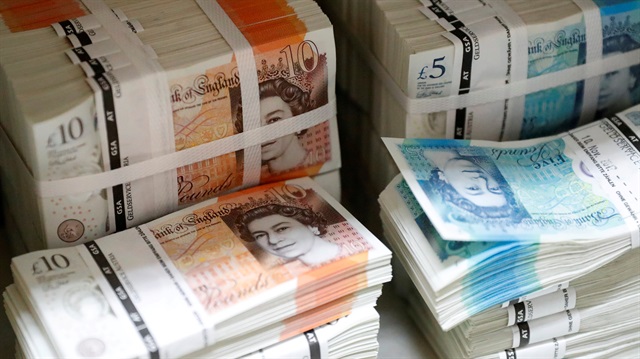
File photo
The pound languished near 13-month lows on Monday, as investors bet on continued dollar strength and uncertainty over whether Britain would secure a trade deal with the European Union before it exits the bloc.
Sterling lost 2 percent of its value last week because of growing unease among investors that Britain was headed for a future where it lacked an established relationship with its largest trading partner, the EU.
On Monday, the British currency dropped 0.3 percent to a low of $1.2735, a fraction higher than Friday's 13-month low.
Istanbul prosecutor's office launched an investigation into individuals suspected of involved in actions that threaten Turkey's economic security.Turkey was targeted by an economic attack, the prosecutor's office said and pledged to take legal action against all written and visual news as well as social media accounts which it deemed to serve towards the purpose of this attack.Turkey Central Bank to provide all liquidity banks needErdoğan slams US for preferring terrorists as partnerNo deposits will be seized: Turkish FinMin
Turkey launches probe into suspected actions targeting economic security
That move was roughly in line with the dollar's rise against a basket of major currencies, fueled by investors rushing into safer assets on fears of market contagion from a dramatic slide in the Turkish lira.
Strong employment or inflation data -- both reports are due this week -- are unlikely to help the pound significantly, analysts said.
Chinese officials have been mostly measured and moderate in their response to U.S. President Donald Trump's ratcheting up of a trade war with Beijing in recent weeks through his announcement of a series of punitive tariffs. They have generally avoided adding to tensions, allowing the Communist Party's official media to make the most bellicose comments.But the mood on the streets of Beijing and Shanghai is a little less accepting. Reuters talked to a cross section of 50 people, mainly from the two cities, about how concerned they are about the trade war, what they think Beijing's response would be, and whether they think Chinese people should boycott American products in retaliation.The interviews showed there is no palpable sense of crisis or panic yet. There is division and confusion over how China should respond to Trump, with some arguing that Beijing should strike back at American interests but others saying they didn’t know what could be done.Alaska seafood industry braces for China tariff painTurks sprint to support national currency after Erdoğan callChinese media keep up drumbeat of criticism of USBut perhaps most worrying for American businesses selling in China, a significant minority of the people interviewed – 14, or 28 percent - want to stop buying American products now, and some say they are already boycotting anything made in the U.S. Others said they would continue to buy American but that could change in the future.If that was representative of the whole of China – and words were turned into action - it might start to put a dent in sales of Apple's iPhones, Disney's movies, Starbucks' drinks and General Motors' cars, among other American products – and that's without any boycott being organised by the government or activists.A decade after China basked in the patriotic glory of an inspirational opening ceremony for the Beijing Olympics, nationalist sentiment is rarely far below the surface.The straw poll's sample is very small and clearly not scientific. The interviews were also conducted in a country where people are often guarded and may well not let foreign media know their real views. Any individual's comments deemed inappropriate – criticism of Xi would fall into this category – could lead to trouble with the authorities.But the views expressed in the 50 interviews are more than the basis for idle curiosity.Here are the results of the straw poll:-Asked whether they were worried about the trade war, only 11 of the 50 (22 percent) said they were, and 39 (or 78 percent) said they weren't concerned.-Asked what Beijing should do in response to Trump's punitive tariffs, 19 (or 38 percent) said that it should strike back hard. The rest came up with various responses, including a refocus on development of the domestic economy, building other export markets, while 8 (or 16 percent) said they had no idea what the government should do.-Asked whether they would stop buying U.S. products, 14 said they would, 31 said they wouldn't (some indicated their views could change if the trade war intensifies), and five didn't have a view.Here are some of the comments from those interviewed:"Of course I'm concerned. It's a clash between the largest and second-largest economy," said Shanghai stockbroker Cai Qing, 40. "None of the relevant parties were fully prepared for the trade war. Policies were rushed, including U.S. policies," he added."To put it bluntly, Americans have always been so arrogant - they make everyone their manufacturer so they can reap the economic fruit," said Qu Xinjun, who works in the steel industry in Shanghai. "Trump is waging a psychological war with China. He was trying to intimidate China. From a psychological standpoint, we should not worry about the trade war, but rather focus on domestic development," he said. "We should trust our country and the leadership and trust that we can win the war.""China has to hit back, which could show its great power status. China has to win this match," said Beijing interior decorator Zhang Shiyou, 56.China has other markets it can look to, and President Xi Jinping's landmark proposal to build a new Silk Road, called the Belt and Road initiative, he said."We Chinese should not buy Apple phones. Like the saying 'Buy the nation's products, love China', buying domestic products will boost our own industries.""A lot of American goods are actually made in China," said Wei Shaochuan, 26, the founder of a tech start-up in China's central Henan province, was interviewed on WeChat."But if, after a period of time, the trade war really incites a sense of hatred against the United States, then I will not watch American movies, not listen to American music, not recommend Disney to friends, and start writing social media posts saying that Americans are not good, in order to counter American cultural products," he said."I'm a strong supporter of Chinese products. I'm a firm opponent of any American product, especially after reading the news," said Zhao Guoxin, 61, a store owner in Beijing. "The other day I went to this American shop and I told them I won't buy one single thing, and I made them very awkward. To be honest I do think America is pretty obnoxious," he said."To be honest, importing from the U.S. isn't our sole route," said Wang Yangqing, a Beijing nurse who said she was in her 20s. "We could also import from European countries. For girls, we use some American skin care products. If tariffs keep rising, I may shift to products from other places such as Japan or Korea.""China should strike back properly," said Xu Dong, 25, a student in Beijing. "But I won't stop buying their products. Some enterprises like Apple in fact bring in tax revenues and employment. It's a brand that is doing good to China," he said,"For me it [the trade war] is great!" said Zhu Tao, 34, a ship catering manager in Beijing. "That's because I receive my salary in U.S. dollars and since the U.S.-China trade war started the U.S. dollar has kept increasing in value compared to the yuan. So I think it has really helped me. It's great!"
Chinese to boycott US products if trade war intensifies
That is because of political uncertainty over Brexit and the fact markets are not pricing in another Bank of England interest rate increase until at least next year.
"The uncertainly of a ‘no-deal Brexit’ is likely to weigh on the pound, and traders could remain cautious until there is more clarity around the UK’s plans post leaving the EU," said Societe Generale analyst Guy Stear.
Against the euro, the pound has held up better as demand for dollars has held back the euro.
The pound traded up 0.1 percent to 89.28 pence per euro , above its recent 2018 lows of 90.30 pence.
More than 100 constituencies that voted to leave the EU in 2016 have now switched their support to remain in the bloc, according to a new analysis.The investigation and its subsequent findings, undertaken by the pro-EU movement Best for Britain and the anti-racist Hope Not Hate group and compiled by analytics company Focaldata and the Guardian’s Observer, has concluded that most seats in the U.K. now hold a majority of voters who want to remain in the EU.The analysis is one of the most extensive and comprehensive studies carried out on Brexit since the referendum two years ago and its findings could have a significant and influential impact on the Brexit debate in parliament later this year.632 constituencies in England, Scotland and Wales were examined as part of the study and found that 112 constituencies that voted to leave the EU now want to remain in the EU. As such, the analysis shows that there are now 341 seats with a majority that wants to remain in the EU, compared to the 229 seats in the referendum two years ago.Overall, according to the model, 53 percent of the population would vote to remain in the EU while 47 percent would vote to leave.Among the many constituencies that now want to remain in the EU are that of Uxbridge (51.4 percent), represented by former foreign secretary Boris Johnson, and Surrey Heath (50.2 percent), represented by environment secretary Michael Gove. The two Tory MPs were the face of the Leave campaign and are proponents of a “hard Brexit.”“This groundbreaking research shows that Brexit is still not inevitable. People across the UK have witnessed the last two years of uncertainty with dismay and are thinking differently – 112 constituencies have switched to majorities that back staying in our current bespoke deal with the EU,” Eloise Todd, the chief executive of Best for Britain, told the Observer.“Our data shows a clear shift in public opinion against Brexit and people’s growing anxiety over how leaving the EU will affect themselves and their families. This cannot be ignored,” said Nick Lowles of Hope not Hate.The study found that the shift in opinion was driven in large by a change among Labour voters who voted to leave and as such north England and Wales, traditional Labour strongholds that voted to leave the EU, are seeing a shift from supporting Leave to supporting Remain.This shift of opinion among Labour supporters will add increased pressure on Jeremy Corbyn to soften his stance on Brexit and his opposition to a second referendum on the final deal.The shift in opinion will also give MPs in parliament the confidence to call for a second referendum on EU membership and opposition groups within parliament are already drawing up plans to push for a final vote or call for a general election if Prime Minister Theresa May fails to deliver a Brexit that works for all.Pro-EU movements such as Best for Britain and Open Britain have launched a nationwide campaign for a second referendum, popularly known as the “People’s Vote.”They will hold a series of rallies and demonstrations in major cities and towns across the U.K. to show the government that support for remaining in the EU has grown considerably in the last two years and that the people deserve the right to have the final say on a deal agreed upon by London and Brussels.Senior MPs and public officials have backed calls for a “People’s Vote” and argue that a second referendum is vital in putting to rest the Brexit gridlock in the government and parliament.
Brexit: Over 100 UK seats ‘switch’ from Leave to Remain
Sterling has been pushed lower as investors rush to protect themselves from further weakness in the run-up to Britain's exit from the EU next March. Most investors still expect Britain to secure a trade deal with the EU, but the risk of no deal is rising.
Warnings this month from Bank of England Governor Mark Carney and trade minister Liam Fox, that the prospect of a no-deal Brexit was growing, triggered the recent slide.