

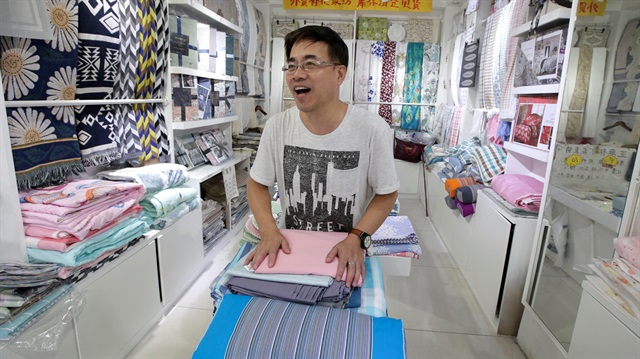
Vendor Zhao Baoxin, 61, speaks during a street interview on U.S.-China trade war at his shop
Chinese officials have been mostly measured and moderate in their response to U.S. President Donald Trump's ratcheting up of a trade war with Beijing in recent weeks through his announcement of a series of punitive tariffs. They have generally avoided adding to tensions, allowing the Communist Party's official media to make the most bellicose comments.
But the mood on the streets of Beijing and Shanghai is a little less accepting. Reuters talked to a cross section of 50 people, mainly from the two cities, about how concerned they are about the trade war, what they think Beijing's response would be, and whether they think Chinese people should boycott American products in retaliation.
The interviews showed there is no palpable sense of crisis or panic yet. There is division and confusion over how China should respond to Trump, with some arguing that Beijing should strike back at American interests but others saying they didn’t know what could be done.
Alaska fishermen are used to coping with fickle weather and wild ocean waves. Now they face a new challenge: the United States' trade war with China, which buys $1 billion in Alaskan fish annually, making it the state’s top seafood export market.Beijing, in response to the Trump administration's move to implement extra levies on Chinese goods, last month imposed a 25 percent tariff on Pacific Northwest seafood, including Alaskan fish, in a tit-for-tat that has engulfed the world's two largest countries in a trade war.The results could be “devastating” to Alaska’s seafood industry, the state’s biggest private-sector employer, said Frances Leach, executive director of United Fishermen of Alaska, the state’s largest commercial fishing trade group.“This isn’t an easily replaced market,” she said. If the tariff war continues, she said, “What’s going to happen is China is just going to stop buying Alaska fish.”For Alaska’s seafood industry, the timing could not be worse. The state has worked for years to attract the Chinese market, and just two months ago, Governor Bill Walker led a week-long trade mission to China in which the seafood industry was heavily represented.Walker’s trade mission was a follow-up to an Alaska visit a year earlier by Chinese President Xi Jinping and his cabinet.Fishermen are worried, said Alan Noreide, a fisherman in the Alaska port town of Seward, where he delivers some of his catch to the local Icicle Seafoods plant, an Alaska-based seafood processing company whose representatives accompanied Walker to China.“We’d rather be left to our own challenges that we have. We don’t need any more,” said Noreide, who focuses on Gulf of Alaska black cod and halibut.Marketers have found that middle-class Chinese customers view Alaska fish, particularly wild Alaskan salmon as a superior product from unspoiled waters.Chinese buyers are interested in "clean, natural, organic" products, said Zoi Maroudas, founder of an Anchorage-based baby food company that sells products like pureed salmon bisque. Maroudas was part of the Alaska trade mission, and said the pitch about Alaskan food “resonated with the people.”But higher prices due to tariffs could nudge Chinese consumers to products from competing countries such as Russia and Norway, closing Alaska's emerging opportunity, said Jeremy Woodrow of the Alaska Seafood Marketing Institute, a state agency.Farmers in the U.S. Midwest are expected to receive a $12 billion agricultural-aid package as a result of tariffs that are hitting soybean and other farmers. Walker and U.S. Senator Lisa Murkowski have argued that Alaska's seafood industry also deserves aid.The precise effects in Alaska have yet to be quantified and are likely to be uneven. A bit over half of the fish sent to China is processed there and re-exported, Woodrow said. While the Chinese government has exempted those products from tariffs, the Trump administration has proposed levies of up to 25 percent on the Alaska products shipped back from China to the United States.Exports of fish that go straight into the Chinese consumer market, such as king crab, are most vulnerable, said Garrett Evridge, an Alaska seafood analyst. 
Alaska seafood industry braces for China tariff pain
Turks from all walks of life have taken it upon themselves to help support their country’s national currency after President Recep Tayyip Erdoğan called on citizens to exchange their dollars and euros to Turkish lira, which experienced a sharp decrease in value following an escalating row between NATO allies Ankara and Washington. A large number of Turks launched individual initiatives aimed at encouraging their fellow citizens to support the lira.One citizen, a baker, offered free loaves of bread to anyone who exchanged their dollars, while another offered a free haircut to those who answered Erdoğan's call. Long lines formed in front of jewelers and exchange offices across Turkey as citizens flocked to sell whatever gold or dollars they have on hand to help support the ailing lira. One such citizen is Hatice Yavuz Duygu who expressed her joy to reporters after she exchanged her dollars to Turkish liras. “I’m happy, I never think or feel sad as I always put my support behind the Turkish lira,” she said.National struggle"Anyone who has dollars, euros, or gold underneath their mattresses should go to the bank and convert them into Turkish liras," Erdoğan told a rally on Friday in the northeastern Bayburt province.Erdoğan called such moves part of a "national struggle.""This will be my people's answer to those who declare economic war against us," he added. Süleyman, a trucker from the province of Kayseri, who despite not having any gold to sell or dollars to exchange, still managed to answer Erdoğan’s call by donating his truck to the government. A teller at an exchange office in Nevşehir spoke to Yeni Şafak about the large turnout of citizens who responded to the president’s call to exchange their dollars. “Especially in the last three to four days, our citizens have seriously begun to exchange their dollars. I’d say 80 percent of citizens have exchanged their dollars and euros based on what I’ve seen.”'US sanctions instigate economic war'Erdoğan: You can never bring this nation in line with the language of threats“Protect your country” “We have to protect our country,” a man from the crowd of people waiting to exchange their dollars yelled. “We have no other country. If you don’t want to become like Syria, then protect your country. The day is that of unity, not of playing politics. I, too, exchanged my foreign currency, everyone should do that no matter how much they have.”Criticizing what he called the "interest lobbies," he added that they cannot "overthrow" Turkey.Trump attacks Turkey after Erdoğan calls on TurksTrump said Friday on Twitter that he authorized the doubling of tariffs, noting that "aluminum will now be 20% and steel 50%. Our relations with Turkey are not good at this time!"He later said in a proclamation released by the White House that the additional tariffs would begin on Aug. 13.Trump's announcement came less than an hour after Erdoğan urged Turks to help defend the country against the economic war against the country.The United States, the world's biggest steel importer, imposed tariffs of 25 percent on steel and 10 percent on aluminum in March for imports from a variety of countries.Since then, its relationship with Turkey, the sixth largest steel importer to the United States, has deteriorated, prompting Ankara to send a delegation this week to Washington to meet with both the State and Treasury Departments.Last week, the United States imposed sanctions on Turkey's justice minister and interior minister for not releasing Pastor Andrew Brunson.Securing the release of evangelical Pastor Brunson, who was arrested in 2016 and faces terrorism charges in Turkey, is a top priority for the United States, and it is also tussling with Turkey over trade issues and differences over Syria.Turkey undeterred by threats: presidential aideUS tariff hike on Turkey fails to make economic sense
Turks sprint to support national currency after Erdoğan call
China's state media continued a barrage of criticism of the United States on Saturday as their tit-for-tat trade war escalated, while seeking to reassure readers the Chinese economy remains in strong shape.Commentaries in the People's Daily, China's top newspaper, likened the United States to a bull in a China shop running roughshod over the rules of global trade and said that China was "still one of the best-performing, most promising and most tenacious economies in the world."Trump says progress made toward trade deal with Mexico, but warns CanadaThe commentaries come as trade tensions between the two countries intensify. China said this week it would put an additional 25 percent tariffs on $16 billion worth of U.S. imports in retaliation against levies on Chinese goods imposed by the United States.One commentary accused the United States of "rudely trampling on international trade rules" and not taking into account China's lowering of tariffs and continued opening of its economy, among other things."People of insight are soberly aware that so-called 'America first' is actually naked self-interest, a bullying that takes advantage of its own strength, challenges the multilateral unilaterally, and uses might to challenge the rules," it read.US media criticizes Trump's tariffs decision on TurkeyAnother commentary argued that the Chinese economy was stable and was expected to remain so.In the second half of this year, "comprehensive deepening of reforms will continuously produce benefits." It said China could take steps to boost domestic demand while continued to cut corporate taxes and fees.With these and other policies, "the Chinese market will show an all-new charm," the commentary said.A separate piece in the People's Daily quoted vice agriculture minister Han Jun saying that if a trade war broke out, many other countries were willing and "completely able to replace American agricultural products' share of the Chinese market."It also quoted the vice minister as saying that the impact of American tariffs on China would be "extremely limited", but warned that were a trade war to escalate, the U.S. agriculture sector would feel its effects.Earlier this week, Chinese state media accused the United States of a "mobster mentality" as it moved to implement additional tariffs on Chinese goods. Beijing had all the necessary means to fight back, the reports said.
Chinese media keep up drumbeat of criticism of US
But perhaps most worrying for American businesses selling in China, a significant minority of the people interviewed – 14, or 28 percent - want to stop buying American products now, and some say they are already boycotting anything made in the U.S. Others said they would continue to buy American but that could change in the future.
If that was representative of the whole of China – and words were turned into action - it might start to put a dent in sales of Apple's iPhones, Disney's movies, Starbucks' drinks and General Motors' cars, among other American products – and that's without any boycott being organised by the government or activists.
A decade after China basked in the patriotic glory of an inspirational opening ceremony for the Beijing Olympics, nationalist sentiment is rarely far below the surface.
The straw poll's sample is very small and clearly not scientific. The interviews were also conducted in a country where people are often guarded and may well not let foreign media know their real views. Any individual's comments deemed inappropriate – criticism of Xi would fall into this category – could lead to trouble with the authorities.
But the views expressed in the 50 interviews are more than the basis for idle curiosity.
Here are the results of the straw poll:
-Asked whether they were worried about the trade war, only 11 of the 50 (22 percent) said they were, and 39 (or 78 percent) said they weren't concerned.
-Asked what Beijing should do in response to Trump's punitive tariffs, 19 (or 38 percent) said that it should strike back hard. The rest came up with various responses, including a refocus on development of the domestic economy, building other export markets, while 8 (or 16 percent) said they had no idea what the government should do.
-Asked whether they would stop buying U.S. products, 14 said they would, 31 said they wouldn't (some indicated their views could change if the trade war intensifies), and five didn't have a view.
Here are some of the comments from those interviewed:
"Of course I'm concerned. It's a clash between the largest and second-largest economy," said Shanghai stockbroker Cai Qing, 40. "None of the relevant parties were fully prepared for the trade war. Policies were rushed, including U.S. policies," he added.
"To put it bluntly, Americans have always been so arrogant - they make everyone their manufacturer so they can reap the economic fruit," said Qu Xinjun, who works in the steel industry in Shanghai. "Trump is waging a psychological war with China. He was trying to intimidate China. From a psychological standpoint, we should not worry about the trade war, but rather focus on domestic development," he said. "We should trust our country and the leadership and trust that we can win the war."
"China has to hit back, which could show its great power status. China has to win this match," said Beijing interior decorator Zhang Shiyou, 56.
China has other markets it can look to, and President Xi Jinping's landmark proposal to build a new Silk Road, called the Belt and Road initiative, he said.
"We Chinese should not buy Apple phones. Like the saying 'Buy the nation's products, love China', buying domestic products will boost our own industries."
"A lot of American goods are actually made in China," said Wei Shaochuan, 26, the founder of a tech start-up in China's central Henan province, was interviewed on WeChat.
"But if, after a period of time, the trade war really incites a sense of hatred against the United States, then I will not watch American movies, not listen to American music, not recommend Disney to friends, and start writing social media posts saying that Americans are not good, in order to counter American cultural products," he said.
"I'm a strong supporter of Chinese products. I'm a firm opponent of any American product, especially after reading the news," said Zhao Guoxin, 61, a store owner in Beijing. "The other day I went to this American shop and I told them I won't buy one single thing, and I made them very awkward. To be honest I do think America is pretty obnoxious," he said.
"To be honest, importing from the U.S. isn't our sole route," said Wang Yangqing, a Beijing nurse who said she was in her 20s. "We could also import from European countries. For girls, we use some American skin care products. If tariffs keep rising, I may shift to products from other places such as Japan or Korea."
"China should strike back properly," said Xu Dong, 25, a student in Beijing. "But I won't stop buying their products. Some enterprises like Apple in fact bring in tax revenues and employment. It's a brand that is doing good to China," he said,
"For me it [the trade war] is great!" said Zhu Tao, 34, a ship catering manager in Beijing. "That's because I receive my salary in U.S. dollars and since the U.S.-China trade war started the U.S. dollar has kept increasing in value compared to the yuan. So I think it has really helped me. It's great!"