

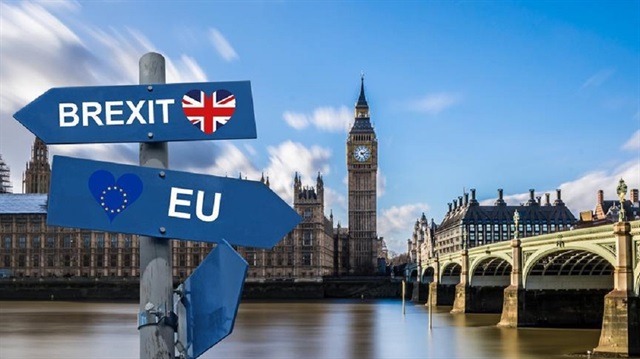
File photo
Pro-EU campaigners seeking to establish legally that Britain alone could stop the Brexit process took an appeal to Scotland's top court on Wednesday.
They want judges to ask the European Court of Justice (ECJ) to clarify whether Britain could choose to remain in the world's biggest trading bloc without permission from the other 27 members. That would require Britain's parliament to first decide that the final Brexit deal, if and when it is reached, was not good enough.
The case is of renewed relevance as Britain's Conservative government works against the clock to reach agreement with Brussels on the terms of its departure ahead of the March 2019 departure date.
The possibility of Brexit happening without an agreement has pummelled the value of sterling on foreign exchange markets, and the government says it has stepped up planning for that possibility.
The Edinburgh Court of Session hearing, backed by British and Scottish lawmakers, is an appeal against a June ruling. Judges then said they could not refer the matter to the ECJ because Britain had not decided to overturn Brexit, and the case was therefore hypothetical.
British Foreign Secretary Jeremy Hunt is starting a three-day tour in Europe to discuss the future relationship arrangements of his country with the EU.He “will today begin a three-day visit to Finland, Latvia, Denmark and the Netherlands to continue his discussions with European partners on the withdrawal of the UK from the EU,” a government statement said.It said the foreign secretary will meet the foreign ministers of all four countries to “outline the U.K.’s determination to build a new relationship with Europe after Brexit which will offer a bright future that benefits all on our continent.”Hunt said the U.K. shares “history and values with our partners in Europe" and that they "work side-by-side to defend the rules-based international system on which our safety and prosperity depend.”“I’m delighted to be visiting four close European partners this week to reiterate that these strong ties will not diminish once we leave the EU,” he added.Europe 2019 revolution: A change of political paradigmUnderlining the common threats, “including terrorism and the destabilising activities of Russia,” Hunt thanked the four countries for the solidarity they showed with Britain “when Russia used a chemical weapon on British soil,” referring to the Sergei and Yulia Skripal poisoning incident this March.Hunt said the U.K.’s strategic choice in Brexit negotiations “is to build a deep and special partnership with the remaining member states.”UK Labour leader slams Netanyahu's 'false' claimsUK: Johnson’s remarks fuel anti-Muslim hate crimes“We want to safeguard our operational capacity as we leave the EU, and so we have put forward precise, credible proposals that ensure our ability to act is maintained,” he said.The British foreign secretary said they “are now at the point where the EU also faces strategic choices: with the option to move the negotiations forward and achieve a deal that works in our mutual interests.”“My simple message is that we need to take that opportunity,” he added.The U.K. is set to leave the EU on March 29, 2019 but a final deal to shape future U.K.-EU relations still has to be agreed upon by the sides.
Eyeing Brexit, UK foreign secretary starts Europe tour
The Scottish court's decision, which can be appealed at Britain's Supreme Court in London, will be announced in the coming weeks, a court spokesman said.
Knowing whether Article 50, the part of the European Treaty which triggers a member state leaving, can be reversed is essential to keeping Britain's options open, said Jo Maugham, a lawyer supporting this and other legal challenges to Brexit.
"This case - if it succeeds - means that when parliament looks again it will know whether we can just withdraw the Article 50 notice and keep all the opt-outs we presently enjoy," he said.
"(We) will have the option of treating Brexit as just a bad dream."
The British government has argued that the question of whether Britain could unilaterally stop Brexit is irrelevant because the will of the voters was made clear in the 2016 referendum and ministers will not reverse the decision.
A European establishment spoiled by history is worrying about the future of the EU while the 2019 summer election is approaching. The ballot could be a revolution in the political map with a solid step back of democratic Christians and of social-democratic components of the EU parliament - the traditional roots of the post-war peace process in the old Continent. A “populist” nightmare is involving politicians, media activists, intellectuals and social scholars riddling the image of a future where the founder’s own idea of Europe could be at stake. But is it a real picture? An official source of the Eurobarometer says a few different things: for the first time since 2007, more Europeans do not believe “my voice counts in the EU,” according to a survey of over 27,000 people across the continent. Yet the same poll — released on July 4 to mark one year until the 2019 European Parliament election — also found a warm welcome for the anti-establishment parties shaking up politics in the bloc. So maybe people are smarter than old politicians, and the sovereigntist wave is justified by a really bad management of the refugees-migrant policy and the total incapacity of European governments to handle the complex changes due to a globalization too much influenced by “finance without borders” and running like a bull outside the stable. Furthermore, the EU Commission’s (non-democratic) leadership lost power, and the EU Counsel rises with its national interests. It has been over a decade that the EU has been just a sum of different interests where the stronger count (Germany and its French vassal) and the lesser pay (Greece, Spain, Italy and others).It is an epic political fail that joins the American and European establishment both punished by elections and characterized by harsh, foolish debate. Hyper-spoiled elites from both sides of the Atlantic got a bad wake up and a hysterical and paranoid reaction because reality has proven to be different from their wishful thinking. Some examples that astonished us are the Hollywood star Robert De Niro with his “F..k the President” with a “privileged” audience’s standing ovation and actress Demi Moore’s statement: “This awful country with disgusting people and everything about it, I’ll boycott everything about Trump” mean that a system short-circuit has occurred, and respect for a country that gives you a chance and for its institutions mean nothing. In Europe, we can see the ugly copy of that already absurd behavioral pattern.Still, the Eurobarometer survey says there is no danger for EU institutions: the survey, carried out for the European Parliament by Kantar Public, a consultancy firm, found that 48 percent of EU citizens surveyed agree that their voice counts in the EU, while 46 percent disagree — and Brexit appears to have improved the pro-EU mood. Before the United Kingdom voted to leave the EU in 2016, just 37 percent of Europeans agreed that their voice counted in the EU.However, citizens feel more connected to national politics than pan-European: 63 percent of Europeans agree their voice counts at the national level, with that figure topping 90 percent in Sweden, Denmark and the Netherlands.The good news for the Eurocrats and politicians preparing for next year’s election is that support for the EU is “the highest score ever measured since 1983,” according to the survey report. It seems there is no danger for the future.So maybe it is just the end of the first stage of EU building that now needs a further step toward a more democratic phase with the so-called “political” phase after the euro currency stage. Not an easy task. The refugee/migrant issue shows all the limits of unrealistic EU policies better, squeezed among a failed globalism in its priorities like the building of new markets, new consumers, new models of society, new types of families ready to spend more and more fragile to new needs and people’s defensive attitudes that do not allow pro-migrant policies. So, weak European politicians choose a hidden way to achieve this task pushed by the old “globalist” elite: humanitarian emergency, using African and Middle Eastern wars and troubles as valves to set migrant flow. Almost immediately, this project went out of control and the European ruling elite found out how harsh the feedback could be with a sinking political support. Now they are depicting new populism as a danger as the seed for new xenophobic attitudes and the chance fascism could rise again in Europe but is the swan song of an obsolete political paradigm, still watching at the last century, defeated by complexity of the modern world. The paradigm is called globalization, now turned “bad” with is financial influence, the rooms for political parties is limited: how to defend local communities from aberrations and unwilling effects of this system on the one side; take advantage of many chances the global market gives on the other side. To achieve this task you do not need any ideology, but just a vison about the future - like circular (non-destructive) economy - and a strong personal ethic and strong popular mandate to resist to huge market forces that have no soul, ethic or morality but can exert big pressure over national and local government, especially if they are corrupted. The Italian government’s “war” against gambling games business, prohibiting any kind of advertising, is a good example of the new role of politicians that people want. The change of paradigm means that old political categories and narratives are fading. A good example is the Brexit troublemaking process that has been weakening PM Theresa May’s UK government.The European Parliament’s next election in July 2019 could show a new political map with a great rising of “sovereigntist” and “anti-establishment” parties. In several European countries, including Finland, Hungary, Latvia, Lithuania, Norway, and Switzerland, right-wing parties have taken the reins of government. And even where populists haven’t gained power, groups such as Britain’s UKIP, the French Front National, and Germany’s Alternative für Deutschland are gaining record popularity.If the survey results are anything to go by, the EU will have difficulty getting more people out to vote next year than they have in the past (turnout in the 2014 ballot was 42.6 percent, a record low). According to this year’s survey results, only half of the EU population has an interest in the Parliament elections. As for what should be on the agenda ahead of the election, citizens picked terrorism as the most pressing topic of discussion, ahead of youth unemployment and immigration. So fear will once again lead public opinion choices.Could this new political map in Europe change even the Mediterranean framework? Sovereigntist and anti-establishment parties want to break free from foreign economical-political influence and will not exert undue influence over other countries. That could open a chance window to build more local oriented/independent governments and could mean the end stop for a neo-colonial attitude in the Mediterranean basin. Of course nothing will come easy, but even Donald Trump’s anti-establishment attitude could help this change toward more bad-globalism-independent societies and states. The U.S. needs to cut bonds between Berlin and Moscow, but in the meanwhile wants to foster its own relation with Putin. Europe has to stay in the Atlantic full-flagged field but with new rules and far from any Euro Asiatic influence. Even the NATO burden-sharing issue is just a political tool to deal with European countries to balance a negative security bill and a trade exchange. Trump wants to cash credits and to stress the political “croupier” role of Washington in Europe more. The spirit of a pragmatic democrat and tireless unifier like Konrad Adenauer seems to need a big revamp and a new paradigm.
Europe 2019 revolution: A change of political paradigm
However, with increasing worries that Brussels and London will not reach a deal in time, a recent poll found 45 percent of voters supported holding a new referendum whatever the outcome of talks with the EU, while 34 percent opposed it.
Prime Minister Theresa May has repeatedly ruled out another vote on Brexit, saying the public made their decision when they voted 51.9 percent to leave and 48.1 percent to stay in 2016.