

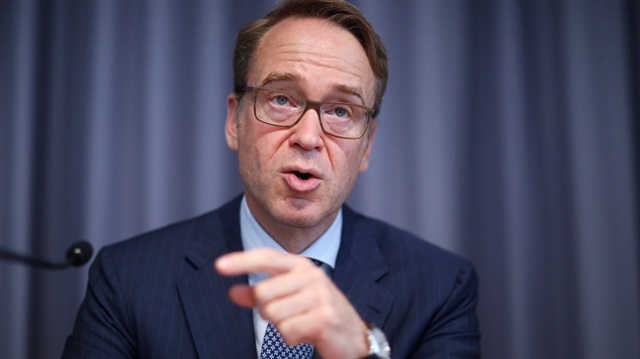
Bundesbank President Jens Weidmann
The European Central Bank should roll back its stimulus programme now that inflation is consistent with its target, Bundesbank President Jens Weidmann said on Thursday, warning against a delay in normalisation after years of central bank support.
The ECB agreed in June to end massive bond purchases by the close of the year, but Weidmann, an outspoken critic of the central bank's easy-money policy, said this should be just the first step in a process that might take years.
"It's also time to begin exiting the very expansionary monetary policy and the non-standard measures, especially considering their possible side effects," Weidmann told reporters.
"This normalisation process will probably take place only gradually over the next few years. That's exactly why it has been so important to actually get the ball rolling without undue delay," he said.
Weidmann was in the spotlight this week after the newspaper Handelsblatt said Chancellor Angela Merkel was giving up on promoting him to succeed ECB chief Mario Draghi next year. She was focusing now on securing the European Commission presidency for a German candidate, the newspaper said.
Weidmann made no reference to the ECB succession in his remarks.
Draghi has also guided markets for an interest rate hike only after next summer, a timeline some hawks consider too soft given that inflation has rebounded, the bloc is into its sixth year of expansion and employment is at record highs.
Weighing on the debate whether inflation is already high enough, Weidmann said that the ECB's projection of 1.7 percent for 2020 is "broadly consistent" with the bank's mandate of close to but below 2 percent, a view contrary to Draghi's take.
Inflation rose to 2.1 percent last month, mostly on higher energy prices. It is likely to fall back below 2 percent in the coming months as domestic price pressures remain muted.
"However, they are likely to intensify as aggregate capacity utilisation increases," Weidmann said about domestic prices. "They will thus counteract waning impetus from other components of the inflation rate, such as energy prices."
European shares edged up on Thursday after the latest round of U.S.-China tariffs kicked in, hurting trade-sensitive autos stocks but boosting demand for sectors seen as more insulated from an escalating trade dispute.The STOXX 600 was up 0.2 percent, buoyed by tech, healthcare, and consumer staples stocks - "defensives" which investors reach for as safer bets in times of uncertainty for their strong earnings growth and high dividend payouts.The United States and China implemented 25 percent tariffs on $16 billion worth of each other's goods early on Thursday, bringing to $50 billion the value of imports subjected to tariffs on either side since early July, with more in the pipeline.Autos stocks were the worst-performing for a second day. On Wednesday a surprise profit warning from tyre maker Continental sank the stock and hit the sector, already one of the worst impacted by tariff fears.Continental fell a further 2.8 percent, bottom of the DAX, taking its losses to 15 percent since Wednesday's open.Carmakers Daimler, BMW and Volkswagen fell 0.6 to 0.8 percent, while Valeo, Renault, Michelin and Peugeot were the biggest CAC 40 fallers.Outside of trade war moves, shares in budget airline Ryanair jumped 4.7 percent to the top of the STOXX after the Irish pilots' union Forsa said it has reached an agreement in an ongoing labour dispute.Danish medical equipment, supplies and distribution company Ambu sank more than 10 percent at the open after its third-quarter results, with traders saying earnings and revenues numbers had missed analysts' targets.Gaming and casino software company Playtech rose 4.8 percent after its half-year profit loss came in smaller than expected. It said competition and tougher regulation in Asian markets had caused the fall in profits.Swiss telecoms group Sunrise Communications rose 5 percent after it increased its guidance for full-year 2018 EBITDA.Building materials firm CRH also gained 3.7 percent after reporting first-half margins held steady and striking a positive tone for earnings in the second half of the year. China says will continue to fight back against US tariffs'US disregard of legal process unacceptable’: Presidential aide
European shares nudge higher, trade tariffs dent autos
China's commerce ministry said on Thursday that Beijing will have to continue to fight back against the latest implementation of U.S. tariffs on $16 billion of Chinese goods.China will file a complaint with the World Trade Organization (WTO) against the U.S. action, the ministry also said in a statement on its website.The latest round of U.S., Chinese import tariffs on each other's goods took effect as of 0401 GMT on Thursday. 'China is aiming to use pressure to affect elections': Taiwan presidentUS, China to resume trade talks in Washington amid low expectationsDollar falls after Trump criticizes FedUS tariffs to have negative impact on economy: Survey
China says will continue to fight back against US tariffs
Sterling eased back from its highest levels in nearly two weeks on Wednesday as investors turned their attention back to negotiations for Britain's departure from the European Union.There have been mixed messages this week on whether British and EU officials will meet an informal October deadline to reach an agreement on how they will structure trade ties following their divorce next year.Diplomats in Brussels said they expected a delay in finalizing the terms of Britain's exit and could need to hold an emergency summit in November.But British Brexit minister Dominic Raab said late on Tuesday that he was confident an exit agreement could be reached by an October 18-19 summit of EU leaders.Dollar weakness after U.S. President Donald Trump's said that he was unhappy with the Federal Reserve for raising interest rates also helped the pound earlier this week.Following Raab's comments, sterling hit its highest levels against the greenback in 12 days, at $1.2924. The British currency had plunged to nearly 14-month lows last week as worries the UK will crash out of the EU without a trade deal mounted.By 0807 GMT on Wednesday, sterling was 0.3 percent lower at $1.2871.The pound was 0.2 percent lower at 89.77 pence per euro."One thing is clear: the agreement will have to be reached well before year-end to leave sufficient time for the ratification ahead of the actual Brexit by the end of March 2019," analysts at Commerzbank wrote in a note to clients."However, the longer the negotiations drag on for the more the FX market has to fear a no-deal accident, i.e. that the UK will leave the EU without a transition agreement which would entail notably elevated risks premiums for the pound exchange rates."They also noted British government papers analyzing the possible consequences of a no-deal Brexit that are due to be published this week would be key for sterling's performance over the next few days."The inherent willingness of both sides to find a Withdrawal Deal solution should serve as a bit of a backstop to the degree of no-deal Brexit risks priced into the currency," said ING currency strategist Viraj Patel."But when it comes to sterling and political risks, it is far too early to signal the all-clear; the biggest test for the pound will be the return of a divided UK parliament from their summer recess and the upcoming Party Conference Season."Pound falls as focus turns to BrexitPound holds above $1.27, buoyed by dollar weakness
Sterling falls from 12-day high as Brexit risks return