

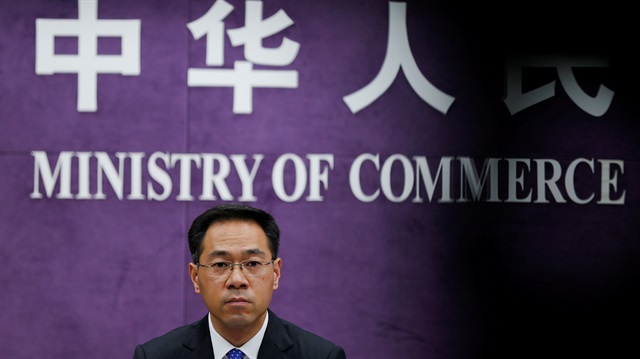
File photo: China's Ministry of Commerce spokesperson Gao Feng attends a news conference at the commerce ministry in Beijing, China
China's commerce ministry said on Thursday that Beijing will have to continue to fight back against the latest implementation of U.S. tariffs on $16 billion of Chinese goods.
China will file a complaint with the World Trade Organization (WTO) against the U.S. action, the ministry also said in a statement on its website.
The latest round of U.S., Chinese import tariffs on each other's goods took effect as of 0401 GMT on Thursday.
Taiwan President Tsai Ing-wen said on Wednesday China was exerting pressure on the island in an attempt to influence its politics, including upcoming local elections."China's pressure towards Taiwan will not stop ahead of the elections," Tsai said in a statement, adding that Beijing was attempting to affect the election results.Self-ruled Taiwan, which Beijing considers a wayward province of "one China", is set to hold mayoral and magisterial elections in late November.Democratic Taiwan vowed on Tuesday to fight China's "increasingly out of control" behaviour after Taipei lost another ally to Beijing when El Salvador switched allegiances to China. 
'China is aiming to use pressure to affect elections': Taiwan president
U.S. and Chinese officials are set to resume contentious trade talks on Wednesday under the cloud of a prediction by U.S. President Donald Trump that there would be no real progress.The discussions among mid-level officials could set a framework for further negotiations as each country prepares to hit the other with new tariffs on Thursday in a deepening dispute over China's economic policies.Trump has threatened to impose duties on virtually all of the more than $500 billion of Chinese goods exported to the United States unless it meets his demands.The two days of meetings are the first formal U.S.-China trade talks since U.S. Commerce Secretary Wilbur Ross met Chinese economic adviser Liu He in Beijing in June.After negotiations in May, Beijing believed it had assurances from the U.S. that tariffs were off the table. But less than 10 days later, the White House said it would push forward on punitive measures.China has said it hopes for quiet, steady talks to get "a good result on the basis of equality, parity and trust."But Trump told Reuters on Monday that he did not "anticipate much". In an interview, he said resolving the trade dispute will "take time because China's done too well for too long, and they've become spoiled."Trump also accused China of manipulating its yuan currency to make up for the effect of tariffs, while arguing the U.S. central bank should be more accommodating.On Tuesday, however, Trump administration officials were largely silent about the latest round of talks. Spokespersons for the U.S. Treasury, the U.S. Trade Representative's office and the U.S. Commerce Department did not respond to queries about the Treasury-led meetings.China expands internment camps targeting Uighurs"These are working-level discussions with representatives from across the administration," a White House official told Reuters. The official declined further comment but pointed out Trump's own pessimistic comments in the Reuters interview."This is to some extent a temperature-taking exercise," said Scott Kennedy, director of China studies at the Center for Strategic and International Studies in Washington. "Expectations are probably low on both sides."Previous talks were held by cabinet-level ministers, including Chinese Vice Premier Liu He, U.S. Treasury Secretary Steven Mnuchin and Commerce's Ross.China's Xi says military must resist 'corrosion' of corruptionThe talks on Wednesday and Thursday will led by lower-level officials, Treasury Undersecretary David Malpass and Chinese Commerce Vice Minister Wang Shouwen. Deputy USTR Jeffrey Gerrish is also expected to participate."The vice minister from Mofcom is not going to be authorized to make some great offer, but if the Chinese say one interesting thing, maybe you set up a second meeting and the level goes up a step," said Derek Scissors, a China scholar at the American Enterprise Institute, a Washington think tank."But I'd say there's an 80-90 percent chance they are a total waste of time, and that's why no one in the administration is talking about this," he added.Ultimately Trump will need to personally be involved in settling the dispute with Chinese President Xi Jinping, Scissors said.China reiterates support for Turkey's economyLengthy DemandsTrump's administration is pressing China to make sweeping economic policy changes to better protect U.S. intellectual property, end its industrial subsidy efforts and open its markets to foreign competition.In May, U.S. officials presented China with a lengthy list of demands that also included reducing the U.S. trade deficit with China by $200 billion annually. It is unclear whether that list has been revised for the latest round.Beijing denies U.S. allegations that it systematically forces the unfair transfer of U.S. technology and insists that it adheres to World Trade Organization rules.China complains about Pentagon report, says it is 'pure guesswork'The discussions this week were expected to do little to stop the scheduled activation of 25 percent U.S. tariffs on another $16 billion in Chinese goods scheduled to take effect at 12:01 a.m. EDT (0401 GMT), along with immediate retaliatory tariffs expected from China on $16 billion of U.S. goods.But this could soon trigger Trump's unveiling of a second $200 billion to $300 billion list of Chinese goods to be targeted with U.S. tariffs.On June 16, when Trump first threatened to dramatically escalate his tariffs with an initial $200 billion list of Chinese goods, he said would hit China with tariffs on another $200 billion in goods if Beijing retaliated a second time.Erin Ennis, senior vice president of the U.S.-China Business Council, said it was probably good for the two sides to start with lower level officials who could "get into the weeds" on the IP protection problems that U.S. companies are facing in China."It's good that they're talking because not talking isn’t solving the issues and is only leading to more tariffs," she said.
US, China to resume trade talks in Washington amid low expectations
The dollar weakened on Tuesday after U.S. President Donald Trump criticized the head of the Federal Reserve for raising interest rates.Trump said on Monday he was "not thrilled" with Jerome Powell's rate hikes and said the U.S. central bank should do more to help him to boost the economy.American presidents rarely criticize the Fed, whose independence is considered important for economic stability. But Trump has made reducing U.S. trade deficits a priority, and the combination of rising interest rates and a strengthening dollar poses risks for export growth."It would appear that Mr Trump would like to keep the U.S. dollar a little on the weak side in order to remain competitive," said CMC Markets chief markets analyst David Madden."But given the dollar has been in demand recently on account of geopolitical issues and the Fed's monetary tightening policy, he might find it difficult to talk the greenback lower."The dollar index against a basket of six other currencies fell 0.3 percent to 95.596 as of 0730 GMT after touching 95.440, its lowest since Aug. 9.Escalating trade tensions between the United States and its trading partners and a plunge in the Turkish lira have pushed the dollar index up recently.But the greenback weakened on Tuesday as investors ditched it as a safe haven before China and the United States hold talks this week that may help ease their dispute over trade.Trade tensions have on the whole helped the dollar, which benefits from geopolitical turmoil as the market seeks out less risky investments."It looks as though Trump's comments have caught the market very long dollar after last week's emerging market rout," said Chris Turner, head of currency strategy at ING in London.YEN BACK?The dollar's advance - it has gained 8 percent since January - would not be reversed, however, unless the Fed decided "that there has been an unwarranted tightening of financial conditions and want to slow the pace of rate hikes," Turner said.The Fed has raised interest rates twice this year and is expected to do so again next month.Traders are preparing for the release of Federal Reserve policy meeting minutes on Wednesday and an annual Jackson Hole symposium for insights into the direction of U.S. monetary policy.Against the U.S. currency, the euro strengthened 0.3 percent to a daily high of $1.154.Concerns that a currency crisis in Turkey would hurt euro zone banks and uncertainty about the Italian government's planned budget have weighed on the euro recently.Trump's remarks appeared to bolster appetite among investors for the Japanese yen as a safe haven of choice.The yen was basically flat at 110.08 yen, paring gains after touching as high as 109.775 yen earlier.The dollar on Tuesday fell below the psychologically-significant 110-yen level for the first time since June 28.The Australian dollar was 0.13 percent higher at $0.7350, after Prime Minster Malcolm Turnbull survived a leadership vote by a narrow margin. 
Dollar falls after Trump criticizes Fed
U.S. President Donald Trump's tariffs would have a negative impact on American economy, a survey revealed Monday.In the survey released by the National Association for Business Economics (NABE), 91 percent of business economists said current tariffs and threats to impose tariffs would negatively impact the American economy.More than 65 percent of the participants said the U.S.' withdrawal from the North American Free Trade Agreement (NAFTA) would also have "a consequential and unfavorable impact on the U.S. economy."While the renegotiations of NAFTA have started last year and yet to be concluded, Trump's tariffs have already strained relations between the U.S. and China, Canada, Mexico, the European Union, and recently the strong NATO ally Turkey.A whopping 74 percent of survey takers said economic policy should do more to mitigate income inequality, while 60 percent said they believe economic policy should do more to mitigate climate change.Trump announced in June 2017 that he intends to withdraw the U.S. from the historic Paris Climate Change agreement, which aims to reduce global carbon emissions.The semiannual survey of the NABE was conducted between July 19 - Aug. 2 based on the responses of 251 members of the association.
US tariffs to have negative impact on economy: Survey