

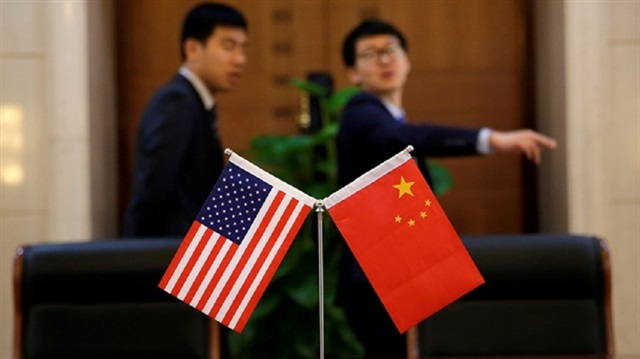
File photo
U.S. and Chinese officials are set to resume contentious trade talks on Wednesday under the cloud of a prediction by U.S. President Donald Trump that there would be no real progress.
The discussions among mid-level officials could set a framework for further negotiations as each country prepares to hit the other with new tariffs on Thursday in a deepening dispute over China's economic policies.
Trump has threatened to impose duties on virtually all of the more than $500 billion of Chinese goods exported to the United States unless it meets his demands.
The two days of meetings are the first formal U.S.-China trade talks since U.S. Commerce Secretary Wilbur Ross met Chinese economic adviser Liu He in Beijing in June.
After negotiations in May, Beijing believed it had assurances from the U.S. that tariffs were off the table. But less than 10 days later, the White House said it would push forward on punitive measures.
China has said it hopes for quiet, steady talks to get "a good result on the basis of equality, parity and trust."
But Trump told Reuters on Monday that he did not "anticipate much". In an interview, he said resolving the trade dispute will "take time because China's done too well for too long, and they've become spoiled."
Trump also accused China of manipulating its yuan currency to make up for the effect of tariffs, while arguing the U.S. central bank should be more accommodating.
On Tuesday, however, Trump administration officials were largely silent about the latest round of talks. Spokespersons for the U.S. Treasury, the U.S. Trade Representative's office and the U.S. Commerce Department did not respond to queries about the Treasury-led meetings.
China is expanding its “political re-education” camps targeting Turkic-Muslim Uighurs in Xinjiang region, according to a Wall Street Journal report.The report, published on Friday, said China has sharply expanded an internment program that initially targeted ethnic Uighur extremists but is now confining vast numbers of the largely Muslim minority group, including the secular, old and infirm, at camps across the country’s northwest.Xinjiang region is home to around 10 million Uighurs. The Turkic Muslim group which makes up around 45 percent of the population of Xinjiang, has long accused China’s authorities for cultural, religious and economic discrimination.Satellite images and a specialist in photo analysis show that camps have been growing, the report said.The report said up to one million people, or about 7 percent of the Muslim population in China’s Xinjiang region, have now been incarcerated in an expanding network of “political re-education” camps, according to U.S. officials and United Nations experts.The full extent of the internment program was long obscured because many Uighurs feared speaking out, the report said. It said six former inmates interviewed described how they or other detainees had been bound to chairs and deprived of adequate food.“They would also tell us about religion, saying there is no such thing as religion, why do you believe in religion, there is no God,” said Ablikim, a 22-year-old Uighur former inmate.The report said three dozen relatives of detainees were interviewed, five of whom reported that family members had died in camps or soon after their release. Many said they had struggled to determine where their relatives were being held and the state of their health.A senior Chinese official, Hu Lianhe of the United Front Work Department, publicly acknowledged the existence of the camps for the first time this week but said they were “vocational training centers”, the report added.Responding to questions from a UN panel, Hu said there is no “arbitrary detention” in Xinjiang and denied one million people were being held. He didn’t say how many people were in the centers.The report said many experts on the region and Uighur activists say unrest there is driven by China’s heavy-handed policing, strict limits on religious activity, and preferential policies for non-Uighur migrants to the region.China stepped up many of those restrictions in the past two years, banning men from growing beards and women from wearing veils, and introducing what many experts regard as the world’s most extensive electronic surveillance program, it added.Other former inmates interviewed said they were instructed that they should not pray, keep a copy of the Quran or fast during Ramadan. Some said they were forced to eat pork, which is forbidden in Islam.
China expands internment camps targeting Uighurs
"These are working-level discussions with representatives from across the administration," a White House official told Reuters. The official declined further comment but pointed out Trump's own pessimistic comments in the Reuters interview.
"This is to some extent a temperature-taking exercise," said Scott Kennedy, director of China studies at the Center for Strategic and International Studies in Washington. "Expectations are probably low on both sides."
Previous talks were held by cabinet-level ministers, including Chinese Vice Premier Liu He, U.S. Treasury Secretary Steven Mnuchin and Commerce's Ross.
China's military must resist the "corrosion" of corruption and ensure the fight against graft is deepened, President Xi Jinping told senior officers, state media said on Sunday, offering a renewed warning against a deep-seated problem.China's military, the world's largest and currently undergoing an ambitious modernisation programme, has been an important focus of Xi's campaign against corruption since he took power six years ago.Xi has repeatedly warned about the threat of corruption to the country and the party, and has vowed not to let up in the fight against it.Dozens of officers have been investigated and jailed, including Xu Caihou and Guo Boxiong, both former vice chairmen of the Central Military Commission, which Xi heads and is in overall charge of the People's Liberation Army.Guo was jailed for life in 2016. Xu died of cancer in 2015 before he could face trial.Speaking at a three day-meeting of the Central Military Commission, which ended on Sunday, Xi said the fight against graft must remain "always on the road" and be deepened, the official Xinhua news agency reported."Go in hot pursuit of and strike hard against hedonism and extravagance," Xinhua cited Xi as saying. "The anti-corruption fight must be unswervingly grasped, and will not change direction or form."There must be no no-go areas and a zero tolerance attitude maintained, with a full and comprehensive supervision system put in place to tackle the problem, he added.China's military must ensure they and their families are upright and clean, and that they can "resist the corrosion of unhealthy tendencies", Xi said.He also said efforts were needed to strengthen the leadership of the ruling Communist Party over the military "to ensure a solid political guarantee for the building of a strong military."Serving and retired officers have said graft in the armed forces is so pervasive it could undermine China's ability to wage war.The anti-graft drive comes as Xi steps up efforts to modernise forces that are projecting power across the disputed waters of the East and South China Seas and deep into the Pacific Ocean, though China has not fought a war in decades. 
China's Xi says military must resist 'corrosion' of corruption
The talks on Wednesday and Thursday will led by lower-level officials, Treasury Undersecretary David Malpass and Chinese Commerce Vice Minister Wang Shouwen. Deputy USTR Jeffrey Gerrish is also expected to participate.
"The vice minister from Mofcom is not going to be authorized to make some great offer, but if the Chinese say one interesting thing, maybe you set up a second meeting and the level goes up a step," said Derek Scissors, a China scholar at the American Enterprise Institute, a Washington think tank.
"But I'd say there's an 80-90 percent chance they are a total waste of time, and that's why no one in the administration is talking about this," he added.
Ultimately Trump will need to personally be involved in settling the dispute with Chinese President Xi Jinping, Scissors said.
China is supporting Turkey's efforts for national security, stability and economy, State Councilor and Minister of Foreign Affairs Wang Yi said after speaking with his Turkish counterpart Mevlüt Çavuşoğlu on the phone on Saturday.The duo exchanged ideas during the phone call; Wang said China supports efforts to boost China-Turkey Strategic Cooperation, according to a written statement from the Chinese Foreign Ministry.Wang said the Turks led by President Recep Tayyip Erdogan will overcome their temporary difficulties, adding that China believes Turkey will develop in a stable way.He added that China remains ready to protect developing countries and the legitimate rights of rising economies.Cavusoglu said Turkey is ready to strengthen its strategic dialogue with China, read the statement."We are expecting to deepen cooperation based on mutual interests with China. We will join the 'One Belt One Road' initiative more actively," the Chinese ministry cited the Turkish foreign minister as saying.The One Belt One Road initiative -- which brings together China, 11 EU member states and five Balkan states -- has been part of Beijing’s ambitious trade plan; it is also referred to as the New Silk Road.China has significantly increased its investments in the region since it introduced the One Belt One Road initiative in 2013, which involves grand infrastructure projects to connect Eurasian countries with China.
China reiterates support for Turkey's economy
Lengthy Demands
Trump's administration is pressing China to make sweeping economic policy changes to better protect U.S. intellectual property, end its industrial subsidy efforts and open its markets to foreign competition.
In May, U.S. officials presented China with a lengthy list of demands that also included reducing the U.S. trade deficit with China by $200 billion annually. It is unclear whether that list has been revised for the latest round.
Beijing denies U.S. allegations that it systematically forces the unfair transfer of U.S. technology and insists that it adheres to World Trade Organization rules.
China's Defence Ministry has lodged a complaint with the United States about a Pentagon report that said China's military was likely training for strikes against the United States and its allies, saying it was "pure guesswork".The assessment, at a time of heightened U.S.-China tensions over trade, was contained in an annual report that highlighted China's efforts to increase its global influence, with defence spending that the Pentagon estimated exceeded $190 billion in 2017.China's Defence Ministry said in a statement late on Friday that the Pentagon report misrepresented China's strategic intentions and exaggerated the "so-called China military threat."Chinese President Xi to visit North Korea next month"China's military expresses resolute opposition to this and has lodged stern representations with the U.S. side," it said.China is on the path of peaceful development and pursues a defensive national strategy, and has always been a contributor to world peace and protector of the global order, the ministry said."The Chinese military's strengthening of modernisation is to protect the country's sovereignty, security and development interests, as well as global peace, stability and prosperity," it said.Chinese tech tariffs may cost US consumers $3.2 billion"The Chinese military's reform, weapons development and defensive capabilities in the internet space are just and reasonable. The criticism in the U.S. report is pure guesswork."The Pentagon report said that while the People's Liberation Army had continued to extend operations, it was not clear what message Beijing was looking to send by carrying out bomber flights "beyond a demonstration of improved capabilities."This year, China's air force landed bombers on islands and reefs in the South China Sea as part of a training exercise in the disputed region.Duterte slams US warning over Russian military dealsIn January the Pentagon put countering Beijing, along with Russia, at the centre of a new national defence strategy.China's Defence Ministry said the "peaceful construction work" in the South China Sea was its right as a sovereign country, and it criticised the United States for its freedom of navigation operations there.It said the report by the United States harms mutual trust between the two countries, the ministry said."We demand the U.S. side abandons Cold War thinking, objectively and rationally views China's defence and military construction, stops issuing the relevant reports, and takes actual steps to promote and protect the stable development of military-to-military relations," it said.While Washington and Beijing maintain a military-to-military relationship aimed at containing tensions, this has been tested in recent months, notably in May when the Pentagon withdrew an invitation to China to join a multinational naval exercise.In June, U.S. Defense Secretary Jim Mattis became the first Pentagon chief to visit China since 2014. 
China complains about Pentagon report, says it is 'pure guesswork'
The discussions this week were expected to do little to stop the scheduled activation of 25 percent U.S. tariffs on another $16 billion in Chinese goods scheduled to take effect at 12:01 a.m. EDT (0401 GMT), along with immediate retaliatory tariffs expected from China on $16 billion of U.S. goods.
But this could soon trigger Trump's unveiling of a second $200 billion to $300 billion list of Chinese goods to be targeted with U.S. tariffs.
On June 16, when Trump first threatened to dramatically escalate his tariffs with an initial $200 billion list of Chinese goods, he said would hit China with tariffs on another $200 billion in goods if Beijing retaliated a second time.
Erin Ennis, senior vice president of the U.S.-China Business Council, said it was probably good for the two sides to start with lower level officials who could "get into the weeds" on the IP protection problems that U.S. companies are facing in China.
"It's good that they're talking because not talking isn’t solving the issues and is only leading to more tariffs," she said.