

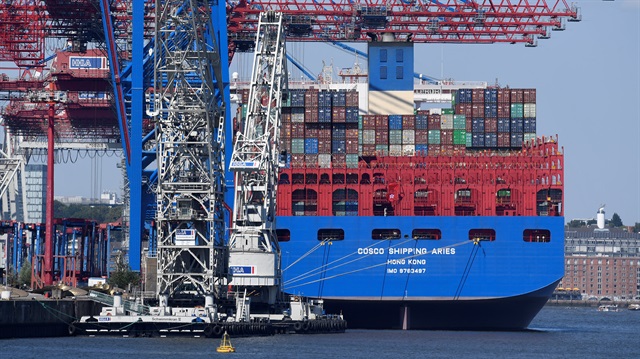
File Photo
China's exports surged more than expected in July despite U.S. duties and its closely watched surplus with the United States remained near record highs, as the world's two major economic powers ramp up a bitter dispute that some fear could derail global growth.
In the latest move by President Donald Trump to put pressure on Beijing to negotiate trade concessions, Washington is set to begin collecting 25 percent tariffs on another $16 billion in Chinese goods on Aug. 23.
In a statement on its official website late on Wednesday, China's commerce ministry criticised the U.S. move as being "unreasonable", saying it had no choice but to adopt the same measure on an equal amount of American goods ranging from oil and steel products to autos and medical equipment.
Wednesday's Chinese data provide the first readings of the overall trade picture for the world's second-largest economy since U.S duties on $34 billion of Chinese imports came into effect on July 6.
All the same, China's exports for July rose a bigger than expected 12.2 percent year-on-year, showing little tariff impact for now and beating June's 11.2 percent rise and analysts expectations in a Reuters poll for 10 percent growth.
Of more direct consequence in the Sino-U.S. trade war, China's surplus with the United States shrank only marginally to $28.09 billion last month from a record $28.97 billion in June. Washington has long criticised China's trade surplus with the United States and has demanded Beijing cut it.
Those demands could get even more strident if the yuan's sharp drop in recent months raises the ire of the United States, which has in the past repeatedly criticised Beijing for manipulating its currency to gain an unfair trade advantage.
Economists say China appears to be taking a more hands-off approach to the yuan, which marked its worst 4-month fall on record between April and July and has provided some reprieve for exporters in the face of the rising trade tensions.
ANZ senior China economist Betty Wang said Beijing will likely resist using its closely managed currency as a tool in the trade war. "Currency devaluation, which may have helped exports to some extent, has been largely market-driven in our view and is not a preferred policy tool by Chinese policy makers as part of the retaliation measures," Wang said.
China's trade with the U.S. also continued to rise in July despite the tariffs, with exports up 11.2 percent year-on-year, and imports increasing 11.1 percent.
Analysts still expect a less favourable overall trade balance for China in coming months given it's early days in the tariff brawl.
BEIJING BOOSTS LIQUIDITY SUPPORT
After a strong start to the year, growth in the world's second-largest economy cooled slightly in the second quarter, partly hit by the government's years-long efforts to tackle debt risks.
China's imports rose 27.3 percent year-on-year in July, in a sign domestic demand remains solid, but the worry is that the escalating Sino-U.S. trade war, rising corporate bankruptcies, and a steep decline in the yuan could put a significant dent on the economy.
The government has responded by releasing more liquidity into the banking system, encouraging lending and promising a more "active" fiscal policy.
World financial markets have taken a battering in recent months as fears grow that Trump's "America First" policies could derail a global economic revival.
Several large American companies have said they would adjust their supply chains to source outside of China if tariffs on Chinese goods impacted them, while China's Haier Group said rising steel prices amid hefty U.S. import tariffs was driving up costs for its business in America.
In a sign there may be more difficulties ahead, a private survey last week found that the business outlook among Chinese services firms was the second-weakest on record in July in part due worries about the trade war.
"STICK OF HEGEMONY"
China has repeatedly warned it will strike back against any further punitive measures by Trump, saying the United States is threatening the global free trade order with its protectionism.
Chinese state media, reflecting the government's stance, has said China will not be cowed in the face of U.S. threats.
The latest commentary from state media on Wednesday took a softer line after resorting to personal attacks against Trump earlier in the week, saying China could get through the storm but refrained from directly mentioning the U.S. president.
All China's main state newspapers published a lengthy commentary by the official Xinhua news agency, entitled "declaration", on their front pages.
"Certain people go against the tide for their own private ends and go against morality; the barrier of tariffs wantonly rise, and the stick of hegemony is raised all around," the commentary said.
"Although this may for a moment bring preening with delight, it will make it hard to resolve economic imbalances or out of kilter politics and other deep-rooted problems," it said.
China has not yet given a date for its previously announced retaliatory tariffs on $16 billion in U.S. goods, which will target commodities such as crude oil, natural gas, coal and some refined oil products.
The latest $16 billion list from the United States will hit semiconductors from China, even though many of the basic chips in these products originate from the United States, Taiwan or South Korea.
John Neuffer, president and CEO of the Semiconductor Industry Association, said in a statement they were disappointed and puzzled why semiconductors remain on the final tariff list.
"We have made the case to the Administration, in the strongest possible terms, that tariffs imposed on semiconductors imported from China will hurt America's chipmakers, not China's, and will do nothing to stop China's problematic and discriminatory trade practices," he said.
India doubled the import tax on more than 300 textile products to 20 percent on Tuesday as the world's biggest producer of cotton tries to curb rising imports from China.It was the second tax hike on textiles in as many months after an increase on other products including fibre and apparels last month.India asks telcos to block Facebook, WhatsApp in case of misuseThe moves are expected to provide relief to the domestic textile industry, which has been hit by cheaper imports. India's total textile imports jumped by 16 percent to a record $7 billion in the fiscal year to March 2018. Of this, about $3 billion were from China.The government did not disclose details of the 328 textile products that will be subject to the duty increase announced on Tuesday.Rising imports sent India's trade deficit with China in textile products to a record high $1.54 billion in 2017/18, alarming industry officials as India had been until recently a net exporter of textile products to China.China to add more cancer drugs to reimbursement list, talks end in SeptSanjay Jain, president of the Confederation of Indian Textile Industry, told Reuters he did not expect China to retaliate to the Indian duty increases as it still has a trade surplus with India.He said India's textile product imports could fall to $6 billion in 2018/19 as a result of the tax hike to 20 percent.India's imports of textile products from Bangladesh, Vietnam and Cambodia also jumped in the last few years as they are not subject to any duty under free trade agreements (FTA) signed by India with these countries.The 20 percent duty will not be applicable to products sourced from those countries due to the FTA, Jain said.Industry officials say in the last few months Chinese fibre has been shipped to Bangladesh and processed and exported to India with zero duty."Rules of origin need to be implemented for textile products. Otherwise Chinese products will land from other countries," said a Mumbai-based garment exporter, who declined to be named.Jain said India's textile and garment exports could rise 8 percent to $40 billion in 2018/19 due to a weak rupee and as the government is expected to introduce incentives to boost overseas sales.India's trade differences with the United States have also been rising since President Donald Trump took office.India, the world's biggest buyer of U.S. almonds, in June decided to raise import duties on almonds and some other U.S. imports by 20 percent, joining the European Union and China in retaliating against Trump's tariff hikes on steel and aluminium. The increased tariff on U.S. goods will be applicable from Sept. 18. 
India doubles import tax on textile products, may hit China
Chinese President Xi Jinping has congratulated Emmerson Mnangagwa on his election as Zimbabwe's president, state news agency Xinhua said on Tuesday, offering support after the African nation's opposition cried foul.Mnangagwa has urged Zimbabweans to unite after he was declared the first elected head of state since Robert Mugabe's removal from power, but the opposition leader has insisted he won and has pledged to challenge the result.China has close economic and diplomatic ties with Zimbabwe, which it has been keen to maintain after Mugabe's ouster last November in a de facto coup that brought his former ally Mnangagwa to power."In a congratulatory message dated Sunday, Xi expressed his wishes that the Zimbabwean government and people would make more achievements in national development under Mnangagwa's leadership," Xinhua said.Xi expects to meet Mnangagwa next month when he visits Beijing for a summit of Chinese and African leaders, it added."Xi said he hoped the meeting with Mnangagwa in Beijing could push forward the comprehensive strategic partnership of cooperation between the two countries."On Monday, Zimbabwe's main opposition said security forces were abducting its members in night raids to intimidate the party and stop it challenging Mnangagwa's win.Opposition leader Nelson Chamisa has rejected Mnangagwa's victory, and has promised to use legal and constitutional means to challenge the outcome. Zimbabwe opposition members in court over post-election violence, victims buriedZimbabwe's Mnangagwa calls for unity, rival questions election resultZimbabwe opposition leader demands 'proper, verified' election results
China congratulates Zimbabwe after disputed vote
Chinese state media on Monday lashed out at U.S. President Donald Trump's trade policies in an unusually personal attack, and sought to reassure investors worried about China's economy as growth concerns rattled its financial markets.China's strictly controlled news outlets have frequently rebuked the United States and the Trump administration as the trade conflict has escalated, but they have largely refrained from specifically targeting Trump.The latest criticism from the overseas edition of the ruling Communist Party's People's Daily newspaper singled out Trump, saying he was starring in his own "street fighter-style deceitful drama of extortion and intimidation".State media says China's response to latest US tariffs restrained, rationalTrump's desire for others to play along with his drama is "wishful thinking", a commentary on the paper's front page said, arguing that the United States had escalated trade friction with China and turned international trade into a "zero-sum game"."Governing a country is not like doing business," the paper said, adding that Trump's actions imperilled the national credibility of the United States.The heated dispute between the world's two biggest economies has roiled financial markets including stocks, currencies and the global trade of commodities from soybeans to coal in recent months.Trump adviser Kudlow warns China after new tariffs announcedThe United States and China implemented tariffs on $34 billion worth of each other's goods in July. Washington is expected to soon implement tariffs on an additional $16 billion of Chinese goods, which China has already said it will match immediately.On Friday, China's finance ministry unveiled new sets of additional tariffs on 5,207 goods imported from the United States worth $60 billion.That move was in response to the Trump administration's proposal of a 25-percent tariff on $200 billion worth of Chinese imports.The trade war, rising corporate bankruptcies, and a steep decline in the value of the yuan versus the dollar have raised concerns that China's economy could face a steeper slowdown.China unveils retaliatory tariffs on $60 billion of US goodsThe government has responded by releasing more liquidity into the banking system, encouraging lending and promising a more "active" fiscal policy.U.S. companies are putting in place measures to cushion the impact of the trade row, including price hikes, and a number of companies - from industrial firms to home furnishers and toymakers - have said they will move some sourcing and manufacturing outside of China.STOCK MARKET SWINGSThe paper's vitriol follows Trump's comments on Twitter from Saturday in which he boasted that his strategy of placing steep tariffs on Chinese imports was "working far better than anyone ever anticipated", and that Beijing was now talking to the United States about trade.Trump cited losses in China's stock market as he predicted the U.S. market could "go up dramatically" once trade deals were renegotiated.China's stocks were lower on Monday as Beijing's latest tariff threats escalated the tit-for-tat Sino-U.S. trade war, though the central bank's efforts to shore up the tumbling yuan helped to stabilise the currency.But a flurry of articles in Chinese state media emphasised the resilience of China's economy and downplayed concerns about the impact of the Sino-U.S. trade war."Market participants foresee a relatively stable Chinese currency in the near term, without fear of impacts from the U.S.-China trade dispute. They expect solid economic growth momentum amid policy fine-tuning," an article in the official English-language China Daily newspaper said, citing Chinese economists.On Friday, the People's Bank of China said it would require banks to keep reserves equivalent to 20 percent of their clients' foreign exchange forwards positions from Monday, in a move to stabilise the yuan."Leading China's economy on a stable and far-reaching path, we have confidence and determination," another commentary in the main edition of the People's Daily said.Trump has threatened tariffs on over $500 billion in Chinese goods, covering virtually all U.S. imports from the Asian giant, demanding that Beijing make fundamental changes to its policies on intellectual property protection, technology transfers and subsidies for high technology industries.The nationalist Global Times, responding in an editorial late on Sunday to White House economic adviser Larry Kudlow's remarks that China should not underestimate Trump's resolve, said China did not fear "sacrificing short-term interests"."China has time to fight to the end. Time will prove that the U.S. eventually makes a fool of itself," the Global Times said. Hardline US 'gundamentalists' pressure NRA from withinTrump aims tweet at LeBron James, questions his intelligenceTrump administration misled public on poverty: Report
Trump's trade 'extortion' won't work: Chinese state media