

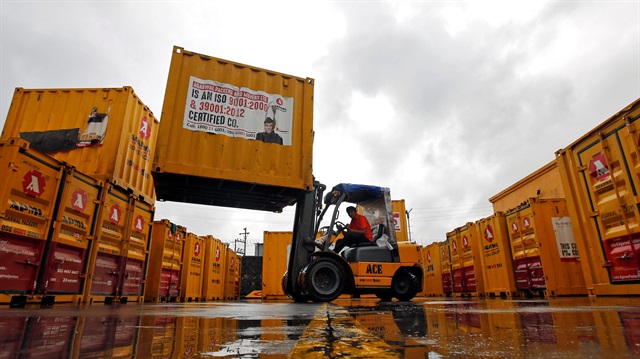
File photo
India doubled the import tax on more than 300 textile products to 20 percent on Tuesday as the world's biggest producer of cotton tries to curb rising imports from China.
It was the second tax hike on textiles in as many months after an increase on other products including fibre and apparels last month.
India has asked its telecom operators to find ways of blocking applications such as Facebook and messaging app WhatsApp in the case of misuse, according to a document seen by Reuters.India has in recent months intensified efforts to crack down on mass message forwards after it found that people were using social media and messaging apps to spread rumours and stoke public anger.WhatsApp in particular has faced the wrath of Indian regulators after false messages circulated on the messaging platform led to a series of lynchings and mob beatings across the country.The department of telecommunications in July asked Indian telecom service providers, as well as mobile and internet industry bodies, to "explore various possible options" to block such apps."You are ... requested to explore various possible options and confirm how the Instagram/Facebook/Whatsapp/Telegram and such other mobile apps can be blocked on internet," according to the government letter dated July 18 and seen by Reuters.Facebook Inc, which owns both WhatsApp and photo-sharing platform Instagram, declined to comment. Telegram did not immediately respond to a request for comment.A source at India's department of telecommunication said the letter was aimed at finding ways to block such apps during "emergency situations"."There is a need for a reasonable good solution to protect national security," said the official, who declined to be named.For WhatsApp, India is its biggest market with more than 200 million users and one where it says people forward more messages, photographs and videos than any other country.Following calls from the government to stem the platform's misuse, WhatsApp has moved to deter mass message forwards and launched an advertising campaign to educate consumers.In July, WhatsApp said message forwards will be limited to five chats at a time, whether among individuals or groups, and said it will remove the quick forward button placed next to media messages.Separately, India's federal police has begun probing Cambridge Analytica's misuse of Facebook user data, which New Delhi suspects included information on Indian users.Shutdown in Kashmir as rights law feared under threatIndian forces kill 5 in KashmirIndian troops kill five in Kashmir, draw protests
India asks telcos to block Facebook, WhatsApp in case of misuse
The moves are expected to provide relief to the domestic textile industry, which has been hit by cheaper imports. India's total textile imports jumped by 16 percent to a record $7 billion in the fiscal year to March 2018. Of this, about $3 billion were from China.
The government did not disclose details of the 328 textile products that will be subject to the duty increase announced on Tuesday.
Rising imports sent India's trade deficit with China in textile products to a record high $1.54 billion in 2017/18, alarming industry officials as India had been until recently a net exporter of textile products to China.
China plans to add a range of cancer drugs to medicines eligible for reimbursement from the government, the official Xinhua news agency said on Saturday, adding that negotiations on pricing with manufacturers should be finished by end-September.China's cancer rates have been soaring, driven by growing numbers of people in their sixties, heavy smoking among men and exposure to pollution.The drugs under discussion treat blood cancers and solid tumours, including colorectal cancer, renal cell carcinoma, lymphoma and chronic myelogenous leukaemia, according to Xinhua.The news comes after a low-budget Chinese movie released earlier this year told a story about a leukaemia patient who turns to smuggling cheap cancer drugs from India.The tale struck a chord with Internet users and even the country's leaders, spotlighting national anxieties about unaffordable hospital care. 
China to add more cancer drugs to reimbursement list, talks end in Sept
Sanjay Jain, president of the Confederation of Indian Textile Industry, told Reuters he did not expect China to retaliate to the Indian duty increases as it still has a trade surplus with India.
He said India's textile product imports could fall to $6 billion in 2018/19 as a result of the tax hike to 20 percent.
India's imports of textile products from Bangladesh, Vietnam and Cambodia also jumped in the last few years as they are not subject to any duty under free trade agreements (FTA) signed by India with these countries.
The 20 percent duty will not be applicable to products sourced from those countries due to the FTA, Jain said.
Industry officials say in the last few months Chinese fibre has been shipped to Bangladesh and processed and exported to India with zero duty.
"Rules of origin need to be implemented for textile products. Otherwise Chinese products will land from other countries," said a Mumbai-based garment exporter, who declined to be named.
Jain said India's textile and garment exports could rise 8 percent to $40 billion in 2018/19 due to a weak rupee and as the government is expected to introduce incentives to boost overseas sales.
India's trade differences with the United States have also been rising since President Donald Trump took office.
India, the world's biggest buyer of U.S. almonds, in June decided to raise import duties on almonds and some other U.S. imports by 20 percent, joining the European Union and China in retaliating against Trump's tariff hikes on steel and aluminium. The increased tariff on U.S. goods will be applicable from Sept. 18.