

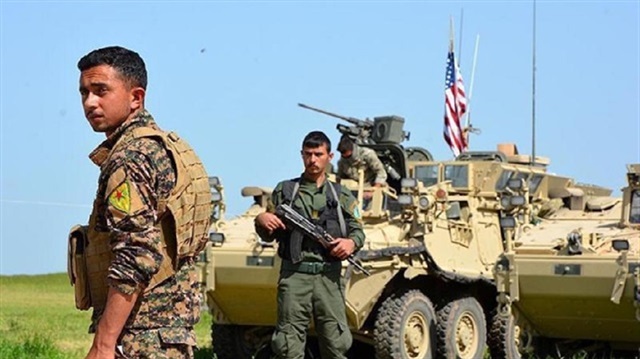
File photo
At least 40 Daesh terrorists were released from the prisons of the Kurdistan Workers’ Party (PKK) terror organization’s Syria affiliate, the People’s Protection Units (YPG), in the Raqqa town of Tal Abyad in exchange for ransoms.
The destination the freed Daesh prisoners were sent to so far remains unknown.
As Turkey launched Operation Olive Branch in Syria’s Afrin, YPG/PKK terrorists released Daesh prisoners from its detention centers under the condition that they fight against the Turkish Armed Forces and Free Syrian Army fighters.
The Washington administration, which intends to maintain a permanent presence in Syria, has completed the construction of three advanced radar systems in Syria’s Hasakah-Tal Baidar countryside along with the Ayn al-Arab and Sarrin regions, and has set up 13 portable and fixed observation-intelligence radar systems.Speaking to Yeni Şafak daily, former Commander of Syria's Deir Ezzor Military Assembly Fayez al-Esmer evaluated the U.S.’s latest moves in Syria and said that in an addition to all attempts to protect Kurdistan Workers’ Party (PKK) terrorists in the region, Pentagon is in preparation to set up a missile defense shield in Syria’s Hasakah and Rmeilan.“The U.S.’s next step is to build a missile defense shield in the region which must be considered as a part of Washington’s long-term plan for chaos in the region,” he said.The U.S. has already begun to create a new no-fly-zone in northern Syria, the same tactic used in the 1991 occupation of Iraq, and started to install advanced radar systems in a 26,000 square kilometer area occupied by the Syrian affiliate of the Kurdistan Workers’ Party (PKK), the PYD, east of the Euphrates. US sets up radars in northern Syria to ‘protect PKK terrorists’Alternatives to Incirlik Air Base Additionally, the U.S administration is looking for alternatives to Incirlik Air Base because of its current strained relationship with Turkey.Incirlik Air base was used during the defeated 15 July coup attempt to aid terrorists of the Fetullah Terrorist Organization (FETÖ) as well as to provide logistics support to Kurdistan Workers’ Party (PKK) in Syria.U.S. warplanes at Incirlik Air Base were moved to other bases, and only cargo planes, refueling aircraft, and scout planes remain.Lately, the U.S. is converting its bases into aerial operation centers in Iraq’s Al Asad, Ayn al-Asad, Qayyarah, as well as those in Rimeylan, Ayn el Arab, Tal Baidar and Sarrin in Syria.Turkey and the U.S. are currently experiencing rocky relations following Washington’s imposition of sanctions on Interior Minister Süleyman Soylu and Justice Minister Abdülhamit Gül for not releasing American Pastor Andrew Brunson, who faces terrorism charges in Turkey.U.S. President Donald Trump ramped up his attack on Turkey by doubling U.S. tariffs on Turkish aluminum and steel imports to 20 percent and 50 percent, respectively. They will monitor Turkey from the border Stressing Pentagon’s lengthy plan for chaos in the region, al-Esmer said that all these steps indicate that the U.S. administration intends to strengthen its presence in Syria while providing support to PKK terrorists.The advanced radar systems will especially be used to monitor Turkey’s air and ground operations at the border, he added.Esmer also said that U.S. warplanes will be more active in the regions of Hasakah, Raqqa and Deir ez-zor and that information received from these points will be transferred to the air forces to create a protection shield.He stressed that all these initiatives must be considered as moves to “intimidate” Turkey, Russia and Iran.Russia and Turkey, along with Iran are sponsoring the Astana peace talks, which focuses on a cease-fire and ending the seven-year civil war in Syria.“The Washington administration has realized that the PKK is insufficient regarding its plans related to east of the Euphrates. Therefore, it will further fortify its military presence in the region. On the other hand, U.S. activities carried out in Syria and Iraq is due to its determination to exploit underground resources,” Esmer added.The U.S has supplied the PYD terror organization and its armed wing, the YPG, with more than 5,000 truckloads of weapons to allegedly use in the fight against Daesh, despite Ankara’s warnings that the fact they are the Syrian offshoots of the PKK terror organization.Russia says sees signs US preparing for possible strike on Syria836 detainees die in Syrian regime prisons: NGODriven from home, White Helmet rescuers start over in north SyriaIran and Syria sign deal for military cooperation
‘US seeks to strengthen presence in Syria by setting up missile defense shield’
The U.S. is in preparation to create a new no-fly-zone in northern Syria, the same tactic used in the 1991 occupation of Iraq, and has already started to install advanced radar systems in Kobani and Hasakah, areas occupied by the Syrian affiliate of the Kurdistan Workers’ Party (PKK), the PYD, east of the Euphrates.The advanced radar installation has been established at U.S. bases at the Ayn al-Arab military airport and the town of Rumeilan in Hasakah Province, according to sources.Pentagon’s preparation for a no-fly-zone indicates that the U.S. administration also wants to interfere in Turkey’s military operations to ensure the safety of PKK terrorists after Ankara’s successful ops conducted in Syria’s Hasakah, Qarrah Chouk Mountains and Iraq’s Sinjar.'Issue not about myself, but Turkey, Islam': ErdoğanTurkey, US conduct 35th round of patrols in ManbijUS wants to protect terrorists against TurkeySpeaking to Yeni Şafak daily, Prof Dr. Mahir Nakip, head of international relations at Çankaya University and originally from Kirkuk, stressed that the “no fly zone” strategy, which will be used in Syria, is the same one used to divide Iraq and is an attempt to protect terrorists from Turkish aerial elements.Turkey launched Operation Olive Branch on Jan. 20, 2018 in Syria’s northwestern region of Afrin to eradicate the area of terrorists belonging to the Kurdistan Workers’ Party (PKK)’s Syrian offshoot, the Democratic Union Party (PYD), following Turkey’s seven-month Euphrates Shield Operation which succeeded in clearing large swathes of Syrian territory from Daesh. “The U.S. was the only actor in Iraq in the entire process. In Syria, things will not proceed as the U.S. wants. The regional actors’ determination and influence, notably Turkey’s, will negate the U.S. plan,” he stated.Two separate no-fly zones in Iraq were proclaimed by the United States, United Kingdom, and France after the Gulf War of 1991 to protect PKK terrorists in northern Iraq.Nakip also stated that the U.S. is aiming to extend the scope of this strategy implemented in northern Syria to Iraq’s Sinjar. “Terrorists deployed in Hasakah, Qarrah Chouk and the Sinjar Mountain area have been hit by Turkish warplanes and will continue to be. The U.S. is clearly trying to ensure safety of the area it designated to the PKK.”The PKK is listed as a terrorist organization by Turkey, the European Union and the United States.No chance of success“The U.S. has no chance of success because Syria is not Iraq. Turkey-Russia-Iran continue to collaborate on peace-oriented initiatives.”The Astana peace talks were launched on Jan. 23-24, 2017 by Turkey, Iran and Russia with the aim of putting an end to violence and improving the humanitarian situation in war-torn Syria.Syria has been locked in a vicious civil war since early 2011 when the Assad regime cracked down on pro-democracy protests with unexpected ferocity.Turkish army destroys PKK weapons cache in northern IraqTurkish operation in Syria foiled PKK/YPG terror plotsNorthwest Syria returns to normal after Turkish operation
US sets up radars in northern Syria to ‘protect PKK terrorists’
On Jan. 20 Turkey launched Operation Olive Branch to remove YPG/PKK and Daesh terrorists from Afrin. On March 18, Turkish troops and the Free Syrian Army liberated the Afrin district center.
Last October, YPG/PKK terrorists, who are currently occupying about 28 percent of Syria, evacuated a large number of Daesh terrorists from the city center of Raqqa after reaching an agreement with the terror group.
The PKK is listed as a terrorist organization by Turkey as well as the U.S. and the EU.
In its terror campaign against Turkey, which has lasted for more than three decades, over 40,000 people have been killed, including women and children.
Secret witnesses in the case of U.S. pastor Andrew Craig Brunson have come forth with shocking claims, alleging that he welcomed Kurdistan Workers’ Party (PKK) sympathizers and organized secret meetings at the Evangelical Resurrection Church.In a statement dated July 20, 2017, M.C. stated that he became Christian 13 years ago at a church in Turkey’s Izmir and consistently attended congregations. M.C. met Brunson and someone called Erik Wiger in 2008 at the Resurrection Church, and observed that the pastor attempted to Christianize Kurds while Wiger was constantly traveling overseas.Brunson and Wiger could be U.S. intelligence agents“I clearly saw in the masses I attended that these individuals (Brunson and Wiger) had serious plans for the Kurdish people. They were very interested in them. When Erik Wiger was in Turkey, he especially conducted activities in the southeast. I heard this from H.T., who met with him in Turkey and is also a Christian who serves in the Navy. I think that Brunson and Wiger work for American intelligence services. These individuals always support Kurds in Turkey and used to say that ‘South Kurdistan’ would be established,” M.C. said in the indictment.Pastor Brunson’s ‘godson’ served as link to PKK: reportsPKK terrorists gather at Resurrection ChurchSecret witness “Göktaşı” claimed that there is a link between the PKK and Brunson, adding that many Syrian migrants and Kurds visit the Resurrection Church, and that they are led by Syrian national known only as Mehmet and B.Y., who are members of the PKK cadre.Göktaşı stated that various individuals, one called Emin and another dubbed Agit, disappeared suddenly after periods of regularly visiting the church. Göktaşı said that he believes that these individuals went to join the PKK’s cadre up in the mountains during their mysterious disappearances.US pastor's lawyer plans appeal to Turkish constitutional courtBrunson’s church hosts secret meetingsThe secret witness added that sometimes the church would host meetings that were not previously set, and that Brunson’s wife Norin and Kurdish leaders B.Y., Syrian Mehmet and Agit would participate. Göktaşı said that nobody from the church congregation was allowed to attend, and that sometimes the meetings would be held in Brunson’s home.Göktaşı claimed that once Brunson was imprisoned, B.Y. took leadership of the church and organized activities in support of the PKK. The secret witness added that hundreds of Arabic Bibles and references were printed at a firm called M.Y. to teach Kurds and Christians in Syria Christianity.G.D., who served as assistant pastor at Izmir’s St. Antoine Church between 2005 and 2011, said t-shirts emblazoned with the PKK’s so-called emblem arrived at the Resurrection Church during some church services, and terror sympathizers spoke in favor of the PKK.Trump using Brunson to rally evangelical votes: reportFETÖ linkThe indictment states that photographs of decryption efforts for terrorists of the Fetullah Terrorist Organization (FETÖ) were shown to G.D., and it was found that Brunson was in close contact with FETÖ-linked M.S. and the terror group’s Aegean region administrator Bekir Baz’s assistant.Brunson is charged with spying for the PKK -- a designated terrorist group in the U.S. and Turkey -- and FETÖ, the group behind the defeated July 2016 coup attempt in Turkey which martyred 251 people and injured thousands.Turkey and the U.S. are currently experiencing rocky relations following Washington’s imposition of sanctions on Interior Minister Süleyman Soylu and Justice Minister Abdulhamit Gül for not releasing the pastor. The sanctions were followed by U.S President Donald Trump increasing tariffs on Turkish imports, which Turkey responded to by imposing customs duties on several U.S.-origin products, including alcohol and tobacco products and cars.
Secret witnesses reveal pastor Brunson’s terror links