

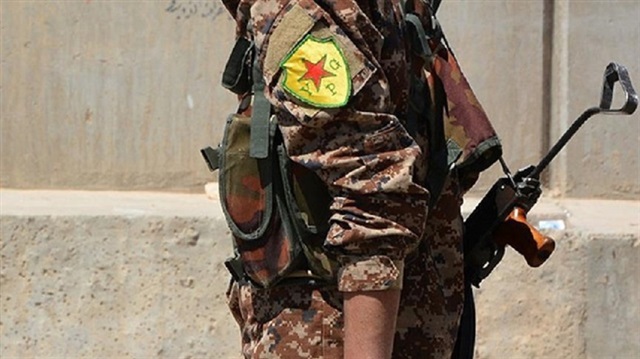
File photo
The YPG/PKK terrorist group has continued to abduct civilians and impose curfews in Syria’s northern city of Ayn al-Arab (Kobani), according to local sources.
The group has recently imposed a curfew in the majority-Arab town of Al-Qubba -- located on Ayn al-Arab’s outskirts -- and 10 nearby villages.
Within the last two days alone, the YPG/PKK has abducted 26 people, including three women, over allegations they were “collaborating” with the Free Syrian Army before releasing them Friday.
Local sources also said the group had ransacked private homes in the area and seized private property.
Arab residents of Al-Qubba are opposed to the group’s continued presence in the town and would like to see it expelled entirely from the region.
The Syrian affiliate of the PKK terrorist group, the YPG/PKK currently holds an estimated 28 percent of Syrian territory.
Syria has only just begun to emerge from a devastating conflict that began in 2011 when the Assad regime cracked down on demonstrators with unexpected ferocity.
Iran has at least 120,000 foreign terrorists fighting in alliance with the Bashar al-Assad regime in Syria since the civil war began in 2011. Some 22 groups surrounded Idlib from three directions, and are currently present in 232 points. For a long time, the Assad regime has been conducting its military operations against the opponents in Syria not through its own army, but mainly through Iran-backed foreign forces. These groups are stationed predominantly in Idlib, Damascus, Homs, the countryside of Deir-Ez Zor and particularly on the Lebanese border. According to the information compiled by Anadolu Agency reporters from media outlets of Iran-backed foreign terrorist groups, Iranian media and opponents in Syria; the Tehran administration started sending militias to Syria in the first months of 2014. Details of Turkish-Russian Idlib deal revealedSyrian opponents also fought with Iran-backed Hezbollah militias before. Hezbollah first gave support to the regime during its operations near the Lebanese border late 2012. Six months later, the group announced its entity and support to the regime in al-Qusayr district of the countryside of Homs. During this period, commanders of the Iranian Revolutionary Guards were regarded as “consultants” in conflict zones and military educations fields, while the soldiers of the guards were regarded as “fighters.”Apart from being involved in the war physically, the Revolutionary Guards provided training and logistic support to militias fighting in Syria. UK thanks Turkey for its 'longstanding role' in SyriaIran’s involvement increase after opponents take Idlib The involvement of the Iranian forces to the conflict field on the side of the Assad regime has intensified after the Syrian opponents took complete control of Idlib and came close to Latakia in early 2015. Early 2015, Bashar al-Assad confessed that his army was in a difficult situation and the numbers of the soldiers decreased. The Iranian army and intelligence, which wanted to keep the regime alive, had tens of thousands of terrorist fighters -- brought from Iraq, Lebanon, Afghanistan, and Pakistan -- enter Syria. These forces actually took the active role in Madaya, al-Zabadani and Barada Valley -- where deaths occurred from starvation and tens of thousands of civilians were blockaded. The militias planted mines near residential areas, depriving civilians from humanitarian aid. As the humanitarian tragedy was beyond endurance, locals and civilian opponents had to flee the region. Thus, the mandatory evacuation process started. Turkish-made drones to monitor implementation of Idlib agreementMost conflicts erupted in Aleppo Iran-backed forces conducted their most intensive attacks on Aleppo, where they were settled since early 2014. The forces surrendered Aleppo to the regime following a 4 month-tragedy, where hundreds of thousands of people were living under siege. The forces evacuated the entire Homs, Eastern Ghouta, Dara and Quneitra regions within 4 months, via the attack-blockade-deportation method. Iran-backed foreign terrorist groups then headed towards Idlib. The groups piling up for the last three months blockaded Idlib from the east, west and the south. Syrians ‘still need our help’: UN aid coordinatorHalf of Iran-backed groups in Syria focused on IdlibIt is known that more than 120,000 Iran-backed groups exist in Syria. Nearly half of these forces are already stationed around Idlib. 22 Iran-backed foreign terrorist groups surrounding Idlib’s de-escalation zone from three directions are present in 232 different points. 12 groups stationed in the east of Idlib and western Aleppo are as follows:Afghan-origin Fatemiyoun and Pakistan-origin Zainabiyoun brigades, Iraqi-origin al-Nujaba movement, Badr Forces, Imam Ali and Imam Hossein Brigades, Lebanese Hezbollah, Bakr Brigades, Iranian-origin Quds forces and Mahdi Army, Syrian Galibiyyun Brigades and Owner of Rights Units. Demilitarization agreement heartens civilians in IdlibIn Syria, there are other groups as well; such as Iranian-origin Basij Brigades, Liwa Zainebiyoun Brigades, Palestinian-origin Quds Brigades, Iranian Revolutionary Guards and its special forces. According to the sources speaking to an Anadolu Agency correspondent in Idlib, these groups, which are deployed in Homs and Damascus will also come to Idlib in case of a possible military operation.Iran’s losses Iran lost senior figures during the operations conducted against the Syrian opponents. According to the information compiled by Anadolu Agency from Iranian official and semi-official media outlets, at least 15 generals were killed since Feb. 2013. Iran’s heaviest toll in Syria was Hossein Hamadani, an Iranian Revolutionary Guard commander, who was killed in Aleppo in 2015.Syria has been locked in a vicious civil war since early 2011 when the Assad regime cracked down on protesters with unexpected ferocity. Since then, hundreds of thousands of people are believed to have been killed and millions more displaced by the conflict.
Syria’s Idlib under siege by foreign terrorists
Turkiye Diyanet Foundation (TDV) General Director Mehmet Savaş Polat said Thursday they had taken all measures for a possible migration movement in Syria's northwestern Idlib."As TDV teams, we have taken all measures in case of a possible migration movement in Idlib," Polat said in a statement.Polat said teams were coordinating in Syria for preparations on measures to take before the potential migration movements reached the border.He said 2,000 children were receiving education in Idlib with the foundation's support. All stationery expenses of the pupils are covered by TDV and 100 teachers are employed at these schools.The TDV has opened four shops distributing free clothes in Idlib. It also hands out 70,000 loaves of bread a day to families in need, Polat said.Polat also said that 15,000 hot meals and loaves of bread for 90,000 people are provided daily to the families living in camps in Syria's northwestern Azaz and al-Bab.He said there were three outlets distibuting free clothes operating in these areas.Polat added that Turkey's top religious authority Diyanet and TDV had restored 113 mosques in Syria's northwestern Afrin and al-Bab, which were damaged by terror groups' attacks.The statement also said that since the start of Syrian civil war, TDV has provided aid worth 200 million Turkish liras ($32 million) and sent 1,850 aid trucks to the region.Mental health center for refugees opens in AnkaraIsraeli air force chief to visit Moscow amid Syria rowDetails of Turkish-Russian Idlib deal revealed
Turkish foundation ready for Syrian migration wave
German Chancellor Angela Merkel discussed recent developments in Syria with Russian President Vladimir Putin over the phone, her office said on Wednesday.Government spokesperson Steffen Seibert said in a statement that the leaders mainly talked about the recent agreement between Turkey and Russia to establish a demilitarized zone in Syria's northwestern Idlib province.“The chancellor welcomed the efforts aimed at preventing a military escalation and protecting the civilian population,” Seibert said.The two leaders also addressed the situation in eastern Ukraine and the humanitarian issues, he added.On Monday, Turkey and Russia agreed to establish a demilitarized zone in Idlib, Syria’s last opposition stronghold, following a meeting in Sochi between Turkish President Recep Tayyip Erdogan and Putin.Ankara and Moscow also signed a memorandum of understanding calling for the “stabilization” of Idlib's de-escalation zone, in which acts of aggression are expressly prohibited.According to the MoU, opposition groups in Idlib will remain in areas where they are already present.Turkish and Russian military forces, meanwhile, will conduct joint patrols along the zone's perimeter with a view to preventing any renewal of fighting.Located near the Turkish border, Idlib is home to more than three million Syrians, many of whom fled from other cities following attacks by regime forces.The Syrian regime announced plans last month to launch a major military offensive in the area, long controlled by various armed opposition groups.But, the UN warned that such an offensive would lead to the "worst humanitarian catastrophe in the 21st century".European media praise Russian-Turkish summit on SyriaForeign troops reach significant numbers in Syria and Iraq Russia says Syria shot down one of its military planes, blames IsraelSyrian opposition says Turkish-Russian deal excludes Idlib attackFrance says not involved in disappearance of Russian plane over Syria'Turkey-Russia deal on Idlib ends Assad dream to regain control over Syria'
German Chancellor discusses Syria with Russia's Putin
The U.S. State Department omitted the PYD/YPG terrorist group from its 2017 Country Reports on Terrorism, which was released Wednesday. The previous edition of the report noted that Turkey views the Syria-based PYD/YPG as an extension of the PKK terror group.With this move, Washington has made public its support of terrorism and its desire to split Syria. The activity in the region shows that Washington is laying the foundations for a terror state.Arms deploymentThe U.S. has accelerated its arms deployment to the PYD/PKK terror group. The U.S. dispatched 250 heavy weapons and armored vehicles to the Democratic Syrian Armed Forces (SDF), which is dominated by the YPG, in June. Over 200 trucks loaded with supplies were sent to the SDF on Aug. 6, and another deployment of several armored vehicles and 250 trucks with weapons and ammunition was sent on Aug. 15.The Syrian Observatory for Human Rights reported that over 1,200 shipments and trucks entered Syria in August alone.Syria’s Idlib under siege by foreign terroristsOccupation expandingThe PKK/YPG claims that the U.S.-supplied weapons will be used in an offensive against Daesh, however the Syrian Observatory for Human Rights has reported that Washington is working to expand several bases in Kobani, Aleppo and Hasakah.The PKK/YPG is extending its occupation to the east of the Euphrates with Washington’s support. Raqqa and Deir ez-Zor are under the siege of the terror group under the guise of fighting against Daesh. The terror group has also taken control of the region’s petrol and water sources.The YPG-dominated SDF controls an area of about 53,000 square kilometers with a percentage of 28.6 of Syrian territory.Details of Turkish-Russian Idlib deal revealedNew administration in NE Syria formed with Washington’s supportWith the support of the U.S., a new administration was created for northeastern Syria during a meeting for the Syrian Democratic Council (SDC) in Ayn Issa in early September. The new administration has been dubbed a coordination body that will connect the self-administrations of the Kurdish majority areas and the civil administrations in Arab majority areas that have their own civil councils.The self-administrations in the Euphrates, Afrin, and Jazeera region with the civil councils in Raqqa, Manbij, Tabqa, and Deir ez-Zor will be linked by the new administration.Top U.S. official visits terror groupWilliam Roebuck, the U.S. ambassador to Bahrain, visited northern Syria on Aug. 26 amid negotiations between the so-called Rojava canton and Damascus over the future of the region.“We are prepared to stay here, as the president (Donald Trump) has made clear,” Roebuck said during his trip.James Jeffrey, the former U.S. ambassador to Turkey who was named U.S. special representative to Syria on Aug. 17, echoed Roebuck’s sentiment as he declared that Washington would remain in the region until it was completely cleared of Daesh.US removes PYD/YPG from annual terrorism reportThe U.S has supplied the PYD terror organization and its armed wing, the YPG, with more than 5,000 truckloads of weapons to allegedly use in the fight against Daesh, despite Ankara’s warnings that the fact they are the Syrian offshoots of the PKK terror organization.Pentagon’s no-fly zone strategyThe Washington administration, which intends to maintain a permanent presence in Syria, has completed the construction of three advanced radar systems in Syria’s Hasakah-Tal Baidar countryside along with the Ayn al-Arab and Sarrin regions, and has set up 13 portable and fixed observation-intelligence radar systems.Pentagon’s preparation for a no-fly-zone indicates that the U.S. administration also wants to interfere in Turkey’s military operations to ensure the safety of PKK terrorists after Ankara’s successful ops conducted in Syria’s Hasakah, Qarrah Chouk Mountains and Iraq’s Sinjar.Sean Ryan, spokesperson for the U.S.-led Coalition against Daesh stated: “The Coalition installs satellites or other necessary equipment wherever needed within our area of operations.”US sends Castle International mercenaries to fight alongside YPG/PKK in SyriaU.S. spreads bases across SyriaWith its initial base establishing activities that were initiated in October 2015, Washington set up two air bases in al-Hasakah, and eight operational military bases in Raqqa and Manbij. Since July 2017, the U.S. has established five new bases, two of which were constructed in Manbij and close to the Euphrates Shield area. Two military bases were also established southwest of Tal Abyad.U.S. sends mercenaries to fight alongside YPG/PKK in SyriaIt has been found that the U.S. works with Castle International, an American giant in the international military services marketplace, in Syria.Specialized in aviation and medical support, Castle International mercenaries are employed by the U.S. in order to fight alongside YPG/PKK terrorists in Syria. Castle International’s social media accounts posted photographs of heavily armed commandos fighting and training beside YPG/PKK terrorists.
US bolsters support to PKK terror group in Syria