

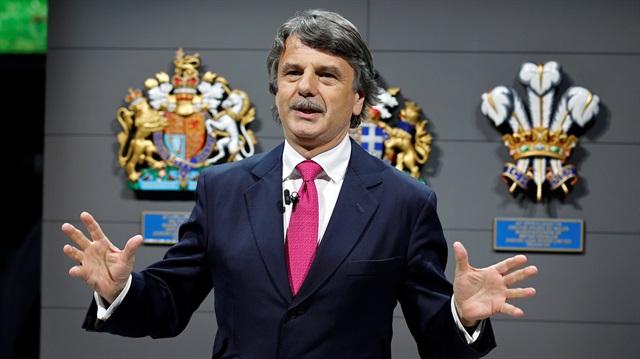
Dr Ralf Speth, Chief Executive Officier of Jaguar Land Rover
The wrong Brexit deal could cost tens of thousands of jobs, the boss of Britain's biggest carmaker Jaguar Land Rover warned on Tuesday, saying he had no idea whether his plants would be able to operate after Britain leaves the EU on March 29 next year.
Ralf Speth told a conference in Birmingham, central England, that JLR had lost a thousand jobs as a result of diesel policy "and those numbers will be counted in the tens of thousands if we do not get the right Brexit deal".
"Brexit is due to happen on the 29th March next year. Currently I do not even know if any of our manufacturing facilities in the UK will be able to function on the 30th," Speth said.
Lawmakers from British Prime Minister Theresa May's Conservative Party can vote against her Brexit plans without it being a vote of confidence in her government, the head of an influential group of pro-Brexit lawmakers said on Tuesday.Brexiteers have said as many as 80 of May's 315 lawmakers could vote against her so-called Chequers plan, leaving the fate of the government and the Brexit deal in the hands of the opposition Labour Party.If she loses that vote, Britain could leave the EU without a deal, an outcome some believe would spark a crisis of confidence that could cost her the premiership.UK finance minister says time running out on Brexit; BoE governor to stay onJacob Rees-Mogg, chair of the European Research Group, a faction within May's Conservatives, plans to vote against the Chequers deal but said that does not mean May has to go."The vote on the legislation will not be a vote of confidence," Rees-Mogg, tipped by some as a possible successor to May, told a pro-Brexit event in parliament."We can vote down the bad Chequers proposals on Monday and support the government in a vote of confidence on Tuesday. They are separate things and trying to align them I think is a mistake. So we can carry on supporting the prime minister but we can oppose this policy until it is changed or collapses."'EU Salzburg summit is a staging post in Brexit talks'
Rejecting Brexit plan is not a confidence vote on UK PM May: Conservative lawmaker
Britain's finance minister Philip Hammond said on Tuesday time was running out to secure a Brexit deal and confirmed that Bank of England Governor Mark Carney had agreed to stay to help the country through "a turbulent period" for its economy.Hammond said the government was devoting all its efforts to securing a deal on a new relationship with the European Union before Britain leaves the bloc in March next year but admitted the clock was ticking."Time is running out. We are working against the clock, we understand that," Hammond told parliament. "We will be working flat out over the coming weeks and months to achieve (a deal)."'EU Salzburg summit is a staging post in Brexit talks'Hammond also confirmed that Carney, who said last week he was prepared to stay in his job beyond next June when his term was due to end, had agreed to remain until 2020."I have been discussing with the governor his ability to be able to serve a little longer in post in order to ensure continuity through what could be quite a turbulent period for our economy in the early summer of 2019," Hammond said."I can tell the House today that the governor has agreed, despite various personal pressures to conclude his term in June, that he will continue until the end of January 2020, in order to help support continuity in our economy during this period."UK govt refuses to say if it has taken legal advice on second Brexit referendumThe United Kingdom will leave the EU on March 29 but as yet no full exit deal has been agreed and many lawmakers in Prime Minister Theresa May's own party object to her own so-called Chequers proposals.Her spokesman said May saw an informal EU summit in Salzburg next week as a "staging post" in Brexit negotiations that would allow EU leaders to discuss her proposals for the first time."It will also be the first time the leaders will discuss together the UK government's white paper which put forward a series of credible and serious proposals," he told reporters.'UK PM May's Brexit plans opposed by 80 rebels in her party'The Chequers proposals envisage continued close trade ties with the EU after Brexit.The EU's chief Brexit negotiator, Michel Barnier, has criticised aspects of May's blueprint but said on Monday he believed a Brexit deal was possible "within six or eight weeks", in comments that lifted the pound currency against the euro and dollar. 
UK finance minister says time running out on Brexit; BoE governor to stay on
British Prime Minister Theresa May sees an informal EU summit next week as a "staging post" in Brexit negotiations, that will allow the bloc's leaders to discuss her proposals to leave the European Union for the first time."The PM said that next Wednesday she will travel to Salzburg to attend the EU informal council which will be both a staging post in exit negotiations and an opportunity to engage with the rest of the EU on shared challenges," her spokesman said, describing a meeting of her cabinet of top ministers."It will also be the first time the leaders will discuss together the UK government's white paper which put forward a series of credible and serious proposals," he told reporters, referring to May's so-called Chequers plan. UK govt refuses to say if it has taken legal advice on second Brexit referendumBritish PM May hopes parliament will support her Brexit planSterling edges up after biggest weekly drop in a month'UK PM May's Brexit plans opposed by 80 rebels in her party'
'EU Salzburg summit is a staging post in Brexit talks'