

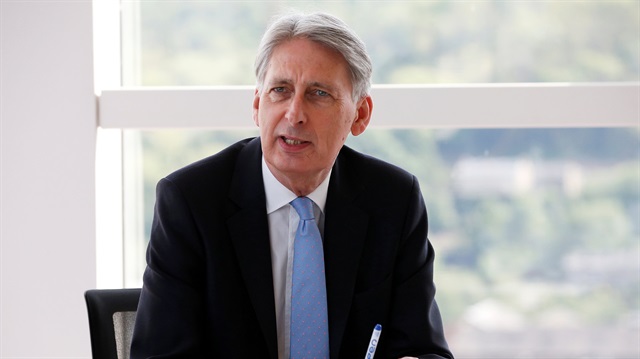
Britain's Chancellor of the Exchequer Philip Hammond
Britain's finance minister Philip Hammond said on Tuesday time was running out to secure a Brexit deal and confirmed that Bank of England Governor Mark Carney had agreed to stay to help the country through "a turbulent period" for its economy.
Hammond said the government was devoting all its efforts to securing a deal on a new relationship with the European Union before Britain leaves the bloc in March next year but admitted the clock was ticking.
"Time is running out. We are working against the clock, we understand that," Hammond told parliament. "We will be working flat out over the coming weeks and months to achieve (a deal)."
British Prime Minister Theresa May sees an informal EU summit next week as a "staging post" in Brexit negotiations, that will allow the bloc's leaders to discuss her proposals to leave the European Union for the first time."The PM said that next Wednesday she will travel to Salzburg to attend the EU informal council which will be both a staging post in exit negotiations and an opportunity to engage with the rest of the EU on shared challenges," her spokesman said, describing a meeting of her cabinet of top ministers."It will also be the first time the leaders will discuss together the UK government's white paper which put forward a series of credible and serious proposals," he told reporters, referring to May's so-called Chequers plan. UK govt refuses to say if it has taken legal advice on second Brexit referendumBritish PM May hopes parliament will support her Brexit planSterling edges up after biggest weekly drop in a month'UK PM May's Brexit plans opposed by 80 rebels in her party'
'EU Salzburg summit is a staging post in Brexit talks'
Hammond also confirmed that Carney, who said last week he was prepared to stay in his job beyond next June when his term was due to end, had agreed to remain until 2020.
"I have been discussing with the governor his ability to be able to serve a little longer in post in order to ensure continuity through what could be quite a turbulent period for our economy in the early summer of 2019," Hammond said.
"I can tell the House today that the governor has agreed, despite various personal pressures to conclude his term in June, that he will continue until the end of January 2020, in order to help support continuity in our economy during this period."
The British government has refused to confirm whether it has taken legal advice on holding a second referendum on the final Brexit deal, saying revealing such information would harm its negotiating position in talks with Brussels.The Brexit department, which oversees the negotiations on Britain's departure from the European Union next year, made the comment in response to a Reuters query submitted under the Freedom of Information law.With less than seven months until Brexit day and Prime Minister Theresa May's Brexit plans under fire, some lawmakers and business leaders are increasingly arguing for people to have a final say on any deal with Brussels.British PM May hopes parliament will support her Brexit planMay has repeatedly ruled out holding a second referendum following the vote two years ago to leave the EU. However, several lawmakers in her Conservative Party back the idea of what is known as a "people's vote", and opposition Labour Party leader Jeremy Corbyn is under pressure to voice his support.Britain's Trades Union Congress, a group of 48 labour unions, added to the pressure on Sunday, with General Secretary Frances O'Grady saying it would back a referendum if May fails to get a deal that will support workers.Asked by Reuters what legal advice it had received this year on holding a second referendum, the Brexit department said there was a public interest in refusing to confirm or deny whether it had such information.Sterling edges up after biggest weekly drop in a month"There is a very strong public interest in the most effective pursuance of the UK’s national interests abroad," the department said in a letter."It is necessary to consider whether the act of confirming or denying whether we hold information ... would be likely to prejudice the government's negotiating position, which would be detrimental to the UK’s relationships with other states, and with European institutions, and would prejudice the promotion and protection of the UK’s interests abroad."The department said it had concluded "the public interest favours maintaining the exclusion" of its duty to reveal whether or not it holds such information.'UK PM May's Brexit plans opposed by 80 rebels in her party'It gave the same answer to a request for information on whether it had taken legal advice on the reversibility of Article 50, the notice of the intention to leave the EU.Brexit minister Dominic Raab said last week that the prospect of a second referendum would invite Brussels to offer Britain the "very worst terms" in any Brexit deal.Britain is due to leave the EU on March 29 but has yet to reach a deal with Brussels on the terms of its departure. May has said members of parliament will get to vote on whether to accept any final deal.In the June 2016 referendum 51.9 percent backed leaving the EU, while 48.1 percent favoured staying. Opinion polls show Britons remain divided over Brexit, though some recent surveys have shown a swing towards support for staying in the EU.A YouGov poll, conducted July 31-Aug. 7 and commissioned by the pro-referendum "People's Vote" campaign, found 45 percent of voters supported holding a new referendum whatever the outcome of talks with the EU, while 34 percent opposed it. 
UK govt refuses to say if it has taken legal advice on second Brexit referendum
The United Kingdom will leave the EU on March 29 but as yet no full exit deal has been agreed and many lawmakers in Prime Minister Theresa May's own party object to her own so-called Chequers proposals.
Her spokesman said May saw an informal EU summit in Salzburg next week as a "staging post" in Brexit negotiations that would allow EU leaders to discuss her proposals for the first time.
"It will also be the first time the leaders will discuss together the UK government's white paper which put forward a series of credible and serious proposals," he told reporters.
British Prime Minister Theresa May's Conservative Party faces a "catastrophic split" if she persists with her so-called Chequers proposals on Brexit and 80 or more of her lawmakers are prepared to vote against the proposals, a former junior minister said.Steve Baker, a former junior Brexit minister who resigned over May's Brexit proposals, told the Press Association that he was not advocating a change of leader but warned May faced a massive problem at the Sept. 30-Oct. 3 party conference."If we come out of conference with her hoping to get Chequers through on the back of Labour votes, I think the EU negotiators would probably understand that if that were done, the Tory party would suffer the catastrophic split which thus far we have managed to avoid," Baker was quoted as saying.UK Trade unions back second Brexit referendumMay's Brexit plans like wrapping 'suicide vest' around UK, says JohnsonBritain must focus on moving ahead with May's Brexit plan: ministerIrish PM says no 'dramatic moves' to report in Brexit talks
'UK PM May's Brexit plans opposed by 80 rebels in her party'
The Chequers proposals envisage continued close trade ties with the EU after Brexit.
The EU's chief Brexit negotiator, Michel Barnier, has criticised aspects of May's blueprint but said on Monday he believed a Brexit deal was possible "within six or eight weeks", in comments that lifted the pound currency against the euro and dollar.