

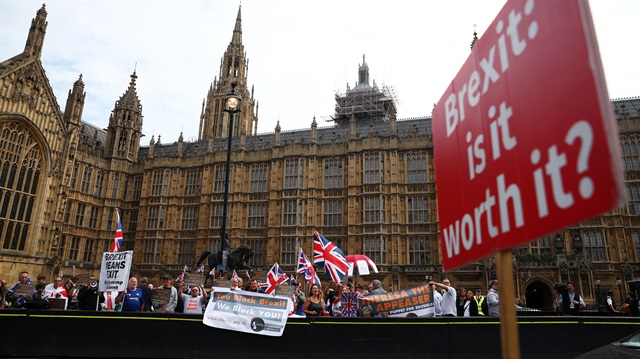
Pro and anti Brexit protesters demonstrate on opposite sides of the road outside the Houses of Parliament in London, Britain, September 5, 2018.
The British government has refused to confirm whether it has taken legal advice on holding a second referendum on the final Brexit deal, saying revealing such information would harm its negotiating position in talks with Brussels.
The Brexit department, which oversees the negotiations on Britain's departure from the European Union next year, made the comment in response to a Reuters query submitted under the Freedom of Information law.
With less than seven months until Brexit day and Prime Minister Theresa May's Brexit plans under fire, some lawmakers and business leaders are increasingly arguing for people to have a final say on any deal with Brussels.
Prime Minister Theresa May hopes parliament will support her plan for Brexit, her spokesman said on Monday, adding it was the only one on the table which delivered on the will of the British people while avoiding a hard border in Northern Ireland.Earlier on Monday a former junior minister warned May's Conservative Party faces a "catastrophic split" if she persists with her so-called Chequers plan, which he said 80 or more of her lawmakers are prepared to vote against."Chequers is the only plan on the table which will deliver on the will of the British people while avoiding a hard border in Northern Ireland. The prime minister is working hard to secure a deal and hopes all MPs (members of parliament) will be able to support it," the spokesman said.He said her cabinet top team of ministers would meet on Thursday to discuss preparations for a possible 'no deal' Brexit. Sterling edges up after biggest weekly drop in a month'UK PM May's Brexit plans opposed by 80 rebels in her party'
British PM May hopes parliament will support her Brexit plan
May has repeatedly ruled out holding a second referendum following the vote two years ago to leave the EU. However, several lawmakers in her Conservative Party back the idea of what is known as a "people's vote", and opposition Labour Party leader Jeremy Corbyn is under pressure to voice his support.
Britain's Trades Union Congress, a group of 48 labour unions, added to the pressure on Sunday, with General Secretary Frances O'Grady saying it would back a referendum if May fails to get a deal that will support workers.
Asked by Reuters what legal advice it had received this year on holding a second referendum, the Brexit department said there was a public interest in refusing to confirm or deny whether it had such information.
Sterling edged higher on Monday after posting its biggest weekly drop in a month last week against a broadly stable dollar as investors cut some large short positions, but Brexit concerns checked the gains.On Monday, the pound edged a fifth of a percent higher at $1.2935 after falling 0.3 percent last week, its biggest drop since early August.On the broader market, dollar bulls pared some of their aggressive long positions before strong U.S. jobs data last week, with the main beneficiaries being sterling and the euro.Against the euro, the British currency was broadly flat at 89.40 pence.Prime Minister Theresa May's Conservative Party faces a catastrophic split if she persists with her "Chequers" proposals, a former junior minister said. Steve Baker, an-ex Brexit minister who resigned over May's proposals for negotiating Britain's departure form the European Union and its future relationship with the bloc, said 80 or more of her lawmakers are prepared to vote against the plan.Such public criticism, just a day after her former foreign minister, Boris Johnson, cast part of the plan as "a suicide vest" wrapped around the British constitution, indicates the level of opposition within the party.The British currency had a volatile week as headlines on the progress of Brexit negotiations forced traders to switch positions rapidly in a currency market that is broadly short on the pound, based on positioning data.A Reuters poll showed that sterling could rise as much as six percent in a year, but a Brexit without any deal between London and Brussels could see it falling as much as eight percent from current levels.
Sterling edges up after biggest weekly drop in a month
"There is a very strong public interest in the most effective pursuance of the UK’s national interests abroad," the department said in a letter.
"It is necessary to consider whether the act of confirming or denying whether we hold information ... would be likely to prejudice the government's negotiating position, which would be detrimental to the UK’s relationships with other states, and with European institutions, and would prejudice the promotion and protection of the UK’s interests abroad."
The department said it had concluded "the public interest favours maintaining the exclusion" of its duty to reveal whether or not it holds such information.
British Prime Minister Theresa May's Conservative Party faces a "catastrophic split" if she persists with her so-called Chequers proposals on Brexit and 80 or more of her lawmakers are prepared to vote against the proposals, a former junior minister said.Steve Baker, a former junior Brexit minister who resigned over May's Brexit proposals, told the Press Association that he was not advocating a change of leader but warned May faced a massive problem at the Sept. 30-Oct. 3 party conference."If we come out of conference with her hoping to get Chequers through on the back of Labour votes, I think the EU negotiators would probably understand that if that were done, the Tory party would suffer the catastrophic split which thus far we have managed to avoid," Baker was quoted as saying.UK Trade unions back second Brexit referendumMay's Brexit plans like wrapping 'suicide vest' around UK, says JohnsonBritain must focus on moving ahead with May's Brexit plan: ministerIrish PM says no 'dramatic moves' to report in Brexit talks
'UK PM May's Brexit plans opposed by 80 rebels in her party'
It gave the same answer to a request for information on whether it had taken legal advice on the reversibility of Article 50, the notice of the intention to leave the EU.
Brexit minister Dominic Raab said last week that the prospect of a second referendum would invite Brussels to offer Britain the "very worst terms" in any Brexit deal.
Britain is due to leave the EU on March 29 but has yet to reach a deal with Brussels on the terms of its departure. May has said members of parliament will get to vote on whether to accept any final deal.
In the June 2016 referendum 51.9 percent backed leaving the EU, while 48.1 percent favoured staying. Opinion polls show Britons remain divided over Brexit, though some recent surveys have shown a swing towards support for staying in the EU.
A YouGov poll, conducted July 31-Aug. 7 and commissioned by the pro-referendum "People's Vote" campaign, found 45 percent of voters supported holding a new referendum whatever the outcome of talks with the EU, while 34 percent opposed it.