

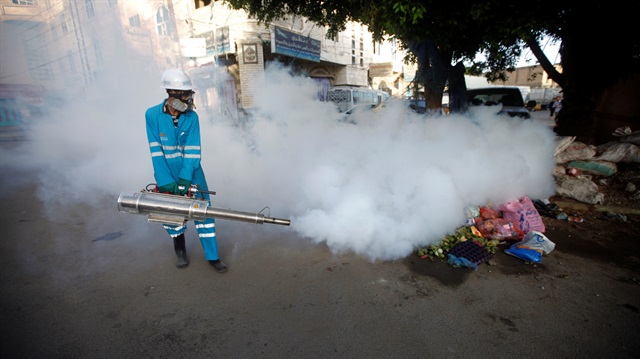
Public health workers spray insecticide amid fears of a new cholera outbreak in Sanaa, Yemen June 7, 2018.
Yemen may be on the brink of a new cholera epidemic, with a heightened death rate due to widespread malnutrition, and the United Nations is hoping for a ceasefire in the north to allow for vaccinations, the World Health Organization said on Friday.
“We’ve had two major waves of cholera epidemics in recent years and unfortunately the trend data that we've seen in the last days to weeks suggests that we may be on the cusp of the third major wave of cholera epidemics in Yemen," WHO emergency response chief Peter Salama told reporters in Geneva.
"We're calling on all parties to the conflict to act in accordance with international humanitarian law and to respect the request of the U.N. and international community for three full days of tranquillity and to lay down arms to allow us to vaccinate the civilian population for cholera."
Northern Yemen has never had an oral cholera vaccination campaign, but 3,000 healthworkers plan to vaccinate more than 500,000 people over the next three days in and around the city of Hodeidah, the Arabian Peninsula country's main port and a key element in U.N. plans for a political solution to the war.
UN Special Envoy to Yemen Martin Griffiths said Thursday he plans to invite Yemen’s warring parties to Geneva for peace talks on Sept. 6.Speaking at a meeting of the UN Security Council, Griffiths said it is time to resume a political process in Yemen to resolve the crisis, alluding to previous peace talks that failed.Griffiths said the September talks "will provide the opportunity for the parties, among other things, to discuss the framework for negotiations, relevant confidence-building measures and specific plans for moving the process forward".Armed tribesmen block highway in Yemen’s AdenAccording to Griffiths, the war has intensified -- particularly in the city of Hudaydah -- despite all efforts to end it.Shuttling between the warring parties to avert a coalition assault on Al Hudaydah, Griffiths recently visited Yemen for peace talks with Houthi rebels to end the four-year conflict."We have tried to find a way to avoid a battle for the city and the port of Al Hudaydah, and we are still trying," he told the council, describing the Red Sea as a platform for a "war theatre".Yemen’s Houthis propose ceasefire initiativeCalling on the parties to avoid any actions that would worsen the humanitarian catastrophe in the country and undermine a political solution, he urged them to create a favorable environment for a political process.According to John Ging, director of the Operational Division at the UN Office for the Coordination of Humanitarian Affairs, 75 percent of Yemen’s population, or roughly 22 million people, are in need of humanitarian assistance and protection.Impoverished Yemen has remained wracked by violence since 2014, when Shia Houthi rebels overran much of the country, including the capital, Sanaa, and Al Hudaydah.High-ranking Yemeni spy assassinated in YemenThe conflict escalated in 2015 when Saudi Arabia and its Sunni-Arab allies launched a massive air campaign in Yemen aimed at rolling back Houthi gains.The violence has devastated Yemen’s infrastructure, including its health and sanitation systems, prompting the UN to describe the situation as “one of the worst humanitarian disasters of modern times”.
Yemen peace talks set for September: UN envoy
On Thursday, Saudi-led air strikes hit a fishing port and fish market in Hodeidah, which is held by Iran-aligned Houthi forces, and 26 people were killed, Yemeni medical sources said.
Al Thawra Hospital, Yemen's biggest, was caught in the attack.
Lise Grande, the U.N. humanitarian coordinator for Yemen, said in a statement that hundreds of thousands of people depended on the hospital to survive.
“Every day this week we have seen new cholera cases in Hodeidah, and now this. The impact of the strikes is appalling. Everything we are trying to do to stem the world’s worst cholera epidemic is at risk.”
Salama said the main hospital building remained intact but many subsidiary departments, especially the statistical department, were hit, affecting workers preparing for the cholera campaign.
This year's cholera incidence was not at the massive level seen a year ago, when case numbers surged to an eventual 1.1 million, but the steady recent increase pointed to a new outbreak beginning, he said.
Previous outbreaks might have helped build cholera immunity in the population, but other diseases, as well as malnutrition, have weakened Yemenis' immune systems.
"What we're likely to see is that interplay with cholera and malnutrition occurring more and more...and not only more cases because of that but even higher death rates among the cholera cases that do occur, because people just don't have the physical resources to fight the disease any longer," Salama said.