

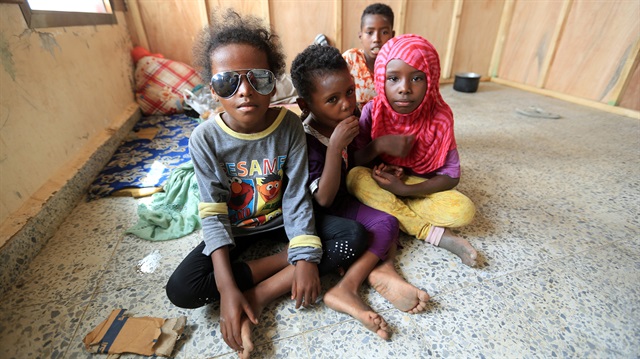
Displaced children sit in a school where they live with their family in al-Qatea near Hodeidah, Yemen.
UN Special Envoy to Yemen Martin Griffiths said Thursday he plans to invite Yemen’s warring parties to Geneva for peace talks on Sept. 6.
Speaking at a meeting of the UN Security Council, Griffiths said it is time to resume a political process in Yemen to resolve the crisis, alluding to previous peace talks that failed.
Griffiths said the September talks "will provide the opportunity for the parties, among other things, to discuss the framework for negotiations, relevant confidence-building measures and specific plans for moving the process forward".
Armed tribesmen on Thursday continued to block a main road in Yemen’s coastal Aden province for the second day in a row, according to witnesses.Members of Yemen’s Yafei tribe reportedly blocked the highway to protest a recent decision by local authorities to release several individuals accused of killing one of their number in May.Yemen’s Houthis propose ceasefire initiativeHigh-ranking Yemeni spy assassinated in YemenAccording to witnesses, tribesmen brandishing heavy weapons -- including anti-aircraft batteries -- used military vehicles to block the thoroughfare.For the last three years, the city of Aden -- which since 2015 has served as Yemen’s interim capital -- has seen sporadic attacks on security forces, judicial officials and religious figures.Impoverished Yemen has remained wracked by violence since 2014, when Shia Houthi rebels overran much of the country, including capital Sanaa.
Armed tribesmen block highway in Yemen’s Aden
According to Griffiths, the war has intensified -- particularly in the city of Hudaydah -- despite all efforts to end it.
Shuttling between the warring parties to avert a coalition assault on Al Hudaydah, Griffiths recently visited Yemen for peace talks with Houthi rebels to end the four-year conflict.
"We have tried to find a way to avoid a battle for the city and the port of Al Hudaydah, and we are still trying," he told the council, describing the Red Sea as a platform for a "war theatre".
A leader of Yemen’s Houthi rebel group on Tuesday unveiled an initiative aimed at halting all military activity in the war-weary country.In a post on Twitter, Mohamed Ali al-Houthi, head of the group’s so-called Supreme Revolutionary Commission, reiterated calls for a “political solution” to the almost four-year-old conflict.“Our initiative would include instructions from Yemeni official parties [in reference to Houthi institutions] to halt all military and naval operations for a specified, renewable period,” he said.Al-Houthi voiced hope that a Saudi-led military coalition -- cobbled together in 2015 to fight the rebel group -- would reciprocate “if they really want peace for the Yemeni people”.Early Wednesday, al-Houthi tweeted again, saying they have halted naval operations for two weeks. "The unilateral ceasefire that has started tonight at 00.00 (2100GMT) will continue until Aug. 15 at 00.00 (2100GMT). However, if there is a positive response from coalition forces, this period can be extended," he said.The Yemeni government, which is currently headquartered in the coastal city of Aden and which is closely supported by the Saudi-led coalition, has yet to issue a formal response to the proposal.The government, however, has previously said it would not negotiate with the rebel group until the latter surrendered the strategic Red Sea port of Al-Hudaydah.While the Houthis have rejected the notion of a unilateral withdrawal from Al-Hudaydah, they have nevertheless voiced their readiness to accept a supervisory role by the UN over the seaport.Earlier this month, UN special envoy to Yemen Martin Griffiths proposed a plan by which the Houthis would pull out of Al-Hudaydah, after which Yemeni police and UN observers would fill the vacuum.In June, Yemeni government forces backed by the Saudi-led coalition launched a wide-ranging operation aimed at retaking Al-Hudaydah and its strategic seaport from the rebels.But the United Arab Emirates, a leading member of the coalition, later announced a pause in the operation in hopes of persuading the Houthis to voluntarily leave the coastal province.Impoverished Yemen has remained wracked by violence since 2014, when the Shia Houthis overran much of the country, including the capital, Sanaa, forcing the country’s pro-Saudi government to take up residence in Aden.The conflict escalated in 2015 when Saudi Arabia and its Sunni-Arab allies launched a massive air campaign in Yemen aimed at rolling back Houthi gains.The violence has devastated Yemen’s infrastructure, including health and sanitation systems, prompting the UN to describe the situation as “one of the worst humanitarian disasters of modern times”.Yemeni army reportedly gains ground east of SanaaParty leader injured in Yemen's Aden attack
Yemen’s Houthis propose ceasefire initiative
Calling on the parties to avoid any actions that would worsen the humanitarian catastrophe in the country and undermine a political solution, he urged them to create a favorable environment for a political process.
According to John Ging, director of the Operational Division at the UN Office for the Coordination of Humanitarian Affairs, 75 percent of Yemen’s population, or roughly 22 million people, are in need of humanitarian assistance and protection.
Impoverished Yemen has remained wracked by violence since 2014, when Shia Houthi rebels overran much of the country, including the capital, Sanaa, and Al Hudaydah.
A high-ranking Yemeni intelligence officer was assassinated in the capital Aden, according to security sources.Colonel Nasser Makrij, a former intelligence officer, was assassinated in front of his house, security sources, speaking on the condition of anonymity, said.Makrij was rushed to hospital but later scummed to his injuries. At least 36 Houthi rebels killed in Yemen clashesImpoverished Yemen has remained wracked by violence since 2014, when Shia Houthi rebels overran much of the country, including capital Sanaa.The conflict escalated in 2015 when Saudi Arabia and its Sunni-Arab allies launched a massive air campaign in Yemen aimed at rolling back Houthi gains.
High-ranking Yemeni spy assassinated in Yemen
The conflict escalated in 2015 when Saudi Arabia and its Sunni-Arab allies launched a massive air campaign in Yemen aimed at rolling back Houthi gains.
The violence has devastated Yemen’s infrastructure, including its health and sanitation systems, prompting the UN to describe the situation as “one of the worst humanitarian disasters of modern times”.