

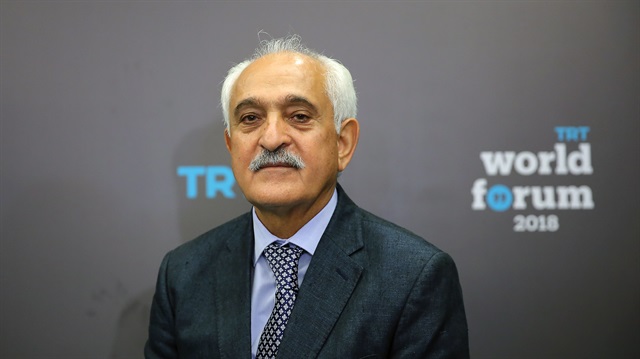
Former Afghan Foreign Minister Rangin Dadfar Spanta
The new U.S. strategy toward Afghanistan and South Asia has failed and there is still instability in Afghanistan, said the former Afghan FM.
Rangin Dadfar Spanta, who once served as the national security advisor of former Afghan President Hamid Karzai, spoke about the current security situation in the country to Anadolu Agency.
“The government's control of important regions in the country has ended. We can say that the U.S. strategy was defeated,” Spanta said. “The U.S. president’s [Donald Trump] strategy hasn’t left a positive impact on the security situation in the country, and there is still instability in Afghanistan."
Spanta went onto say that it was important for the Afghan government to expand the regions it controlled and implement the rule of law in these regions, but there were even more problems now compared to past years.
Touching on the claims of nine U.S. bases in Afghanistan, he said: “The situation of military bases is based on agreements signed between Washington and Kabul. These bases were given to the use of the U.S. So, both Afghanistan and the U.S. should adhere to their obligations.”
He said the essence of the matter was that Washington did not stick to its commitments to Afghanistan.
“For this reason, we need to review the security agreement with Washington for a better implementation of the agreement and the fulfillment of U.S. promises.”
In 2014, Kabul signed the Bilateral Security Agreement (BSA) with Washington aimed to handle its presence after the end of its combat mission that same year.
Recently, Afghanistan has been considering a review of the BSA over the U.S.’s alleged failure to head off rising violence and a spate of Taliban attacks.
- Peace talks between Afghanistan and Taliban
Spanta said peace talks between Afghanistan and the Taliban were not possible.
“Both the Kabul government and Afghan High Peace Council confessed [this] a few days earlier,” he said, adding that it was foreign powers like the U.S., Russia and the Central Asia countries, who established a dialogue with the Taliban.
“The Afghans, despite being the owner of the land, didn’t take part in the peace talks,” he said.
He also said that Zalmay Khalilzad, the new U.S. special envoy for Afghanistan, could play a more important role in talks between Afghanistan and the Taliban than the former diplomats, who did not know the country well enough.
Also mentioning the matters of dispute between Afghanistan and Pakistan, he reminded Turkey was playing a mediator role between the two countries.
“Considering Turkey’s friendly and brotherly relations with the two countries, I believe that Turkey will play a very positive and valuable mediator role in the future,” he said.
We have destroyed the cultural backbone of the other for many years, said a French research director from the Institute of Research and Study on the Arab and Muslim Worlds (IREMAM).“During, let’s take the rhythm of our relations to Algeria, since 1830, we destroyed the institutional, political, military, cultural backbone of the other. We were the other. The other had to be us,” said Francois Burgat to Anadolu Agency.Speaking on the rise of racism in Europe, Burgat said: “We were in a situation of complete hegemony on the Muslim world. This was during the colonial period.“So this is where we come from.”Burgat said that the “previous dominant” found himself in a newfound position.“He [the dominant] has to accept that he is no longer the unique reference for modernity, the good or the progress,” he said. “He has to accept the fact that the other nations on the earth have equal rights.”Burgat recalled the episode involving Turkish-German footballer Mesut Ozil who quit from the German national team in July, citing racial discrimination.Since May, Ozil was criticized by German politicians and media outlets, for meeting Turkish President Recep Tayyip Erdogan in London ahead of June 24 elections in Turkey.'Unilateralism, racism top causes of global insecurity'Racism and Islamophobia connectedHe added that similar situations were experienced in France some 20 years ago.“Zinedine Zidane, for instance, was the target of these kind of expressions,” he said, mentioning the Algerian-origin footballer of the French national team.“Before the Germany incident, in France many people used to say; immigrants are French when they score a goal in football and they are immigrants when they lose,” he added.Stating that “the enemy, or the other” was an Arab some 20 years ago, now it has become “a Muslim”, Burgat said racism and Islamophobia were connected.“The identity of the other has just moved from racial understanding to religious understanding,” he added.“Thirty years ago, my father was working in a steel factory in the French Alps. He said to me, ‘Look Francois, these buses, for years we have sent them empty toward Morocco. A specific region of Morocco, [the northern region of] Rif. And they came back full.And if this process hadn’t been going for 10 or 15 years, the company wouldn’t be what it is nowadays.”He underlined that Christianity was not the only legitimate ground for a multicultural society in the Europe, and added each religion had its own unique features.
'France destroyed cultural backbone of others'