

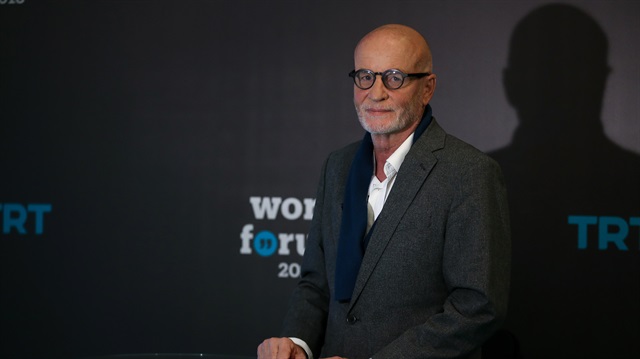
Francois Burgat, French research director from the Institute of Research and Study on the Arab and Muslim Worlds (IREMAM)
We have destroyed the cultural backbone of the other for many years, said a French research director from the Institute of Research and Study on the Arab and Muslim Worlds (IREMAM).
“During, let’s take the rhythm of our relations to Algeria, since 1830, we destroyed the institutional, political, military, cultural backbone of the other. We were the other. The other had to be us,” said Francois Burgat to Anadolu Agency.
Speaking on the rise of racism in Europe, Burgat said: “We were in a situation of complete hegemony on the Muslim world. This was during the colonial period.
“So this is where we come from.”
Burgat said that the “previous dominant” found himself in a newfound position.
“He [the dominant] has to accept that he is no longer the unique reference for modernity, the good or the progress,” he said. “He has to accept the fact that the other nations on the earth have equal rights.”
Burgat recalled the episode involving Turkish-German footballer Mesut Ozil who quit from the German national team in July, citing racial discrimination.
Since May, Ozil was criticized by German politicians and media outlets, for meeting Turkish President Recep Tayyip Erdogan in London ahead of June 24 elections in Turkey.
Presidential spokesman Ibrahim Kalın blamed on Thursday increasing "unilateralism" and "racism" for the insecurity and crises across the world."The world feels insecure in the face of increasing unilateralism and racism and when one world leader tells another that they can't survive even for two weeks without his help," Kalın told a session of the TRT World Forum in Istanbul themed "Regional Players and the Shifting Security Equation in the Middle East".On Wednesday, U.S. President Donald Trump warned that Saudi Arabia would be unlikely to last a fortnight without military assistance from Washington."The problem of security is a global problem. It is not just about Muslim countries. It is not just about Muslim nations or the Middle East. I feel very insecure when I see the rising Islamophobia in Europe," he said."In fact, it is generated by the failures of the regional countries, no doubt, and regional actors, but it is also exacerbated by the global powers.""Every time we think of the Middle East, we think of conflict and war, but this was not the story of the region until a century ago. Yet only a few centuries ago, many countries that make up the Middle East today were home to many luminaries," he noted.Video: 'Unilateralism, racism top causes of global insecurity'Idlib deal happened thanks to ErdoğanOver a deal between Turkey and Russia to save civilians in Syria's Idlib from a military offensive by the Assad regime, Kalın said, "the agreement is certainly the best news we have.""The deal is there thanks to tireless efforts by our President Recep Tayyip Erdogan who made it happen.”Noting Turkey cannot carry this burden on its own, Kalın said: "You see these shifting policies of key players in Syria from the United States to […] Gulf countries and others. And that creates not only a lot of confusion but also a loss of trust on the ground.”The presidential spokesman noted that the U.S. said the country was in Syria to eliminate Daesh but "as they said Daesh [is] largely defeated."Following a meeting in Sochi, Russia, last month between Turkish President Recep Tayyip Erdogan and his Russian counterpart Vladimir Putin, the two countries agreed to establish a demilitarized zone in Idlib, Syria’s last opposition stronghold.Ankara and Moscow also signed a memorandum of understanding calling for the “stabilization” of Idlib's de-escalation zone, in which acts of aggression are expressly prohibited.Under the deal, opposition groups in Idlib will remain in areas in which they are already present, while Russia and Turkey will conduct joint patrols in the area with a view to preventing renewed fighting.Syria has only just begun to emerge from a devastating conflict that began in 2011 when the Assad regime cracked down on demonstrators with unexpected ferocity.
'Unilateralism, racism top causes of global insecurity'
Racism and Islamophobia connected
He added that similar situations were experienced in France some 20 years ago.
“Zinedine Zidane, for instance, was the target of these kind of expressions,” he said, mentioning the Algerian-origin footballer of the French national team.
“Before the Germany incident, in France many people used to say; immigrants are French when they score a goal in football and they are immigrants when they lose,” he added.
Stating that “the enemy, or the other” was an Arab some 20 years ago, now it has become “a Muslim”, Burgat said racism and Islamophobia were connected.
“The identity of the other has just moved from racial understanding to religious understanding,” he added.
“Thirty years ago, my father was working in a steel factory in the French Alps. He said to me, ‘Look Francois, these buses, for years we have sent them empty toward Morocco. A specific region of Morocco, [the northern region of] Rif. And they came back full.
And if this process hadn’t been going for 10 or 15 years, the company wouldn’t be what it is nowadays.”
He underlined that Christianity was not the only legitimate ground for a multicultural society in the Europe, and added each religion had its own unique features.