

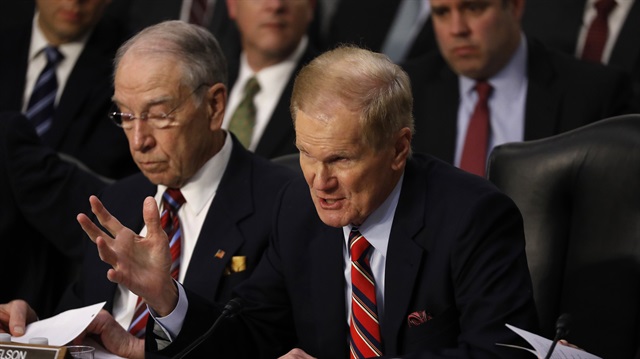
Sen. Bill Nelson
Russian operatives have penetrated some of Florida's election systems and could delete registered voters ahead of the November elections if the systems are not adequately protected, Florida U.S. Senator Bill Nelson told the Tampa Bay Times on Wednesday.
"They have already penetrated certain counties in the state and they now have free rein to move about," Nelson told the newspaper, which posted an audio recording of the interview on its website.
Democrat Nelson and Republican Senator Marco Rubio of Florida wrote a letter last month to the state's 67 county election supervisors about potential threats, the newspaper said. But that letter lacked the specificity Nelson has laid out, according to the Times.
"We were requested by the chairman and vice chairman of the (Senate) Intelligence Committee to let supervisors of election in Florida know that the Russians are in their records," Nelson told the newspaper.
But the state department that oversees elections pushed back against Nelson's comments, saying it received "zero information" from Nelson, federal or state agencies to support the infiltration claim. Nelson is running for re-election in November against Florida Governor Rick Scott.
"If Senator Nelson has specific information about threats to our elections, he should share it with election officials in Florida,” said Sarah Revell, spokeswoman for the Florida Department of State, adding that state and local officials received funding to strengthen the security of election systems.
Rubio's office declined comment. The Senate Intelligence Committee did not immediately respond to requests for comment.
"This is no fooling time and that's why two senators, bipartisan, reached out to the election apparatus of Florida to let them know the Russians are in your records and all they have to do, if those election records are not protected, is to go in and start eliminating registered voters," Nelson told the Times.
"You can imagine the chaos that would occur on Election Day when the voters get to the polls" and discover they are no longer registered, he said.
U.S. intelligence agencies have concluded that Russian operatives targeted the 2016 presidential race with a hacking and disinformation campaign to try to tilt the election in President Donald Trump's favor. They said they found no evidence vote tallies were changed.
U.S. intelligence officials have said Russian election interference efforts are continuing and now target the Nov. 6 elections.
Republican U.S. Senator Rand Paul said on Wednesday he delivered a letter from President Donald Trump to the Russian government during a trip to Moscow."I was honored to deliver a letter from President Trump to President Vladimir Putin’s administration. The letter emphasized the importance of further engagement in various areas including countering terrorism, enhancing legislative dialogue and resuming cultural exchanges," Paul wrote in a Twitter post.I was honored to deliver a letter from President Trump to President Vladimir Putin’s administration. The letter emphasized the importance of further engagement in various areas including countering terrorism, enhancing legislative dialogue and resuming cultural exchanges.— Senator Rand Paul (@RandPaul) 8 Ağustos 2018 The White House had no immediate comment on the letter.Paul, an ally of Trump, said he had traveled to the Russian capital to encourage diplomacy amid tense relations between Moscow and Washington.On Monday, he invited Russian lawmakers to visit Washington after holding talks in Moscow with parliamentarians and pledging to block new sanctions against Russia.U.S. intelligence agencies say Russia interfered in the 2016 U.S. presidential election to try to tilt the race in Trump’s favor, an assertion Moscow rejects. The two countries are also at odds over Syria and Ukraine. 
US Senator Paul delivers letter from Trump to Putin
The goal of U.S. economic sanctions against Iran is a great threat for the country. In the first phase, the U.S. wants to lead Iran into a state of introversion and for it to retreat from regions such as Syria, Lebanon, Iraq, Palestine and Yemen.If the sanctions are long-term it could jeopardize Iran policies. The most serious threat is triggering an atmosphere of chaos, which would lead to a division of the country by causing financial difficulties and increasing unemployment rates.The sanctions target Tehran's acquisition of U.S. dollars, the trade of precious metals, transactions related to Iran's rial, activities relating to Iran's sovereign debt, and the country's automotive sector.Stating that the Trump administration was using Iran as domestic political leverage ahead of November's midterm elections in the states, Iranian President Hassan Rouhani said, "They want to launch psychological warfare against the Iranian nation.Iran links talks with US to lifting of sanctionsThe first round of the U.S. sanctions were re-imposed early Tuesday under an executive order, and President Donald Trump, who defied Washington’s allies, pledged that companies doing business with Tehran would be barred from doing business with the United States.Iran dismissed a last-minute offer from the Trump administration for talks, saying it could not negotiate while Washington had reneged on a 2015 deal to lift sanctions in return for curbs on Iran’s nuclear program.Iran FM slams US sanctionsIn May, Trump withdrew the U.S. from a nuclear deal, which was signed in 2015 between Iran and the P5+1 group of nations (the five permanent members of the UN Security Council plus Germany).The nuclear deal places restrictions on Iran’s nuclear program in exchange for billions of dollars in sanctions relief.US will not be able to prevent Iran from exporting oil: Iranian FMSanctions could lead the region to chaosThis unpredictable attempt is being evaluated as the beginning of a process that needs to be followed carefully. It is emphasized that Iran should take measures to protect its integrity and deliver calming and uniting messages to its nation and neighbors, because the region cannot overcome another war after those in Syria and Iraq.On the other hand, the PKK-linked and U.S.-backed the Kurdistan Free Life Party (PJAK) terror organization is another threat Iran may have to deal with, as terrorists could take this chaos as an opportunity to ramp up their attacks.
US seeks to trigger chaos in Iran by reinstating sanctions
The U.S. on Tuesday set a wide-ranging list of $16 billion worth of Chinese goods that will be hit with a 25 percent tariff later this month in the latest trade escalation between Washington and Beijing.Customs and Border Protection will start to collect the duties on 279 of an original list of 284 product lines beginning Aug. 23, according to the Office of the U.S. Trade Representative.Affected goods include AC and DC motors, voltage-current regulators, steam turbines, railway cars, antennas and integrated circuits.Chinese exports accelerate as US prepares new tariffsThe U.S. in early July imposed 25 percent tariffs on $34 billion in Chinese goods, roiling Beijing, who struck back with an equivalent amount of levies on U.S. goods.China announced last Friday it plans to impose tariffs of up to 25 percent on $60 billion of U.S. goods as the trade salvos between the world's two largest economies continued.In the interim, the U.S. is readying 10 percent tariffs on an additional $200 billion worth of Chinese goods.The U.S. has been seeking to have China reverse course on what it calls Beijing's "unreasonable and discriminatory" policies related to technology transfer and intellectual property and to narrow the trade deficit.Trump's trade 'extortion' won't work: Chinese state mediaA report released by the Trade Representative in March determined China "uses joint venture requirements, foreign investment restrictions, and administrative review and licensing processes to require or pressure technology transfer from U.S. companies" and "deprives U.S. companies of the ability to set market-based terms in licensing and other technology-related negotiations."It further said China conducts and backs hacking efforts targeting U.S. companies that seek to steal business secrets.President Donald Trump's National Economic Council director, Larry Kudlow, warned China against underestimating the president, saying "China knows what we are asking, they just have not made satisfactory responses."The U.S.-China trade relationship is estimated at $650 billion annually. But the U.S. imports far more from China than it exports.U.S. exports to China totaled $169.8 billion in 2016, while imports hit $478.8 billion that year.
US sets second tranche of China tariffs