

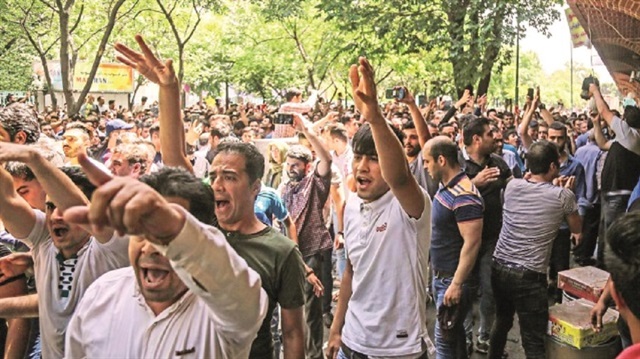
File photo
The goal of U.S. economic sanctions against Iran is a great threat for the country. In the first phase, the U.S. wants to lead Iran into a state of introversion and for it to retreat from regions such as Syria, Lebanon, Iraq, Palestine and Yemen.
If the sanctions are long-term it could jeopardize Iran policies. The most serious threat is triggering an atmosphere of chaos, which would lead to a division of the country by causing financial difficulties and increasing unemployment rates.
The sanctions target Tehran's acquisition of U.S. dollars, the trade of precious metals, transactions related to Iran's rial, activities relating to Iran's sovereign debt, and the country's automotive sector.
Stating that the Trump administration was using Iran as domestic political leverage ahead of November's midterm elections in the states, Iranian President Hassan Rouhani said, "They want to launch psychological warfare against the Iranian nation.
The Iranian president said on Monday that his country was open to talks if the U.S. returned to the previous nuclear deal.Hassan Rouhani who spoke on state national TV said that the negotiations with U.S. would be meaningless while the sanctions are still imposed on Iran.“It is meaningless to invite for new talks while sanctions are still there,” the president said. US’s first round of sanctions on Iran goes into effect"We are always ready to negotiate," Rouhani said. "But they need to return to [the Iran nuclear deal]. And they need to be honest. You can’t negotiate while putting sanctions on Iran [...]."“The principle of negotiations is loyalty, and how can we negotiate with a county who left the table imposing sanctions?” he said.Referring to Iran’s relations with the EU, Rouhani voiced his expectations for more tangible actions from Europe.Iran FM slams US sanctions“Our partners in Europe and other region have been doing their best, but we are expecting more concrete actions from them,” the president said.Earlier on Monday, U.S. Secretary of State Mike Pompeo said Washington will enforce sanctions against Iran.In May, Trump withdrew the U.S. from a nuclear deal, which was signed in 2015 between Iran and the P5 1 group of nations (the five permanent members of the UN Security Council plus Germany).The nuclear deal places restrictions on Iran’s nuclear program in exchange for billions of dollars in sanctions relief.Last week, U.S. President Donald Trump said that he was ready to hold talks with his Iranian counterpart Hassan Rouhani without preconditions.
Iran links talks with US to lifting of sanctions
The first round of the U.S. sanctions were re-imposed early Tuesday under an executive order, and President Donald Trump, who defied Washington’s allies, pledged that companies doing business with Tehran would be barred from doing business with the United States.
Iran dismissed a last-minute offer from the Trump administration for talks, saying it could not negotiate while Washington had reneged on a 2015 deal to lift sanctions in return for curbs on Iran’s nuclear program.
Iranian Foreign Minister Javad Zarif on Monday decried the re-imposition of U.S. sanctions, which are set to go into force on Tuesday.“US is waging the propaganda that it is in touch with Iran’s people and [Israeli Prime Minister Benjamin] Netanyahu writes tweets and sheds crocodile tears every day,” Zarif said in statements cited by Iran’s ISNA news agency.“You claim that you have connection with Iranian people but the first sanction that you re-imposed against Iran was related to airplane sales; airplanes that would have been used in favor of Iranian people,” he said.The top Iranian diplomat said U.S. economic sanctions and threats would not force Iran to change its policies.“Yes, we have been passing through a very critical period of time and U.S. sanctions and extortion may cause some problems,” Zarif said. “But the world is talking about an isolated U.S., not a lonely Iran.”Earlier Monday, U.S. Secretary of State Mike Pompeo said Washington will enforce sanctions against Iran.In May, Trump withdrew the U.S. from a nuclear deal, which was signed in 2015 between Iran and the P5 1 group of nations (the five permanent members of the UN Security Council plus Germany).The nuclear deal places restrictions on Iran’s nuclear program in exchange for billions of dollars in sanctions relief.Last week, U.S. President Donald Trump said that he was ready to hold talks with his Iranian counterpart Hassan Rouhani without preconditions.Saudi agrees to admit Iran diplomat to head office in kingdomIran's Revolutionary Guards says it held Gulf war games this week
Iran FM slams US sanctions
In May, Trump withdrew the U.S. from a nuclear deal, which was signed in 2015 between Iran and the P5+1 group of nations (the five permanent members of the UN Security Council plus Germany).
The nuclear deal places restrictions on Iran’s nuclear program in exchange for billions of dollars in sanctions relief.
The United States will not be able to prevent Iran from exporting oil, Iranian Foreign Minister Mohammad Javad Zarif was cited as saying by an Iranian newspaper on Wednesday.U.S. officials have said in recent weeks that they aim to reduce Iran's oil exports to zero as a means of pressuring Tehran to halt its nuclear and missile programmes and involvement in regional conflicts in Syria and Iraq."If the Americans want to keep this simplistic and impossible idea in their minds they should also know its consequences,” Zarif said. “They can’t think that Iran won’t export oil and others will export.”Zarif did not specify what consequences the U.S. could face.
US will not be able to prevent Iran from exporting oil: Iranian FM
Sanctions could lead the region to chaos
This unpredictable attempt is being evaluated as the beginning of a process that needs to be followed carefully. It is emphasized that Iran should take measures to protect its integrity and deliver calming and uniting messages to its nation and neighbors, because the region cannot overcome another war after those in Syria and Iraq.
On the other hand, the PKK-linked and U.S.-backed the Kurdistan Free Life Party (PJAK) terror organization is another threat Iran may have to deal with, as terrorists could take this chaos as an opportunity to ramp up their attacks.