

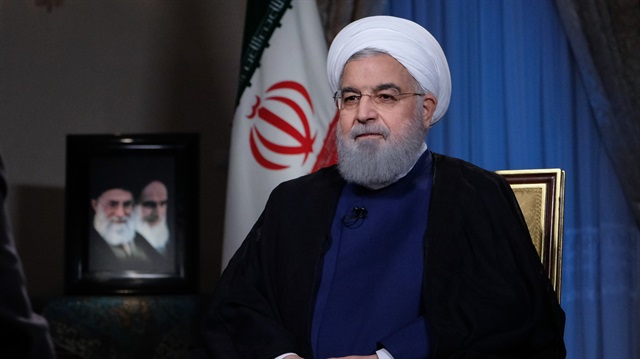
Iranian President Hassan Rouhani
The Iranian president said on Monday that his country was open to talks if the U.S. returned to the previous nuclear deal.
Hassan Rouhani who spoke on state national TV said that the negotiations with U.S. would be meaningless while the sanctions are still imposed on Iran.
“It is meaningless to invite for new talks while sanctions are still there,” the president said.
The first round of the U.S. pre-nuclear deal sanctions on Iran, largely targeting the country’s banking sector, went into effect on Tuesday.The economic penalties, which will be rigorously enforced, officially went into effect at one minute after midnight Washington time (0401GMT) Tuesday morning.Iran FM slams US sanctionsThe sanctions target Tehran's acquisition of U.S. dollars, precious metals trade, transactions related to Iran's rial, activities related to Iran's sovereign debt, and the country's automotive sector.1 million Iranians may lose jobsIran's Minister of Labor and Social Affairs Ali Rabiei has said that around 1 million Iranians may lose their jobs due to the sanctions.Iran says Trump, regional allies isolated over Tehran policyThe actions follow President Donald Trump's decision May 8 to withdraw the U.S. from the 2015 Joint Comprehensive Plan of Action (JCPOA) that world powers, including the U.S, struck with Iran. The agreement placed unprecedented curbs on Iran's nuclear program, subjecting it to a rigorous inspection regime in exchange for billions of dollars in relief from international sanctions.A second wave of sanctions is set to take effect Nov. 5, targeting Iran's port operators, petroleum-related transactions, and Iran's shipping sector and central bank.
US’s first round of sanctions on Iran goes into effect
"We are always ready to negotiate," Rouhani said. "But they need to return to [the Iran nuclear deal]. And they need to be honest. You can’t negotiate while putting sanctions on Iran [...]."
“The principle of negotiations is loyalty, and how can we negotiate with a county who left the table imposing sanctions?” he said.
Referring to Iran’s relations with the EU, Rouhani voiced his expectations for more tangible actions from Europe.
Iranian Foreign Minister Javad Zarif on Monday decried the re-imposition of U.S. sanctions, which are set to go into force on Tuesday.“US is waging the propaganda that it is in touch with Iran’s people and [Israeli Prime Minister Benjamin] Netanyahu writes tweets and sheds crocodile tears every day,” Zarif said in statements cited by Iran’s ISNA news agency.“You claim that you have connection with Iranian people but the first sanction that you re-imposed against Iran was related to airplane sales; airplanes that would have been used in favor of Iranian people,” he said.The top Iranian diplomat said U.S. economic sanctions and threats would not force Iran to change its policies.“Yes, we have been passing through a very critical period of time and U.S. sanctions and extortion may cause some problems,” Zarif said. “But the world is talking about an isolated U.S., not a lonely Iran.”Earlier Monday, U.S. Secretary of State Mike Pompeo said Washington will enforce sanctions against Iran.In May, Trump withdrew the U.S. from a nuclear deal, which was signed in 2015 between Iran and the P5 1 group of nations (the five permanent members of the UN Security Council plus Germany).The nuclear deal places restrictions on Iran’s nuclear program in exchange for billions of dollars in sanctions relief.Last week, U.S. President Donald Trump said that he was ready to hold talks with his Iranian counterpart Hassan Rouhani without preconditions.Saudi agrees to admit Iran diplomat to head office in kingdomIran's Revolutionary Guards says it held Gulf war games this week
Iran FM slams US sanctions
“Our partners in Europe and other region have been doing their best, but we are expecting more concrete actions from them,” the president said.
Earlier on Monday, U.S. Secretary of State Mike Pompeo said Washington will enforce sanctions against Iran.
In May, Trump withdrew the U.S. from a nuclear deal, which was signed in 2015 between Iran and the P5 1 group of nations (the five permanent members of the UN Security Council plus Germany).
The nuclear deal places restrictions on Iran’s nuclear program in exchange for billions of dollars in sanctions relief.
Last week, U.S. President Donald Trump said that he was ready to hold talks with his Iranian counterpart Hassan Rouhani without preconditions.