

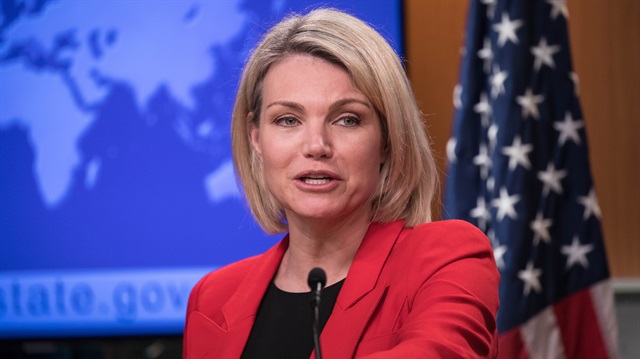
U.S. Department of State Spokesperson Heather Nauert
The U.S. on Monday strongly criticized the Syrian regime over "thousands" of death notices it has been releasing, saying they confirm suspicions of systematic arrests, torture and murder.
State Department spokesperson Heather Nauert said in a statement that over 117,000 people are believed to have been detained or forcibly disappeared in Syria since the conflict began in 2011, and "the vast majority" are suspected to be in regime custody "across a network of prisons where regime officials torture and murder civilians to intimidate and silence any opposition” to Bashar al-Assad’s rule.
"Extensive documentation and other evidence of this torture and murder is being collected by international organizations and support the world’s continued condemnation of the Syrian regime and prosecution of culpable officials in various courts," she said.
"The United States strongly reiterates its condemnation of the Assad regime’s cruel actions and calls on it to adhere to international laws and norms pertaining to the treatment of prisoners, including by allowing access for independent monitors."
Syria has only just begun to emerge from a devastating conflict that began in 2011, when the Assad regime cracked down on demonstrators with unexpected ferocity.
Hundreds of thousands have been killed and millions displaced in the seven-year conflict, according to UN figures. The Syrian Network for Human Rights says nearly 120,000 people have been arbitrarily arrested.
A Syrian Turkmen commander said the Assad regime has kept at least 500,000 people in prisons.Speaking to Anadolu Agency, Turkmen Mountain region's 3rd Coastal Armed Division Commander Tarik Solak recalled his two-and-a-half-year ordeal of captivity in the regime’s notorious Saydnaya Prison in capital Damascus.“Around 4,000 people are held hostage at Saydnaya Military Prison. There are at least half a million prisoners nationwide,” Solak said.“They have even turned schools into prisons. There are prisons that we are not even aware of.”Amnesty International has termed Saydnaya a “human slaughterhouse”, known for its systematic murder, torture, enforced disappearance and extermination carried out since 2011.“Our division was at the Israeli border. We were 270 people. We wanted to leave the military and join the opposition. There was no opposition back then, we wanted to join the civilians,” Solak said.He said they were held by the regime after their secret was leaked from within their own ranks.Solak added that they faced immense torture in prison.“After getting to the ward [following captivity in a cell for 33 days], torture continued in different ways. We were 20 people. They beat us at every meal. They electrocuted us. They would empty our food into the toilet. 'Eat there', they would say. They would violently beat us with water pipes.”He added: “It was forbidden to see the military doing these things. When he heard the sound of footsteps, we had to put our hands on our heads and face the wall.”Solak was “pardoned” and released for an unknown reason in June 2014.“In the last three months in prison, they were starved, they began to vomit, then got diarrhea and died. I've experienced it all too. I got out in the last phase. I could no longer stand on my feet. I expected to die. One day they pulled me out,” Solak said.He came out weighing only 40 kilograms and had to undergo five surgeries on his stomach and intestines.- Developments at the Turkmen Mountain regionOn the recent military buildup in the region, Solak said: “There is Turkey’s presence at the de-escalation zone. The Turkish soldiers say they will not withdraw and the regime will not attack. We take strength from them.”He emphasized that the buildup was done by Iran-backed terrorist groups, and that Iran wants to seize all of Syrian territory and settle in.Last week, the regime began a military buildup in southwestern Idlib in a bid to attack Syria’s northwestern Turkmen Mountain region, which is located within the de-escalation zones.Idlib was a top issue during the Astana meeting, as the Turkish delegation stressed the importance of maintaining the cease-fire regime in the region.Solak said that Russia assured the opposition in Daraa during the 9th round of Astana talks, but seized it at the first opportunity.“That is why we have made our preparations of defense [in Idlib]. But we are committed to our guarantor Turkey's strategy. The first stage is the dissolution of radical groups,” Solak said.He said: “We have Turkmen Mountains, but with 5 million people staying in Idlib, it would not be worthy for us. The priority is Idlib. If Idlib is lost, neither Al-Bab nor Afrin can be protected.”“When the time comes, I do not believe Turkey will leave Turkmen Mountain to its fate. I believe they will not leave,” Solak added.
'Assad regime keeping over 500,000 captives in prisons'
The UN refugee agency UNHCR is awaiting for details of a U.S.-Russian plan on the return of Syrian refugees, a UNHCR spokeswoman in Lebanon said Sunday.“A UNHCR team is communicating with Syrians in Lebanon and we have a team in Syria,” Lisa Abou Khaled told Anadolu Agency.Moscow and Washington were reportedly discussing a joint plan to jointly organize the return of Syrian refugees to their homeland following agreements between the Russian and American leaders during their summit talks in Helsinki last month.As for the return of refugees to their areas, Abou Khaled said “some of those who returned could not go back to their homes and some others went to live with their relatives.”“Regarding the security situation, we do not have sufficient data,” the spokeswoman said, going on to assert the UN agency’s relations with the Lebanese government were good.Lebanese Foreign Minister Gebran Bassil has earlier accused the UNHCR of hampering the return of Syrian refugees in Lebanon to their war-torn country, an accusation denied by the UN agency.There are around 997,000 Syrian refugees in Lebanon, according to UN figures. This figure, however, does not include refugees who are not officially registered with the UNHCR.Syria has only just begun to emerge from a devastating conflict that began in 2011, when the Assad regime cracked down on demonstrators with unexpected ferocity.Tens of thousands have been killed and millions displaced in the seven-year conflict, according to UN figures.Russia confirms proposed Syria cooperation with USChina willing to fight alongside Assad regime
UN awaits details of US-Russia plan on Syrian refugees
With the aim of attacking Turkmen Mountain, the Assad regime and Iranian-backed militia groups have continued to deploy forces in northern areas of Syria’s Latakia province, which falls within a network of de-escalation zones.According to opposition sources, the regime and its allies are preparing for a major assault on Turkmen Mountain and the nearby city of Jisr Al-Shugur in Idlib.Abu Abd Ateyra, a commander of the opposition’s Turkmen Mountain Operations Room, told Anadolu Agency on Thursday that the regime was still carrying out massive deployments with a view to capturing both Turkmen Mountain and opposition-held parts of Idlib.UN calls on Assad regime to protect civilians“The regime is preparing for a massive operation targeting Turkmen Mountain,” he said. “It hopes to capture Idlib’s Jisr ash-Shugur before seizing all remaining areas still under opposition control.”Noting the strategic importance of the mountainous region stretching through Idlib, Abd Ateyra went on to assert that opposition forces were ready to respond to an imminent assault by regime forces. Assad regime deploys troops, tanks to wage war against Syria’s IdlibIn 2015, the regime -- backed by Russian air power -- captured some 85 percent of Latakia’s Turkmen Mountain region, forcing some 20,000 of the area’s Turkmen and Arab inhabitants to flee northward to Turkey.Under and earlier agreement endorsed by Turkey, Russia and Iran, Turkmen Mountain falls within a network of de-escalation zones in which acts of aggression are expressly forbidden.Assad regime tortured 8,000 to deathSyria has only just begun to emerge from a devastating conflict that began in 2011, when the Assad regime cracked down on demonstrators with unexpected ferocity.
Assad regime sets sights on Syria's Turkmen Mountain