

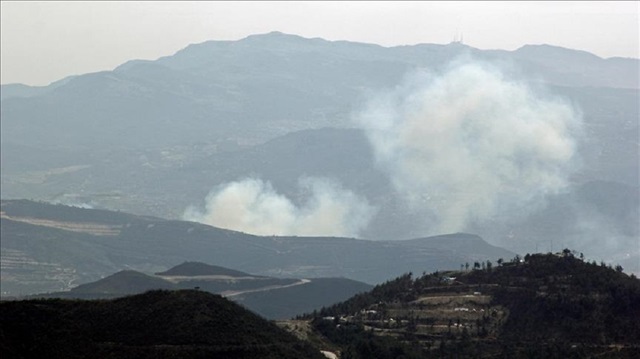
File photo
With the aim of attacking Turkmen Mountain, the Assad regime and Iranian-backed militia groups have continued to deploy forces in northern areas of Syria’s Latakia province, which falls within a network of de-escalation zones.
According to opposition sources, the regime and its allies are preparing for a major assault on Turkmen Mountain and the nearby city of Jisr Al-Shugur in Idlib.
Abu Abd Ateyra, a commander of the opposition’s Turkmen Mountain Operations Room, told Anadolu Agency on Thursday that the regime was still carrying out massive deployments with a view to capturing both Turkmen Mountain and opposition-held parts of Idlib.
The UN Human Rights Commission on Tuesday called on Syria's Bashar al-Assad regime to protect civilians from terrorist attacks and build trust among the local community. In a statement, the commission also condemned recent attacks by Daesh in the southwestern Syrian district of As-Sweida.“The Government of Syria has a duty to take action to prevent violent acts that may endanger the lives and well-being of civilians.”Turkey ensures security in Idlib: Syrian oppositionThe UN urged the regime to take into account those who committed the crime against humanity. “We are also concerned that the situation in As-Sweida may worsen, particularly if the local communities do not trust the government to protect them or defend their rights,” the statement added.Syria has only just begun to emerge from a devastating conflict that began in 2011, when the ruling Assad regime cracked down on demonstrators with unexpected ferocity.190,000 Syrians return to liberated hometownsUN, Turkey, Iran, Russia talk Syrian charter committee
UN calls on Assad regime to protect civilians
“The regime is preparing for a massive operation targeting Turkmen Mountain,” he said. “It hopes to capture Idlib’s Jisr ash-Shugur before seizing all remaining areas still under opposition control.”
Noting the strategic importance of the mountainous region stretching through Idlib, Abd Ateyra went on to assert that opposition forces were ready to respond to an imminent assault by regime forces.
The Assad regime has speeded up its military deployments to Syria’s northwestern Idlib province, the largest remaining Syrian opposition-held enclave, dispatching dozens of troops, tanks, armored vehicles, missile-launching platforms and Iran-backed Shia militias along the Turkmen Mountain.The regime has already started to bomb positions belonging to the Syrian opposition along the Jisr ash-Shugur- Turkmen Mountain line, where 3 million people currently reside, according to reports. Qaramanli, Qatana, Obin are reportedly amongst the towns that were harassed by Iran-backed Shia militias.The Turkish Armed Forces (TAF) in response have started to reinforce its observation points by building concrete walls in the Turkmen Mountain area in Latakia and has been dispatching more than 300 concrete walls from Reyhanlı located at the Turkish border.Under the Astana agreement, Turkish forces are present at 12 points from Idlib's north to south.Idlib, located in northwestern Syria on the Turkish border, has faced intense attacks by the Bashar al-Assad regime after a vicious civil war broke out in 2011.Since March 2015, Idlib is no longer under the control of the Assad regime and has been overrun by opposition groups.The Astana peace talks were launched on Jan. 23-24, 2017, with the aim of putting an end to violence and improving the humanitarian situation in war-torn Syria.PKK awaits for an attackA so-called senior leader of the Kurdistan Workers’ Party (PKK) Aldar Khalil said that if the war starts in Idlib, they would collaborate with the Damascus regime to attack Turkish forces.Khalil stated that the PKK terror organization’s primary aim is to attack Afrin after Idlib, and for this purpose they will deliver thousands of terrorists to Syria’s Idlib province from the Aleppo-Hama route in cooperation with the Assad regime.On Jan. 20 Turkey launched Operation Olive Branch to remove YPG/PKK and Daesh terrorists from Afrin. On March 18, Turkish troops and Free Syrian Army members liberated its city center, on the 58th day of the operation.The Kurdistan Worker’s Party (PKK) and its Syrian offshoot the People's Protection Units (YPG) terrorist group had reached an agreement on delivering the control of Syria’s two major dams, Tabqa and Tishrin, to the Assad regime in exchange for a supply of electricity and water needs in areas occupied by the terror group in early July.
Assad regime deploys troops, tanks to wage war against Syria’s Idlib
In 2015, the regime -- backed by Russian air power -- captured some 85 percent of Latakia’s Turkmen Mountain region, forcing some 20,000 of the area’s Turkmen and Arab inhabitants to flee northward to Turkey.
Under and earlier agreement endorsed by Turkey, Russia and Iran, Turkmen Mountain falls within a network of de-escalation zones in which acts of aggression are expressly forbidden.
After the Syrian regime’s years of silence about the fate of tens of thousands of people that rights groups say have been forcibly kidnapped in the war, authorities have begun quietly updating registers to acknowledge thousands of deaths.Following the ongoing talks between Russia, Turkey and Iran in Astana to release detainees in regime prisons, Damascus released a list which stated that 8,000 civilians detained over the course of seven years were dead-- likely by torture-- including academicians, journalists and civil servants.The regime has tried to conceal the massacre and torture by listing their cause of death as “heart attacks” and cited infectious diseases. Among the dead are 125 children and 63 women.The listed names were registered in Aleppo, Homs, Daraa, Tartus, Idlib, Lattakia, Deir ez-zor, Raqqaa and Hasakah. Tortured to death Syrian Opposition Commander General Adib Shelaf allegedly said that more than 200,000 civilians have been disappeared in detention facilities belonging to the Syrian regime and that at least 40,000 were tortured to death in jails.Shelaf stated, “The Syrian regime decided to covertly de-register those who were detained during the Syrian civil war due to a groundswell of international pressure. The regime noted the cause of deaths on official records as either ‘heart attack’ or due to ‘infectious diseases.’”Syria’s Zaman al-Wasl newspaper and the Violations Documentation Centre in Syria have reported names of 8,000 prisoners who were tortured to death over the past seven years in regime jails in July.The number of deaths based on regions is as follows:1- Damascus suburbs: 18562. Daraa: 12833. Homs: 12534. Damascus: 8705. Hama: 7626. Idlib: 5857. Aleppo: 4738. Deir Ezzor: 4509. Latakia: 15410. Quneitra: 11011. Raqqa: 5012. Hasaka: 4413. Tartus: 2814. Swaida: 23 Ten victims of non-Syrian nationalities, and two of the victims were not affiliated with any nationality.UN, Turkey, Iran, Russia talk Syrian charter committeeAstana talks to contribute to end of civil warThe Astana peace talks, which were launched in January 2017 with the aim of putting an end to violence and improving the humanitarian situation in war-torn Syria by Iran, Russia and Turkey, is being considered as the sole solution to the end of the Syrian civil war.The United Nations Special Envoy for Syria Staffan de Mistura will have talks with Iran, Russia and Turkey representatives in September to draft a new Syrian constitution. According to a UN statement, Mistura held informal talks in Sochi with Russian, Iranian and Turkish representatives and received lists from the Assad regime and the opposition on proposed candidates for the Constitutional Committee on Tuesday.Turkey, Russia, Iran set to free some Syrian detaineesThe constitutional committee will include 50 people from “government, opposition representatives, Syrian experts, civil society, independents, tribal leaders and women.”In addition to the formation of a constitutional committee, the 10th round of Syrian talks is focused on the latest situation in de-escalation zones in Idlib, the return of refugees, and the release of prisoners.Officials from Turkey, Russian and Iran on Monday agreed to the mutual release of some Syrian detainees from both the regime and opposition sides.Syria has been locked in a vicious civil war since early 2011, when the Assad regime cracked down on pro-democracy protests. Since then, more than 250,000 people have been killed and over 10 million were displaced, according to the UN.
Assad regime tortured 8,000 to death
Syria has only just begun to emerge from a devastating conflict that began in 2011, when the Assad regime cracked down on demonstrators with unexpected ferocity.