

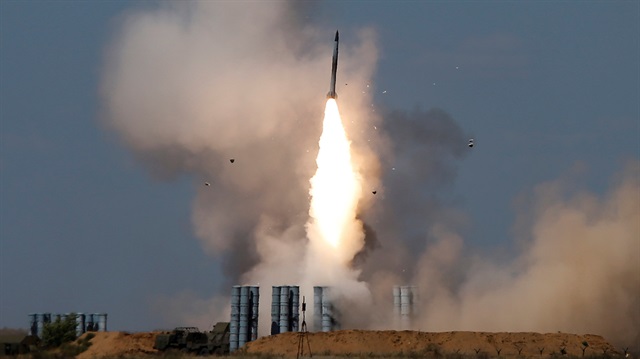
FILE PHOTO: An S-300 air defense missile system
The U.S. general overseeing American forces in the Middle East said on Thursday Russia's deployment of the S-300 surface-to-air missile system in Syria was a needless escalation and a knee-jerk response to last month's downing of a Russian military aircraft.
Army General Joseph Votel, who leads the U.S. Central Command, confirmed the deployment and added that it would help shield Iranian activities in Syria, which have triggered air raids by Israel.
Russia has begun delivering the S-300 air defense system to Syria, Foreign Minister Sergei Lavrov said Friday.Speaking at a news conference following his address at the 73rd session of the UN General Assembly in New York, Lavrov said delivery of the system has already started following the recent downing of a Russian military aircraft over Syria.On Tuesday, Israeli F-16s entered Syrian airspace to strike Syrian military targets in northwestern Latakia province.When Syria’s Russian-built S-200 air defense system responded to the airspace breach, a Russian Il-20 military plane was struck by a missile, destroying the aircraft and killing all 15 servicemen on board.On Monday, Moscow -- accusing Israel of using the Russian aircraft as a means of evading Syrian air defenses -- announced its decision to provide Damascus with the advanced S-300 air defense system.Israeli PM hopes to derail Russia-Syria S-300 dealIn a statement, Russian Defense Minister Sergei Shoigu said the system would "significantly" strengthen the Syrian regime’s air-defense capabilities.According to Russian officials, the S-300 can strike targets up to 250 kilometers (155 miles) away and destroy multiple targets simultaneously.Saying Russia will not allow a repeat of what happened in Raqqah while they are fighting terrorism in Syria, Lavrov said thousands of Syrians have already started returning to Aleppo and Eastern Ghouta.He was referring to a deal struck last year in which Daesh fighters and their families were allowed to escape Raqqah under the gaze of the U.S. and British-led coalition which controlled the city.Touching on the al-Nusra terrorist group’s presence in the disarmament zone in Idlib, he said the militias and heavy weapons were being transferred to other areas, adding that Turkey took the responsibility to differentiate the moderate opposition group ready to engage in the political process from al-Nusra, which is not an easy task.On Sept. 17, Turkish President Recep Tayyip Erdogan and Russian President Vladimir Putin agreed in the Russian city of Sochi to establish a disarmament zone in Syria’s Idlib province.Located near the Turkish border, Idlib is home to more than 3 million Syrians, many of whom fled to other cities following attacks by forces of the Bashar al-Assad regime.
Russia has started delivering S-300 system to Syria: FM
Russia claimed that its S-300 defense system will be able to close parts of the Syrian airspace "where necessary", a Russian Foreign Ministry director said in a news conference on Tuesday.Vladimir Ermakov, director of the department for nonproliferation and arms control of the Russian Foreign Ministry, said: "Russia's supplies to Syria would be able to close Syrian airspace where necessary.""There is nothing at all [to prohibit Russia's move] in the area of reduction of strategic offensive weapons, missile arsenals and nuclear weapons, except the Russia-U.S. agreements. And the current situation allows to assume that the probability of concluding some new agreements in the coming years is not very high," said Ermakov.On Monday, Russia's Defense Minister Sergei Shoigu said in a statement that the country will give a S-300 anti-aircraft missile system to the Syrian regime forces within two weeks.Netanyahu says Israel will continue Syria operations to prevent Iranian entrenchment"It is capable of intercepting air threats at a range of more than 250 kilometers and simultaneously hitting several aerial targets," he said in the statement.Contrary to concerns of U.S. National Security Adviser John Bolton that the deployment would escalate tensions, Ermakov said, it would in fact "lead to stabilization" of the situation in the region."In fact, these actions will lead to the stabilization of region, as we will be able to close the airspace if and where necessary, and, most importantly, our servicemen that fulfill their international duty at the Syrian government's invitation will be protected," he said, as quoted by state news agency RIA Novosti.Also speaking at the news conference, Kremlin spokesman Dmitry Peskov reiterated that S-300 systems' supplies were "not directed at any third country".Turkey establishes factories in Syria’s Afrin to liven economyLast week, Israeli F-16s entered Syrian airspace to strike Syrian military targets in the northwestern Latakia province.When Syria’s Russian-built S-200 air-defense system responded to the airspace breach, a Russian Il-20 military plane was struck by a missile, destroying the aircraft and killing all 15 servicemen on board.Moscow accused Israel of using the Russian aircraft as a shield against the Syrian defense.Russia backs Syrian regime forces while Israel conducts airstrikes against alleged Iran-backed forces operating along its border.The two militaries cooperate through an emergency hotline to prevent incidents.
Russia claims S-300 may close parts of Syrian airspace
Russia will supply an S-300 surface-to-air missile system to Syria within two weeks, Defence Minister Sergei Shoigu said on Monday, a week after Russia blamed Israel for indirectly causing the downing of a Russian military plane in Syria.The crash which killed 15 Russian service members had forced Moscow to take "adequate retaliatory measures to increase the safety of Russian military fighting international terrorism in Syria," Shoigu said in a televised address."A modern S-300 air defence missile system will be transferred to the Syrian armed forces within two weeks," he said. The system will "significantly increase the Syrian army's combat capabilities," he said.Russia, which fights in Syria to support the government, has said Syria shot the IL-20 surveillance plane down by mistake shortly after Israeli jets hit a nearby target. Russia blamed Israel for creating dangerous conditions that caused the crash.Israel, which has struck Syria scores of times during the seven-year war, has said it will work to improve "deconfliction" of its missions with Russian forces, but will not halt them. It has long lobbied Moscow not to provide the S-300 to Syria.Shoigu said Russia will equip Syrian anti-aircraft units with Russian tracking and guidance systems in order to identify Russian aircraft.Russia in April had hinted that it would supply the S-300 to President Bashar al-Assad despite Israeli objections.The missile system, originally developed by the Soviet military, but since modernised and available in several versions with significantly different capabilities, fires missiles from trucks and is designed to shoot down military aircraft and short- and medium-range ballistic missiles.Israel says its air strikes on Syria are not a threat to Russia's ally Assad, but that it must carry them out to halt arms shipments to Iranian-backed Lebanese group Hezbollah. It has made repeated efforts to persuade Moscow not to sell S-300s to Syria, as it fears this would hinder its aerial capability. 
Russia says it will supply Syria with S-300 air defence system