

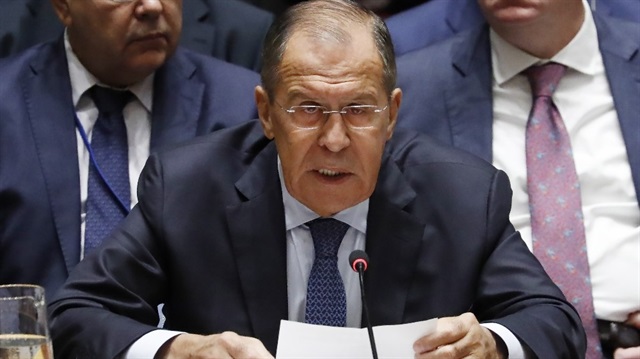
Russian Foreign Minister Sergei Lavrov
Russia has begun delivering the S-300 air defense system to Syria, Foreign Minister Sergei Lavrov said Friday.
Speaking at a news conference following his address at the 73rd session of the UN General Assembly in New York, Lavrov said delivery of the system has already started following the recent downing of a Russian military aircraft over Syria.
On Tuesday, Israeli F-16s entered Syrian airspace to strike Syrian military targets in northwestern Latakia province.
When Syria’s Russian-built S-200 air defense system responded to the airspace breach, a Russian Il-20 military plane was struck by a missile, destroying the aircraft and killing all 15 servicemen on board.
On Monday, Moscow -- accusing Israel of using the Russian aircraft as a means of evading Syrian air defenses -- announced its decision to provide Damascus with the advanced S-300 air defense system.
Israeli Prime Minister Benjamin Netanyahu will try to discourage Russia from providing Syria with an S-300 air-defense system during his upcoming visit to the U.S., according to Israeli media reports.Netanyahu is scheduled to attend the 73rd session of the UN General Assembly, which is currently underway in New York.On Monday, Israel’s Channel 2 reported that Netanyahu would attempt to persuade U.S. President Donald Trump to offer Russian President Vladimir Putin a “diplomatic initiative” in exchange for the latter refraining from delivering the S-300 system to Syria.Last week, several Israeli F-16s entered Syrian airspace before striking military targets in Syria’s northwestern Latakia province.Russia claims S-300 may close parts of Syrian airspaceWhen Syria’s Russian-built S-200 air-defense system responded to the attack, a Russian Il-20 military plane was struck by anti-aircraft fire, killing all 15 servicemen on board.Days later, Moscow -- accusing Israel of using the Russian aircraft as a means of evading Syrian air defenses -- announced its decision to provide Damascus with an advanced S-300 air-defense system.Channel 2 did not provide details as to Netanyahu’s proposed “diplomatic initiative”, but said the prime minister hoped to return from New York “with a guarantee that the Israeli Air Force would have the freedom to operate in Syrian airspace”.Israel’s Channel 10, meanwhile, quoted an unnamed Israeli official as saying that the situation with Russia constituted a “serious crisis”.Netanyahu says Israel will continue Syria operations to prevent Iranian entrenchmentThe broadcaster went on to report that Israel’s Security Cabinet had convened on Tuesday -- with Netanyahu in attendance -- to discuss the row with Moscow.After the meeting, the cabinet reportedly instructed the Israeli army to continue conducting operations in Syria.The meeting also reportedly tackled the implications of Russia's decision to provide Syria with the S-300 system, delivery of which is expected within two weeks.In a statement, Russian Defense Minister Sergei Shoigu said the system would "significantly" strengthen the Syrian regime’s air-defense capabilities.According to Russian officials, the S-300 can strike targets up to 250 kilometers away and destroy multiple targets simultaneously.
Israeli PM hopes to derail Russia-Syria S-300 deal
In a statement, Russian Defense Minister Sergei Shoigu said the system would "significantly" strengthen the Syrian regime’s air-defense capabilities.
According to Russian officials, the S-300 can strike targets up to 250 kilometers (155 miles) away and destroy multiple targets simultaneously.
Saying Russia will not allow a repeat of what happened in Raqqah while they are fighting terrorism in Syria, Lavrov said thousands of Syrians have already started returning to Aleppo and Eastern Ghouta.
He was referring to a deal struck last year in which Daesh fighters and their families were allowed to escape Raqqah under the gaze of the U.S. and British-led coalition which controlled the city.
Touching on the al-Nusra terrorist group’s presence in the disarmament zone in Idlib, he said the militias and heavy weapons were being transferred to other areas, adding that Turkey took the responsibility to differentiate the moderate opposition group ready to engage in the political process from al-Nusra, which is not an easy task.
On Sept. 17, Turkish President Recep Tayyip Erdogan and Russian President Vladimir Putin agreed in the Russian city of Sochi to establish a disarmament zone in Syria’s Idlib province.
Located near the Turkish border, Idlib is home to more than 3 million Syrians, many of whom fled to other cities following attacks by forces of the Bashar al-Assad regime.