

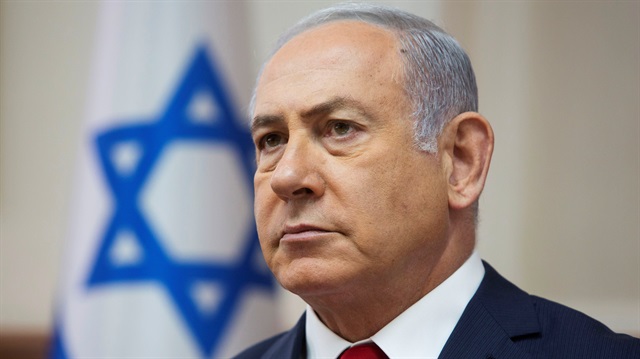
Israeli Prime Minister Benjamin Netanyahu
Israeli Prime Minister Benjamin Netanyahu will try to discourage Russia from providing Syria with an S-300 air-defense system during his upcoming visit to the U.S., according to Israeli media reports.
Netanyahu is scheduled to attend the 73rd session of the UN General Assembly, which is currently underway in New York.
On Monday, Israel’s Channel 2 reported that Netanyahu would attempt to persuade U.S. President Donald Trump to offer Russian President Vladimir Putin a “diplomatic initiative” in exchange for the latter refraining from delivering the S-300 system to Syria.
Last week, several Israeli F-16s entered Syrian airspace before striking military targets in Syria’s northwestern Latakia province.
Russia claimed that its S-300 defense system will be able to close parts of the Syrian airspace "where necessary", a Russian Foreign Ministry director said in a news conference on Tuesday.Vladimir Ermakov, director of the department for nonproliferation and arms control of the Russian Foreign Ministry, said: "Russia's supplies to Syria would be able to close Syrian airspace where necessary.""There is nothing at all [to prohibit Russia's move] in the area of reduction of strategic offensive weapons, missile arsenals and nuclear weapons, except the Russia-U.S. agreements. And the current situation allows to assume that the probability of concluding some new agreements in the coming years is not very high," said Ermakov.On Monday, Russia's Defense Minister Sergei Shoigu said in a statement that the country will give a S-300 anti-aircraft missile system to the Syrian regime forces within two weeks.Netanyahu says Israel will continue Syria operations to prevent Iranian entrenchment"It is capable of intercepting air threats at a range of more than 250 kilometers and simultaneously hitting several aerial targets," he said in the statement.Contrary to concerns of U.S. National Security Adviser John Bolton that the deployment would escalate tensions, Ermakov said, it would in fact "lead to stabilization" of the situation in the region."In fact, these actions will lead to the stabilization of region, as we will be able to close the airspace if and where necessary, and, most importantly, our servicemen that fulfill their international duty at the Syrian government's invitation will be protected," he said, as quoted by state news agency RIA Novosti.Also speaking at the news conference, Kremlin spokesman Dmitry Peskov reiterated that S-300 systems' supplies were "not directed at any third country".Turkey establishes factories in Syria’s Afrin to liven economyLast week, Israeli F-16s entered Syrian airspace to strike Syrian military targets in the northwestern Latakia province.When Syria’s Russian-built S-200 air-defense system responded to the airspace breach, a Russian Il-20 military plane was struck by a missile, destroying the aircraft and killing all 15 servicemen on board.Moscow accused Israel of using the Russian aircraft as a shield against the Syrian defense.Russia backs Syrian regime forces while Israel conducts airstrikes against alleged Iran-backed forces operating along its border.The two militaries cooperate through an emergency hotline to prevent incidents.
Russia claims S-300 may close parts of Syrian airspace
When Syria’s Russian-built S-200 air-defense system responded to the attack, a Russian Il-20 military plane was struck by anti-aircraft fire, killing all 15 servicemen on board.
Days later, Moscow -- accusing Israel of using the Russian aircraft as a means of evading Syrian air defenses -- announced its decision to provide Damascus with an advanced S-300 air-defense system.
Channel 2 did not provide details as to Netanyahu’s proposed “diplomatic initiative”, but said the prime minister hoped to return from New York “with a guarantee that the Israeli Air Force would have the freedom to operate in Syrian airspace”.
Israel’s Channel 10, meanwhile, quoted an unnamed Israeli official as saying that the situation with Russia constituted a “serious crisis”.
Prime Minister Benjamin Netanyahu said on Tuesday Israel would continue its military operations in Syria, after Russia announced it would supply an advanced anti-aircraft system to its Syrian ally."We will continue to act to prevent Iranian military entrenchment in Syria and we will continue the military coordination between the IDF (Israel Defence Forces) and the Russian army," Netanyahu told reporters before boarding a flight to New York, where he will address the U.N. General Assembly.Russia said on Monday it would supply an S-300 surface-to-air missile system to Syria in two weeks despite strong Israeli objections, a week after Moscow accused Israel of indirectly causing the downing of a Russian military jet in Syria.Russia, which fights in Syria to support the government against rebels and militants, has said Syrian anti-aircraft batteries shot its IL-20 surveillance plane down by mistake shortly after Israeli jets hit a nearby target.No obstacles in way of Iran-Turkey cooperation: RouhaniMoscow accused Israel of creating dangerous conditions that caused the incident.Israel, which has carried out air strikes in Syria many times during the civil war, said after the incident it would work to improve "deconfliction" of its missions with Russian forces, but would not halt them.Netanyahu spoke by telephone with Russian President Vladimir Putin on Monday. In his remarks on Tuesday, Netanyahu said he had agreed with Putin "that the working teams from the IDF and the Russian army will meet soon".The Israeli leader made the remarks after convening his security cabinet to discuss the tensions with Moscow.Turkey establishes factories in Syria’s Afrin to liven economy"Over the past three years, Israel has been highly successful in preventing the Iranian military entrenchment in Syria and Iranian attempts to transfer lethal weaponry to Hezbollah in Lebanon," Netanyahu said.But he said there had been occasions when things had not gone smoothly, calling Syria's downing of the Russian plane "tragic".Israel has long lobbied Moscow not to provide the S-300 to Syria, fearing this would hinder its aerial capability to strike the forces of Iran and its Hezbollah allies in Syria. 
Netanyahu says Israel will continue Syria operations to prevent Iranian entrenchment
The broadcaster went on to report that Israel’s Security Cabinet had convened on Tuesday -- with Netanyahu in attendance -- to discuss the row with Moscow.
After the meeting, the cabinet reportedly instructed the Israeli army to continue conducting operations in Syria.
The meeting also reportedly tackled the implications of Russia's decision to provide Syria with the S-300 system, delivery of which is expected within two weeks.
In a statement, Russian Defense Minister Sergei Shoigu said the system would "significantly" strengthen the Syrian regime’s air-defense capabilities.
According to Russian officials, the S-300 can strike targets up to 250 kilometers away and destroy multiple targets simultaneously.