

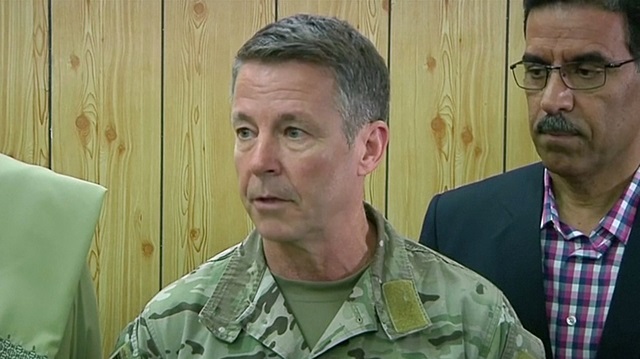
U.S. Gen. Scott Miller
The top U.S. general in Afghanistan said on Friday he did not believe he was the target of an attack that killed a powerful police chief, and Afghan officials said the gunman may have deliberately avoided hitting him.
The gunman assassinated the police chief of Kandahar province on Thursday along with a top Afghan intelligence agency officer, but the U.S. commander of Afghanistan's NATO-led force, General Scott Miller, who was standing nearby when the attack occurred, was not hurt.
"My assessment is that I was not the target. It was a very close confined space. But I don't assess that I was the target," Miller told Afghanistan's Tolo News TV in an interview.
General Abdul Razeq, police commander of the southern province and one of Afghanistan's most powerful security officials, was fatally wounded by a bodyguard of the provincial governor as he came from a meeting with officials on Thursday.
Parliamentary elections in the southern Afghan province of Kandahar, due to be held on Saturday, will be delayed by one week following the assassination of the powerful provincial police commander, officials said on Friday.Hafizullah Hashimi, spokesman of the Independent Election Commission, said the decision to delay the vote had been taken because the people of Kandahar were "morally not ready to vote" following the death of the commander, General Abdul Razeq, who was killed by a rogue bodyguard of another top official on Thursday. Afghanistan in shock after death of powerful police commanderMattis says too soon to say if Afghan attack will affect ballot
Election in Afghan province of Kandahar to be delayed a week
In addition, the local head of the NDS intelligence service was killed and the provincial governor severely wounded, while the attacker himself was killed.
Miller was also at the meeting and was heading to his helicopter to return to Kabul when the gunman opened fire.
The Taliban claimed the attack in a statement saying both Razeq and Miller were the targets.
Two Americans and a coalition contractor were wounded, however Afghan security officials, who believe Pakistan was involved in the plan, said they believed the attacker deliberately avoided killing Miller.
Afghan election commissioners recommended suspending Saturday's parliamentary vote in the southern province of Kandahar after the assassination of one of the country's most powerful security chiefs dealt a stunning blow to the Western-backed government.General Abdul Razeq, the Kandahar police commander, was killed outside the provincial governor's office on Thursday, when a bodyguard opened fire on a group of officials as they left a meeting with General Scott Miller, the commander of U.S. and NATO forces in Afghanistan.Miller was not injured but the regional intelligence agency commander was killed and the provincial governor severely wounded, decimating the leadership of one of the country's most strategically important provinces.Although nominally a provincial police chief, Razeq was one of the most powerful political figures in Afghanistan and a formidable opponent of the Taliban, with unchallenged authority across the volatile south of the country.Mattis says too soon to say if Afghan attack will affect ballotThe recommendation to suspend the vote in Kandahar province must still be approved by a vote of the National Security Council and other government agencies and some officials warned that any delay would threaten the whole process and hand the Taliban a major propaganda victory."The security agencies will vote to hold the election in Kandahar on time because there are enough troops to provide security," said one senior official.U.S. Defense Secretary Jim Mattis said it was too soon to say what effect Razeq's death would have but added that the U.S. military's mission was unaltered."We need to find who's done this," Mattis told reporters travelling with him in the southeast Asian city-state of Singapore. "But right now, we are going toward the election and we will continue to defend the Afghan people."Top Afghan official killed in shooting, US general unhurtThursday's attack underlined how precarious the situation remains in Afghanistan after more than 17 years of war and even after Taliban and U.S. officials have opened preliminary contacts to find a basis for future peace talks.It was unclear how the attack would affect a peace process, following a meeting last week of Taliban officials and the U.S. special envoy, Zalmay Khalilzad, but it complicates an already difficult situation."You're going to start asking questions about, 'Well, how trustworthy are they? What influence do they really have?'" said one former Defense Department official who left the Pentagon recently, referring to the Taliban."And you know the bottomline question is, 'Why are we still dealing with them?' or 'Should we deal with them?'"Afghan Taliban issue fresh call to boycott 'foreign plot' of electionsMattis said he had not spoken to Miller and could not confirm the Taliban's claim of responsibility but believed the attack would not affect Miller's security arrangements or U.S. military movements in Afghanistan.The Taliban issued a fresh warning not to take part in the election on Friday, telling people to stay at home and saying it would shut down roads and would be "closely monitoring all developments".Mattis was cautious about whether the Thursday attack could hit voter turnout but said the U.S. aim of finding a negotiated, Afghan-led political solution to the conflict was unchanged."We remain absolutely committed to an Afghan-led Afghan reconciliation," he said.RUTHLESSMiller, who knew Razeq well from his previous tours of duty in Afghanistan, issued a statement saluting a "great friend"."Afghanistan lost a patriot," he said on Twitter. "The good he did for Afghanistan and the Afghan people cannot be undone."A disarmingly youthful-looking figure, with a toothy smile belying a fearsome reputation, the 39-year-old Razeq was accused of building a fortune from extracting millions of dollars from traders and businesses.He was also accused of torturing prisoners and other abuses, which he denied.Last year, the United Nations Committee against Torture cited "numerous and credible allegations" that Razeq was complicit in severe human rights abuses, including extrajudicial killings and secret detention centres.He clashed frequently with President Ashraf Ghani, defying attempts to sack him, but he enjoyed popular support in Kandahar and the surrounding provinces and was adept at navigating the region's complex tribal politics.He was also highly respected by U.S. officers who saw his ruthless methods as the most effective weapon against the Taliban in both Kandahar and the wider south."Razeq was, kind of, the embodiment of security, not just in Kandahar. It is Uruzgan, it's Zabul province," said the recently retired Defense Department official."He had a lot of sway over other senior officials and certainly in the police." 
Afghanistan in shock after death of powerful police commander
"They didn't want repercussions from the U.S. and the international community. It was a pure warning for Miller that they can hit him if they want to," one of the Afghan officials, who spoke on condition of anonymity, said.
Razeq himself was a fierce critic of Pakistan and its intelligence service, which Afghan officials regularly accuse of supporting Taliban operations, a charge Islamabad denies.
On Friday, the chief of the Pakistan army staff issued a statement condemning the Kandahar violence and saying it supported initiatives towards peace in the region.
A foreign security official said Razeq had stopped visiting the governor's house in recent months because he feared it had been infiltrated and had only gone because Miller and his delegation were there.
The identity of the killer, named by Afghan officials as Gulbuddin, was known immediately, and police have made three arrests, but details of his background or why he carried out the attack remained unclear.
One senior foreign security official briefed on the case said the attacker had been recruited this year as part of the governor's security detail.
No one had claimed his body, but his colleagues in the security team said his family members lived in the outskirts of Kandahar.