

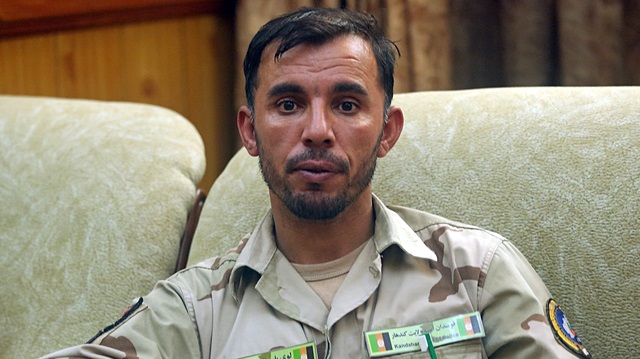
Gen. Abdul Razeq
Afghan election commissioners recommended suspending Saturday's parliamentary vote in the southern province of Kandahar after the assassination of one of the country's most powerful security chiefs dealt a stunning blow to the Western-backed government.
General Abdul Razeq, the Kandahar police commander, was killed outside the provincial governor's office on Thursday, when a bodyguard opened fire on a group of officials as they left a meeting with General Scott Miller, the commander of U.S. and NATO forces in Afghanistan.
Miller was not injured but the regional intelligence agency commander was killed and the provincial governor severely wounded, decimating the leadership of one of the country's most strategically important provinces.
Although nominally a provincial police chief, Razeq was one of the most powerful political figures in Afghanistan and a formidable opponent of the Taliban, with unchallenged authority across the volatile south of the country.
It is too soon to say how an attack in Afghanistan that killed a top security chief would affect voter turnout in Saturday's elections, U.S. Defense Secretary Jim Mattis said, but added that the U.S. military's mission was unaltered."It's the loss of a patriot," Mattis said on Friday, referring to the death of General Abdul Razeq, the police commander in southern Kandahar."But we remain absolutely committed to an Afghan-led Afghan reconciliation. We need to find who's done this. But right now, we are going toward the election and we will continue to defend the Afghan people." Top Afghan official killed in shooting, US general unhurtAfghan Taliban issue fresh call to boycott 'foreign plot' of electionsAfghan lawmaker among four killed in Taliban blast ahead of elections
Mattis says too soon to say if Afghan attack will affect ballot
The recommendation to suspend the vote in Kandahar province must still be approved by a vote of the National Security Council and other government agencies and some officials warned that any delay would threaten the whole process and hand the Taliban a major propaganda victory.
"The security agencies will vote to hold the election in Kandahar on time because there are enough troops to provide security," said one senior official.
U.S. Defense Secretary Jim Mattis said it was too soon to say what effect Razeq's death would have but added that the U.S. military's mission was unaltered.
"We need to find who's done this," Mattis told reporters travelling with him in the southeast Asian city-state of Singapore. "But right now, we are going toward the election and we will continue to defend the Afghan people."
The top U.S. commander in Afghanistan, General Scott Miller escaped unhurt after a burst of gunfire in the governor's compound in Kandahar province on Thursday but the powerful police chief General Abdul Razeq was killed, officials said.A senior security official said the governor's bodyguard opened fire and hit Razeq in the back as soon as officials came out of the meeting. The governor and the local head of the NDS intelligence service were wounded.Several Afghan and international security officials said Razeq, one of Afghanistan's most powerful commanders with a fearsome reputation as an enemy of the Taliban, had been killed.Afghan Taliban issue fresh call to boycott 'foreign plot' of electionsMiller, who had been attending a meeting with security officials ahead of parliamentary elections on Saturday, was not injured but two Americans were wounded in the crossfire and had been evacuated, NATO spokesman Colonel Knut Peters said."Provincial officials including the governor, the police chief and other officials were accompanying the foreign guests to the plane when the gunshots happened," said Said Jan Khakrezwal, the head of the provincial council.
Top Afghan official killed in shooting, US general unhurt
Thursday's attack underlined how precarious the situation remains in Afghanistan after more than 17 years of war and even after Taliban and U.S. officials have opened preliminary contacts to find a basis for future peace talks.
It was unclear how the attack would affect a peace process, following a meeting last week of Taliban officials and the U.S. special envoy, Zalmay Khalilzad, but it complicates an already difficult situation.
"You're going to start asking questions about, 'Well, how trustworthy are they? What influence do they really have?'" said one former Defense Department official who left the Pentagon recently, referring to the Taliban.
"And you know the bottomline question is, 'Why are we still dealing with them?' or 'Should we deal with them?'"
The Taliban issued a fresh call for Afghans to boycott this week's parliamentary elections on Thursday, denouncing the vote as a foreign-imposed process.The statement was the third such call and followed a similar message on Wednesday telling teachers not to participate as election workers in polling stations, many of which are located in schools.It said the elections "are a foreign plot to prolong occupation" and said it was the duty of every Afghan to oppose them."Consequently, preachers and prayer leaders must inform their constituency, while tribal leaders and influential figures must prevent participation by the public," the statement said.Afghan lawmaker among four killed in Taliban blast ahead of electionsThe elections for the lower house of parliament are due to take place on Saturday but preparations have been dogged by chaotic organisation and allegations of widespread fraud as well as worries that polling stations will be attacked.Thousands of police and soldiers have been deployed across the country to ensure security but already nine candidates have been assassinated and hundreds of people have been killed and wounded in election-related attacks.Although the Taliban say they will not deliberately target civilians, security officials say attacks are likely on Saturday morning to deter voters from going to polling stations.The Taliban's strong opposition to the vote comes against a backdrop of contacts with U.S. officials over possible talks to end the 17-year war in Afghanistan, with both sides attempting to secure the upper hand before any formal negotiations begin.The elections, which have been repeatedly delayed, are seen as a key credibility test for Afghanistan's democratic institutions but with two days left until the vote, officials were still rushing to complete preparations.Untested biometric voter registration equipment introduced at the last minute at the demand of political parties was still being sent out and set up in remote provincial voting centres and it was unclear whether it would be ready in time.Some 8.8 million names have been registered but millions of these are believed to be fraudulently recorded and the real number of likely voters is unknown.The lower house of parliament, with 249 seats and an extra seat reserved for the small Sikh community, has little power but the elections are seen as a vital step before more important presidential elections in April next year.District council elections, which were due to be held alongside the parliamentary elections, have been abandoned and in Ghazni province voting will be delayed because of arguments over the representation of different ethnic groups. 
Afghan Taliban issue fresh call to boycott 'foreign plot' of elections
Mattis said he had not spoken to Miller and could not confirm the Taliban's claim of responsibility but believed the attack would not affect Miller's security arrangements or U.S. military movements in Afghanistan.
The Taliban issued a fresh warning not to take part in the election on Friday, telling people to stay at home and saying it would shut down roads and would be "closely monitoring all developments".
Mattis was cautious about whether the Thursday attack could hit voter turnout but said the U.S. aim of finding a negotiated, Afghan-led political solution to the conflict was unchanged.
"We remain absolutely committed to an Afghan-led Afghan reconciliation," he said.
RUTHLESS
Miller, who knew Razeq well from his previous tours of duty in Afghanistan, issued a statement saluting a "great friend".
"Afghanistan lost a patriot," he said on Twitter. "The good he did for Afghanistan and the Afghan people cannot be undone."
A disarmingly youthful-looking figure, with a toothy smile belying a fearsome reputation, the 39-year-old Razeq was accused of building a fortune from extracting millions of dollars from traders and businesses.
He was also accused of torturing prisoners and other abuses, which he denied.
Last year, the United Nations Committee against Torture cited "numerous and credible allegations" that Razeq was complicit in severe human rights abuses, including extrajudicial killings and secret detention centres.
He clashed frequently with President Ashraf Ghani, defying attempts to sack him, but he enjoyed popular support in Kandahar and the surrounding provinces and was adept at navigating the region's complex tribal politics.
He was also highly respected by U.S. officers who saw his ruthless methods as the most effective weapon against the Taliban in both Kandahar and the wider south.
"Razeq was, kind of, the embodiment of security, not just in Kandahar. It is Uruzgan, it's Zabul province," said the recently retired Defense Department official.
"He had a lot of sway over other senior officials and certainly in the police."