

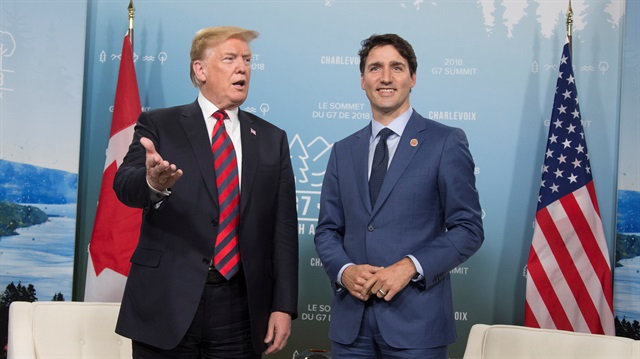
File photo: Canada's Prime Minister Justin Trudeau (R) meets with U.S. President Donald Trump
Canada and the United States will make a final push to iron out differences on a pact to modernize the North American Free Trade Agreement (NAFTA) on Friday, with Mexico on standby to return to talks aimed at ending a year of hard-fought negotiations.
U.S. Trade Representative Robert Lighthizer and Canadian Foreign Minister Chrystia Freeland were unable to clinch a deal despite meeting late into the evening on Thursday. They will reconvene on Friday morning.
Mexico is also expected to rejoin the talks at some point on Friday, allowing for three-way negotiations to resume after a two-month break. A bilateral deal announced by the United States and Mexico on Monday was a breakthrough that infused renewed optimism around a new NAFTA.
The latest talks between Canada and the United States have been intense but constructive, marking a departure from acrimonious tit-for-tat that surrounded past rounds.
The European Union's detente on tariffs with the United States has not put to rest "profound disagreements" on trade policy, the European commissioner in charge of trade said on Thursday.U.S. President Donald Trump agreed in July to refrain from imposing car tariffs while the two sides sought to cut other trade barriers, in a move described then by the European Commission chief as major concession.Speaking to the trade committee of the European Parliament on Thursday, European Trade Commissioner Cecilia Malmstrom discussed a group that she and U.S. Trade Representative Robert Lighthizer will lead to determine how tariffs might be removed on industrial goods."We are not negotiating anything, we have a working group. We have profound disagreements with the United States on trade policy," Malmstrom told EU lawmakers.China announces tax cuts in move to support economyA number of those lawmakers were fierce critics of a planned EU-U.S. Transatlantic Trade and Investment Partnership (TTIP), negotiations on which ended after Trump's election victory in 2016."We are not restarting TTIP ... This could be a more limited trade agreement, focused on tariffs on goods only," Malmstrom said.She also said the European Union would be willing to reduce its car tariffs to zero, if the United States did the same, going beyond the provisional agreement struck in July which referred only to "non-auto industrial goods"."We would do it if they do it. That remains to be seen," she said, adding she hoped a deal could be finalised by the end of the Commission's five-year term running until October 31, 2019.As clock ticks, Canada and US seek ways to salvage NAFTAThe European Union remains at odds with the United States over U.S. blocking of the appointment of judges at the World Trade Organization, over tariffs set for reasons of national security and over Washington's tough stance towards China.Malmstrom said many U.S. companies and politicians were voicing concerns over goods becoming more expensive in the United States as a result of tariffs.The European Union shared U.S. criticism of China over industry subsidies, state intervention and forced technology transfers, but believed its approach was wrong, she said."We share those concerns, but we do not agree with their methods of imposing massively billions of tariffs on China, as they have also done with Turkey. We do not share U.S. view that trade wars are good and easy to win," the commissioner said. 
EU deeply disagrees with US on trade despite detente
"The mood is cooperative and it's positive. I think everybody is working towards a deal," said Flavio Volpe, president of Canada's Automotive Parts Manufacturers Association.
"This isn't like some of the other NAFTA rounds where people were introducing poison pills for political reasons or otherwise," he said.
U.S. President Donald Trump has set a Friday deadline for the three countries to reach an agreement, which would allow outgoing Mexican President Enrique Pena Nieto to sign it before he leaves office at the end of November. Under U.S. law, Trump must wait 90 days before signing the pact.
However, Trump hinted that the Friday deadline may be flexible, saying that a deal with Canada may come that day, or "within a period of time."
Talks between Canada and the United States are intensifying as the two countries push to hammer out a deal on a revamped North American Free Trade Agreement by a Friday deadline, with both sides upbeat about the progress made so far.Despite some contentious issues still on the table, the increasingly positive tone contrasted with U.S. President Donald Trump's harsh criticism of Canada in recent weeks, raising hopes that the year-long talks will conclude soon with a trilateral agreement.Negotiations entered a crucial phase this week after the United States and Mexico announced a bilateral deal on Monday, paving the way for Canada to rejoin talks to salvage the 24-year-old accord that accounts for over $1 trillion in annual trade.Trump has set a Friday deadline for the three countries to reach an agreement, which would allow Mexican President Enrique Pena Nieto to sign it before he leaves office at the end of November. Under U.S. law, Trump must wait 90 days before signing the pact.Canada, US set for second day of NAFTA talks amid growing optimismThe U.S. president has warned he could try to proceed with a deal with Mexico alone and levy tariffs on Canadian-made cars if Ottawa does not come on board, although U.S. lawmakers have said ratifying a bilateral deal would not be easy.Negotiators were expected to work through the night ahead of more talks on Thursday morning between Canada's lead negotiator, Foreign Minister Chrystia Freeland, and U.S. Trade Representative Robert Lighthizer.Trump and Canadian Prime Minister Justin Trudeau expressed optimism on Wednesday about reaching an agreement by Friday, although much work remains on specific issues.One sticking point for Canada is the U.S. effort to dump the Chapter 19 dispute-resolution mechanism that hinders the United States from pursuing anti-dumping and anti-subsidy cases. Lighthizer said on Monday that Mexico had agreed to eliminate the mechanism.Trump says 'big deal looking good with Mexico'"I think the Canadian view on Chapter 19 is well known," Freeland told reporters late on Wednesday after a day of talks. "This is a very intense moment in the negotiations. We're trying to get a lot of things done really quickly. I think it will be most effective if we keep our negotiations on specific issues to the negotiating table."Ottawa is also ready to make concessions on Canada's protected dairy market in a bid to save the dispute-settlement system, the Globe and Mail reported on Tuesday. The dairy sector has repeatedly attracted Trump's fury.That compromise is likely to upset Canadian dairy farmers, who have an outsized influence in Canadian politics, with their concentration in the vote-rich provinces of Ontario and Quebec."Ultimately, we've got huge issues that are still to be resolved," said Jerry Dias, head of Canada's influential Unifor labor union. "Either we're going to be trading partners or we're going to fight."
As clock ticks, Canada and US seek ways to salvage NAFTA
The new NAFTA agreement that is taking shape will likely strengthen North America as a manufacturing base by making it more costly for automakers to import a large share of vehicle parts from outside the region.
New chapters governing the digital economy and stronger intellectual property, labor and environmental standards could also work to the benefit of U.S. companies, possibly helping Trump to fulfill his campaign promise of creating more American jobs.
But challenges remain. The United States wants to eliminate Chapter 19, a dispute-resolution mechanism that has hindered it from pursuing anti-dumping and anti-subsidy cases. Lighthizer said on Monday Mexico had agreed to cut the mechanism but Canada wants to keep dispute resolution in NAFTA.
Canada and United States are set to tackle their contentious issues in bilateral talks on Wednesday, as the two nations work to salvage the North American Free Trade Agreement amid signs Ottawa was open to taking a more conciliatory approach.After more than a year of talks, Mexico and the United States announced a bilateral deal on Monday, setting the stage for Canada to rejoin negotiations to modernize 24-year-old NAFTA which accounts for over $1 trillion in annual trade between the three nations.Canadian Foreign Minister Chrystia Freeland told reporters on Tuesday that Mexico's concessions on auto rules of origin and labour rights was a crucial breakthrough, clearing the way for Ottawa to resume talks with United States this week.Trump says 'big deal looking good with Mexico'After being sidelined from the talks for more than two months, Freeland will be under pressure to accept terms the United States and Mexico worked out. The U.S. Congress also wants a deal that includes Canada."The fact that agreement on those difficult issues for Mexico was able to be reached definitely clears the way for us to have significant, substantive, and I hope productive, conversations with the U.S. this week," Freeland said after a brief meeting with U.S. Trade Representative Robert Lighthizer.She dodged questions on what points Canada would be willing to concede on, noting that Ottawa's key issues are well known.Mexico-US NAFTA agreement close, but item still pending"We will, as we have done throughout this negotiation, stand up for the Canadian national interest and for Canadian values, while looking for areas where we can find a compromise that everyone can live with," she said.U.S. President Donald Trump warned he could proceed with a deal with Mexico alone and levy tariffs on Canada if it does not come on board with the revised trade terms.Despite the optimism, there are some sticking points. One of the issues for Canada in the revised deal is the U.S. effort to dump the Chapter 19 dispute resolution mechanism that hinders the United States from pursuing anti-dumping and anti-subsidy cases. Lighthizer said on Monday that Mexico had agreed to eliminate the mechanism.Mexico minister says trying to get NAFTA deal as soon as possibleOther hurdles include intellectual property rights and extensions of copyright protections to 75 years from 50, higher threshold than Canada has previously supported.But with even these hurdles, this is the closest the three nations have come to clinching a deal, and they race towards a Friday deadline to reach an in-principle deal."I think that what they probably need by Friday is some indication from Canada to the Americans that it's ready to play ball, that they're ready to negotiate in good faith," said Mark Warner, a trade lawyer with MAAW Law, which specialises in Canadian and U.S. law."If Chrystia Freeland goes down there and she starts going on and on about red lines again, then I think it's all over," he added.US tariffs to have negative impact on economy: Survey
Canada, US set for second day of NAFTA talks amid growing optimism
Mexican and U.S. officials are close to agreeing they have resolved their bilateral issues in the renegotiation of the North American Free Agreement (NAFTA) but a major issue must still be settled, a top Mexican official said on Monday.Mexican Economy Minister Ildefonso Guajardo said he still had to conclude a "very important" issue when asked by reporters if Mexico and the United States had reached agreement. He did, however, note that an announcement was "probably on the agenda."Separately, a Mexican source familiar with the talks said it was "almost certain" there would be an announcement on Monday when asked if the two sides had reached an agreement. Mexico minister says trying to get NAFTA deal as soon as possible
Mexico-US NAFTA agreement close, but item still pending
Canada has reportedly offered to make concessions to its protected dairy industry, which has come under repeated attack from Trump, in an effort to retain Chapter 19.
Trump argues Canada's hefty dairy tariffs are hurting U.S. farmers, an important political base for his Republican party. But dairy farmers have great political clout in Canada, too, and concessions could hurt the ruling Liberals ahead of a 2019 federal election.
"To continually undermine the industry is absolutely devastating and it weakens our industry overall," said David Wiens, vice president of Dairy Farmers of Canada. Trump wanted changes that would destroy family farms across Canada, he said.