

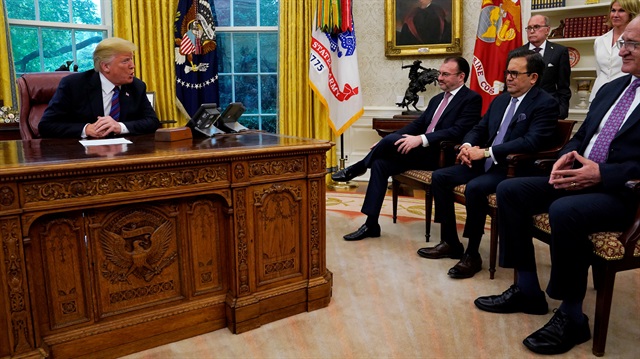
Mexico's Foreign Minister Luis Videgaray (C), Mexico's Economy Minister Ildefonso Guajardo (3rdR), White House chief economic adviser Larry Kudlow (3rdR-standing) and Jesus Seade (R), Mexico's President-elect Obrador's representative in trade negotiations look on as U.S. President Donald Trump (L) announces a deal to replace the North American Free Trade Agreement (NAFTA) at the White House in Washington, U.S., August 27, 2018.
Canada and United States are set to tackle their contentious issues in bilateral talks on Wednesday, as the two nations work to salvage the North American Free Trade Agreement amid signs Ottawa was open to taking a more conciliatory approach.
After more than a year of talks, Mexico and the United States announced a bilateral deal on Monday, setting the stage for Canada to rejoin negotiations to modernize 24-year-old NAFTA which accounts for over $1 trillion in annual trade between the three nations.
Canadian Foreign Minister Chrystia Freeland told reporters on Tuesday that Mexico's concessions on auto rules of origin and labour rights was a crucial breakthrough, clearing the way for Ottawa to resume talks with United States this week.
U.S. President Donald Trump on Monday suggested the United States and Mexico were close to a "big deal" on trade after days of negotiations between the two partners in the North American Free Trade Agreement."A big deal looking good with Mexico!" Trump wrote in a post on Twitter.The Mexican economy minister said on Monday that Mexican and U.S. officials were nearing an agreement on bilateral issues, but a major issue still needed to be settled. Mexico-US NAFTA agreement close, but item still pending
Trump says 'big deal looking good with Mexico'
After being sidelined from the talks for more than two months, Freeland will be under pressure to accept terms the United States and Mexico worked out. The U.S. Congress also wants a deal that includes Canada.
"The fact that agreement on those difficult issues for Mexico was able to be reached definitely clears the way for us to have significant, substantive, and I hope productive, conversations with the U.S. this week," Freeland said after a brief meeting with U.S. Trade Representative Robert Lighthizer.
She dodged questions on what points Canada would be willing to concede on, noting that Ottawa's key issues are well known.
Mexican and U.S. officials are close to agreeing they have resolved their bilateral issues in the renegotiation of the North American Free Agreement (NAFTA) but a major issue must still be settled, a top Mexican official said on Monday.Mexican Economy Minister Ildefonso Guajardo said he still had to conclude a "very important" issue when asked by reporters if Mexico and the United States had reached agreement. He did, however, note that an announcement was "probably on the agenda."Separately, a Mexican source familiar with the talks said it was "almost certain" there would be an announcement on Monday when asked if the two sides had reached an agreement. Mexico minister says trying to get NAFTA deal as soon as possible
Mexico-US NAFTA agreement close, but item still pending
"We will, as we have done throughout this negotiation, stand up for the Canadian national interest and for Canadian values, while looking for areas where we can find a compromise that everyone can live with," she said.
U.S. President Donald Trump warned he could proceed with a deal with Mexico alone and levy tariffs on Canada if it does not come on board with the revised trade terms.
Despite the optimism, there are some sticking points. One of the issues for Canada in the revised deal is the U.S. effort to dump the Chapter 19 dispute resolution mechanism that hinders the United States from pursuing anti-dumping and anti-subsidy cases. Lighthizer said on Monday that Mexico had agreed to eliminate the mechanism.
Mexico's economy minister Ildefonso Guajardo said on Thursday that he was trying to get a deal in the renegotiation of the North American Free Trade Agreement (NAFTA) as soon as possible.Mexico and the United States are holding talks this week and have said they are close to resolving remaining bilateral issues in the revamp of the trade pact.Speaking as he entered talks with U.S. officials in Washington, Guajardo said that there were always sticking points in a negotiation. 
Mexico minister says trying to get NAFTA deal as soon as possible
Other hurdles include intellectual property rights and extensions of copyright protections to 75 years from 50, higher threshold than Canada has previously supported.
But with even these hurdles, this is the closest the three nations have come to clinching a deal, and they race towards a Friday deadline to reach an in-principle deal.
"I think that what they probably need by Friday is some indication from Canada to the Americans that it's ready to play ball, that they're ready to negotiate in good faith," said Mark Warner, a trade lawyer with MAAW Law, which specialises in Canadian and U.S. law.
"If Chrystia Freeland goes down there and she starts going on and on about red lines again, then I think it's all over," he added.
U.S. President Donald Trump's tariffs would have a negative impact on American economy, a survey revealed Monday.In the survey released by the National Association for Business Economics (NABE), 91 percent of business economists said current tariffs and threats to impose tariffs would negatively impact the American economy.More than 65 percent of the participants said the U.S.' withdrawal from the North American Free Trade Agreement (NAFTA) would also have "a consequential and unfavorable impact on the U.S. economy."While the renegotiations of NAFTA have started last year and yet to be concluded, Trump's tariffs have already strained relations between the U.S. and China, Canada, Mexico, the European Union, and recently the strong NATO ally Turkey.A whopping 74 percent of survey takers said economic policy should do more to mitigate income inequality, while 60 percent said they believe economic policy should do more to mitigate climate change.Trump announced in June 2017 that he intends to withdraw the U.S. from the historic Paris Climate Change agreement, which aims to reduce global carbon emissions.The semiannual survey of the NABE was conducted between July 19 - Aug. 2 based on the responses of 251 members of the association.
US tariffs to have negative impact on economy: Survey