

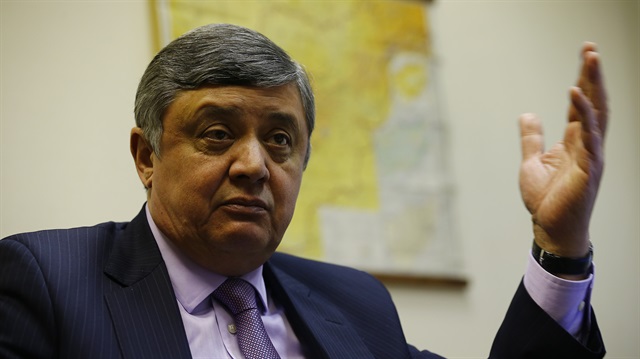
Russian presidential envoy to Afghanistan Kabulov
The U.S. prefers acting solo in the Taliban reconciliation process and does not take into account interests of Afghanistan's regional partners and neighbors, the Russian presidential envoy to Afghanistan said.
In an interview to Anadolu Agency, Zamir Kabulov said Moscow has been more inclusive in the process by inviting Washington in collective efforts to resolve the situation in Afghanistan.
The latest attempt was an invitation to the U.S. to a meeting in Moscow, the diplomat said.
The Moscow meeting was to be held on Sept. 4, but late in August Afghan President Ashraf Ghani proposed to postpone it because of a reshuffle in the government's power bloc.
Some experts voiced concern over possible refusal of the Taliban to come to Moscow once the meeting has been rescheduled to the convenience of the Kabul government, as the militant group does not recognize the present government in Afghanistan.
Nevertheless, Kabulov said Moscow expected Taliban to show up as the meeting provides a "unique opportunity" for dialogue with representatives of Afghanistan's neighbors and allies.
A particular hindrance to the meeting is the new Afghanistan National Security Council head Hamdullah Mohib. The 35-year-old is more west-oriented and not interested in an interaction with Moscow, political observers say.
Mohib previously represented Afghanistan as the country's ambassador to the United States. Mohib received a Western education and is married to a U.S. citizen Lael Adams, who is an expert on Afghanistan.
“Hanif Atmar (whom Mohib replaced at the office) was a strong and influential figure in the leadership of Afghanistan. His departure will undoubtedly affect the work of the office of the National Security Council, which also dealt with issues of national reconciliation," Kabulov said.
UN chief Antonio Guterres said in comments published Thursday that U.S. power is in decline as Washington loses its ability to impact world events.“I think that the soft power of the United States … is being reduced at the present moment,” Guterres said during an interview with the Atlantic magazine.Guterres warned the development poses unique challenges for the international community, because without Washington there "is no way to solve most of the problems in the world."“The United States is today involved in a number of conflicts of different natures—in relation to trade, in relation to other situations—and indeed that means that the … attraction of American society that was a dominant factor in international relations just a few decades ago is today less clear,” Guterres said.Guterres did not refer to the Trump administration by name, but his comments reflect an increasing number of trade spats the U.S. under President Donald Trump has become embroiled in, as well the U.S.'s withdrawal from major international accords and UN bodies.Guterres suggested the world today is "in pieces," moving away from a U.S.-led order to a multi-polar system that has yet to fully settle.“It’s inevitable that mono-state leadership of the international order will be more and more put into question,” he said.“Both the United States and the rest of the world need to be able to adapt to this new situation,” added Guterres.US Army mobilizes against lead hazards at bases around globeUS appoints ‘PKK commander’ to spearhead attacks against Syrian opposition in IdlibPompeo approves ongoing military aid to Saudi coalition'Moscow ready to make steps to improve Russia-US ties'
UN chief says US power in decline, world 'in pieces'
The White House rejected a claim Thursday that U.S. President Donald Trump offered $5 billion in aid to Palestine if it returns to the negotiating table with Israel.The claim was reported by Globes, an Israeli newspaper, which said the U.S. president was even willing to give more than the amount proposed, according to anonymous diplomatic sources who spoke to Globes."Either the Palestinians continue their refusal and stubbornness, in which case the PA [Palestine Authority] will sink into a severe economic crisis, or the Palestinian leadership straightens up, comes to talk, and gets political and economic independence," the Globes wrote.Trump's Special Representative on International Negotiations Jason Greenblatt responded saying that it was completely false and no such offer was made."Fact: False. When the peace plan is released, if the PA [Palestinian Authority] is serious about peace wants to improve Palestinian lives, the PA should want to review the plan engage. It is an absurd idea to pay $5b for a party to ‘return to the negotiating table.’ How would that accomplish peace??" Greenblatt said on Twitter.The U.S. has taken steps in recent months to cut funding and resources to Palestinian interests, including cutting aid to Palestine and shutting down the office of the Palestinian mission in Washington.The steps have been seen as the U.S.'s approach to its plan for Middle East peace.Turkey slams US decision to close Palestine Liberation OrganizationUS shutters Palestine Liberation Organization's missionUS aid cut to East Jerusalem hospitals ‘catastrophic'
US denies $5 billion offer in aid to Palestine
Turkey’s Foreign Minister said early Friday that Washington should reconsider its alliances in Syria as the Assad regime prepares to launch a bloody offensive on northwestern Idlib province.In a letter to The New York Times titled 'A Looming Disaster in Syria', Mevlut Cavuşoğlu warned that the YPG terrorist group has struck an alliance with Bashar al-Assad and is sending troops to help him recapture Idlib from the rebels.“The alliance has grown deeper since senior leaders of the so-called Syrian Democratic Forces, spearheaded by the YPG, held formal talks with the Syrian regime to carve out a place for themselves in the new Syria,” he said."Having YPG forces operating from Syria, just miles from the border of Turkey, is untenable. It’s time for Washington to assess who its real allies in the region are."Located near the Turkish border, Idlib province is home to more than 3 million Syrians, many of whom fled from other cities following attacks by regime forces.The Syrian regime recently announced plans to launch a major military offensive in Idlib, which has long been controlled by various armed opposition groups.As a result, Turkey has been reinforcing its military presence on the border with Syria.The UN has warned that such an offensive would lead to the "worst humanitarian catastrophe in the 21st century".Cavusoglu also emphasized in the letter that the YPG is the Syrian affiliate of the PKK, which has led a violent terror campaign in Turkey for more than 30 years and that Turkey, the U.S. and the EU have listed the PKK as a terrorist organization.In its more than 30-year terror campaign against Turkey, the PKK has been responsible for the deaths of some 40,000 people.US appoints ‘PKK commander’ to spearhead attacks against Syrian opposition in IdlibGerman, Russian foreign ministers to discuss SyriaTurkish FM meets Chinese envoy, Iraqi Turkmen leaderTurkey's UN envoy demands immediate cease-fire in IdlibLet’s stop the civil war in Syria’s Idlib: Turkish FM
US should reconsider its alliances in Syria: Turkish FM
'Moscow has little role, US none'
Responding to the U.S. State Department statement on the absence of significant results of the first meeting in Moscow regarding the Afghan peace process, Kabulov said: "The indisputable achievements of the Moscow meeting in April 2017 are: the recognition by participants of the futility of using force on the armed opposition, the need to find a pan-Afghan agreement by political means, and the collective appeal voiced by Afghanistan and regional countries to the Taliban movement to abandon armed confrontation."
"From the events held under the auspices of the United States, we do not see even such small steps that would contribute to the launch of the intra-Afghan peace process," Kabulov said.
Kabulov rejected the U.S. refusal for attending the Moscow meeting on the pretext that the Afghan side was not leading it.
“This thesis seems far-fetched to us, because the meeting was scheduled under the joint chairmanship of the Russian and Afghan delegations, as Washington was informed. Apparently, Americans participate only in such meetings, which are held under their leadership and meet the interests of the United States," he added.
At the same time, Kabulov, acknowledged that the U.S. is a key player in Afghanistan because of its military presence, leadership of the NATO mission in the country, and financial assistance to the Kabul government.
"It is no coincidence that the Taliban movement declares its readiness to negotiate peace with them (the U.S.), not with Kabul, with a precondition of the withdrawal of foreign, primarily American, troops from the country," he said.
A suicide bomber in Afghanistan killed at least 25 people at a gathering on Tuesday on the highway between the eastern city of Jalalabad and the main border crossing into neighbouring Pakistan, officials said.The blast, less than a week after a suicide attack killed more than 20 people in the capital, Kabul, came as violence has flared across the nation, with heavy fighting in northern provinces.Officials have warned violence is likely to intensify ahead of parliamentary elections next month and a presidential election in April.There was no immediate claim of responsibility for Tuesday's attack, although the Taliban issued a statement denying involvement.At least 25 bodies were taken to hospitals but the final total was unclear and could rise, said Inamullah Miakhel, a spokesman for the provincial health department.More Afghans displaced by drought than conflict, UN saysSohrab Qaderi, a member of the Nangarhar provincial council, said at least 56 bodies were taken to hospital, with 43 more wounded.The violence has dampened hopes of peace talks to end Afghanistan's 17-year conflict but two Taliban officials on Tuesday told Reuters the movement was preparing for another meeting with U.S. officials following one in July.Nangarhar, one of the main strongholds of Daesh fighters since early 2015, has been one of the most volatile regions this year, with a string of suicide bombings and attacks on its capital, Jalalabad.Officials and elders said Tuesday's attack targeted a gathering to protest against a police commander, adding that hundreds of people were present when the blast happened.The blast dispersed the crowd, but more people gathered after the explosion to continue the protest.Afghan Taliban prepare for new peace talks with USQaderi said rescue efforts were being hampered by reports of another suicide bomber in the area, making police and emergency services cautious about approaching the scene.The explosion followed a series of smaller blasts on Tuesday that targeted schools in Jalalabad and surrounding districts, killing at least one person and wounding three.In the northern province of Sar-e Pul, hundreds of armed men assembled to boost the city's defences as security forces fought to push the Taliban back from the city centre, said Zabihullah Amani, the provincial governor's spokesman.There were no reports of U.S. strikes in Sar-e Pul on Tuesday but there were three strikes on Monday, a spokesman for U.S. forces in Afghanistan said in an emailed statement.Two air strikes in Baghlan province on Tuesday followed six the day before and American advisers were on the ground supporting Afghan troops, the spokesman added.Ghulam Mohammad Balkhi, deputy spokesman for the Afghan army's 209 Corps, said at least 30 Taliban fighters were killed in the joint operation. 
Afghanistan suicide attack causes dozens of casualties as violence flares
A total of 275,000 people have been displaced by drought in western Afghanistan - 52,000 more than the number uprooted by conflict this year - with over two million threatened by the effects of water shortages, the United Nations said.Reports from the U.N. and aid charities described farmers lacking seeds to sow following crop failures in some areas and livestock dying for the want of anything to eat.Afghanistan, a country where nearly 20 million people rely on farming, has suffered a 45 per cent fall in agricultural output this year as the drought has bitten, officials at the ministry of agriculture have said.In a regular update, the U.N. humanitarian office reported that 120,000 people fleeing the drought arrived in Qala-e-Naw city in Badghis province in the week to Sept. 9.Afghan Taliban prepare for new peace talks with USA second U.N. report, with data covering August, said more than 100,000 people may have moved to Herat city for the same reason by the end of last month. It estimated 2.2 million Afghans would be affected by the drought this year.In Qala-e-Naw, where there are an estimated 66,500 drought-displaced people, supplies and humanitarian aid are already insufficient to meet the needs of newly arrived families.The U.N. cited an assessment by aid charity World Vision International that 99 percent of people in Badghis said their food situation was worse or a lot worse than a year ago.Taliban kill over 50 security personnel in Afghanistan"The assessment also indicates that most farmers lost last season's harvest and nearly all of them lack seeds for new planting season," the U.N. report said, noting reports that about 40 per cent of livestock has been lost in Badghis due to a lack of pasture and fodder.The Famine Early Warning Systems Network (FEWS NET), a U.S. funded food security monitoring service, said in a report on Aug. 31 that the number of Afghans in a food "crisis" was atypically high."Crisis" is step three on a five step scale, where four is "emergency" and five is "catastrophe" and possible famine.US Defence Secretary makes unannounced visit to AfghanistanIn Badghis and Faryab provinces, emergency outcomes are expected to emerge in January, FEWS NET said."Normally during this time period, food security outcomes begin to seasonally improve in much of the country, but due to drought and severe reduction in wheat production, reduced labor opportunities, and continued conflict more households face Crisis outcomes than normal," it said. 
More Afghans displaced by drought than conflict, UN says
The Taliban are preparing to send a delegation for further talks with U.S. officials about ending the conflict in Afghanistan, two officials involved with the process said on Tuesday, adding that the meeting could address a possible prisoner swap.The two officials, who spoke on condition of anonymity, said Taliban leaders were meeting to discuss the makeup of the three- or four-person delegation and the subjects to be discussed.They said the Taliban would like to discuss an exchange of prisoners and could hold another meeting soon if the United States showed seriousness in talks by releasing prisoners.Taliban kill over 50 security personnel in Afghanistan"This meeting will determine the future talks and we would see if the U.S. is serious and sincere in negotiation," one of the officials involved said."We would hand over a list of prisoners languishing in jails across Afghanistan. If they set free our prisoners then we would meet again for another great cause."If confirmed, the meeting would follow an earlier round of talks in Doha in July, where Taliban officials met Alice Wells, Principal Deputy Assistant Secretary for South and Central Asia at the U.S. State Department.US Defence Secretary makes unannounced visit to AfghanistanThe Taliban delegation at the planned upcoming meeting would be led by the head of the group's Qatar-based political office, Sher Mohammad Abbas Stanakzai, the officials said.However they said the high command was planning to replace Stanakzai, who has been serving as interim head, with a new permanent head of the Qatar office."You may know Sher Mohammad Abbas Stanakzai was deputed in the Qatar office on acting charge basis. The top leadership is now planning to appoint someone else in his place," one said.Eight Afghan police killed in insider attackHopes that peace talks to end the 17-year conflict in Afghanistan have stuttered in recent months, following the failure to agree a repeat of the unprecedented Eid ceasefire in June which saw unarmed Taliban fighters mingling with security forces in Kabul and other cities.Over the past year, the United States has stepped up air strikes against the Taliban and boosted training for Afghan forces. However U.S. officials say the goal is to reach a negotiated, Afghan-led settlement to end the war.On the Taliban side, the assault on the strategic city of Ghazni last month that killed hundreds of soldiers, police and civilians underlined the insurgents' determination to increase pressure on the Western-backed government in Kabul.Pakistan to help US bring Taliban to negotiating tableThe Taliban have maintained their refusal to negotiate directly with the internationally recognised Afghan government, which they consider an illegitimate regime put in place by foreign powers and say they will only talk to the United States.As the push for talks has picked up following the Eid ceasefire in June, the United States has agreed to participate directly and has appointed former U.S. ambassador to Kabul Zalmay Khalilzad as special envoy to reinforce the effort. Taliban says founder of militant Afghan Haqqani network dies
Afghan Taliban prepare for new peace talks with US