

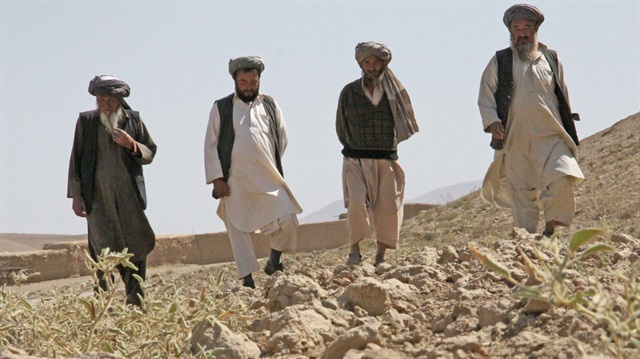
File photo
A total of 275,000 people have been displaced by drought in western Afghanistan - 52,000 more than the number uprooted by conflict this year - with over two million threatened by the effects of water shortages, the United Nations said.
Reports from the U.N. and aid charities described farmers lacking seeds to sow following crop failures in some areas and livestock dying for the want of anything to eat.
Afghanistan, a country where nearly 20 million people rely on farming, has suffered a 45 per cent fall in agricultural output this year as the drought has bitten, officials at the ministry of agriculture have said.
In a regular update, the U.N. humanitarian office reported that 120,000 people fleeing the drought arrived in Qala-e-Naw city in Badghis province in the week to Sept. 9.
The Taliban are preparing to send a delegation for further talks with U.S. officials about ending the conflict in Afghanistan, two officials involved with the process said on Tuesday, adding that the meeting could address a possible prisoner swap.The two officials, who spoke on condition of anonymity, said Taliban leaders were meeting to discuss the makeup of the three- or four-person delegation and the subjects to be discussed.They said the Taliban would like to discuss an exchange of prisoners and could hold another meeting soon if the United States showed seriousness in talks by releasing prisoners.Taliban kill over 50 security personnel in Afghanistan"This meeting will determine the future talks and we would see if the U.S. is serious and sincere in negotiation," one of the officials involved said."We would hand over a list of prisoners languishing in jails across Afghanistan. If they set free our prisoners then we would meet again for another great cause."If confirmed, the meeting would follow an earlier round of talks in Doha in July, where Taliban officials met Alice Wells, Principal Deputy Assistant Secretary for South and Central Asia at the U.S. State Department.US Defence Secretary makes unannounced visit to AfghanistanThe Taliban delegation at the planned upcoming meeting would be led by the head of the group's Qatar-based political office, Sher Mohammad Abbas Stanakzai, the officials said.However they said the high command was planning to replace Stanakzai, who has been serving as interim head, with a new permanent head of the Qatar office."You may know Sher Mohammad Abbas Stanakzai was deputed in the Qatar office on acting charge basis. The top leadership is now planning to appoint someone else in his place," one said.Eight Afghan police killed in insider attackHopes that peace talks to end the 17-year conflict in Afghanistan have stuttered in recent months, following the failure to agree a repeat of the unprecedented Eid ceasefire in June which saw unarmed Taliban fighters mingling with security forces in Kabul and other cities.Over the past year, the United States has stepped up air strikes against the Taliban and boosted training for Afghan forces. However U.S. officials say the goal is to reach a negotiated, Afghan-led settlement to end the war.On the Taliban side, the assault on the strategic city of Ghazni last month that killed hundreds of soldiers, police and civilians underlined the insurgents' determination to increase pressure on the Western-backed government in Kabul.Pakistan to help US bring Taliban to negotiating tableThe Taliban have maintained their refusal to negotiate directly with the internationally recognised Afghan government, which they consider an illegitimate regime put in place by foreign powers and say they will only talk to the United States.As the push for talks has picked up following the Eid ceasefire in June, the United States has agreed to participate directly and has appointed former U.S. ambassador to Kabul Zalmay Khalilzad as special envoy to reinforce the effort. Taliban says founder of militant Afghan Haqqani network dies
Afghan Taliban prepare for new peace talks with US
A second U.N. report, with data covering August, said more than 100,000 people may have moved to Herat city for the same reason by the end of last month. It estimated 2.2 million Afghans would be affected by the drought this year.
In Qala-e-Naw, where there are an estimated 66,500 drought-displaced people, supplies and humanitarian aid are already insufficient to meet the needs of newly arrived families.
The U.N. cited an assessment by aid charity World Vision International that 99 percent of people in Badghis said their food situation was worse or a lot worse than a year ago.
In a string of coordinated armed assaults in Afghanistan, the Taliban killed more than 50 security personnel while the government forces killed at least 150 militants, officials and local media confirmed on Monday.Amruddin Danishjo, member of the Jawzjan provincial council, told Anadolu Agency the Taliban overran a number of security check points in Khamaab district of the province, killing 10 security personnel. The Taliban have also surrounded 50 security personnel in the district center, cutting their supply lines.A number of former pro-government militants have joined the Taliban in Jawzjan, he added.According to local Tolo News, the Taliban have created check points on the main highway linking Jawzjan with neighboring Sar-e-Pul province, posing a grim threat to the provincial center. Zabihullah Amani, governor of Sar-e-Pul, urged the Kabul government to urgently send additional troops to safeguard the province from falling to the Taliban.Meanwhile, officials in Madian Wardak province confirmed on Monday scores of security personnel were killed in multiple raids on check points by the Taliban in the Daimurad district since Sunday night. Abdul Waheed, secretary of the provincial council, told Anadolu Agency the security forces pushed Taliban out of the district center after deadly clashes resulting in killings of more than 40 security personnel.Deadly clashes have also been reported in Kunduz province bordering Tajikistan.The Ministry of Defense noted in an official statement that 52 Taliban were killed in Maidan Wardak and at least 100 more in Paktia, Baghlan, Uruzgan, Ghazni, Helmand, Farah and Nangarhar provinces following air and ground operations.US Defence Secretary makes unannounced visit to AfghanistanEight Afghan police killed in insider attackTurkey condemns terror attacks in Afghan capital
Taliban kill over 50 security personnel in Afghanistan
"The assessment also indicates that most farmers lost last season's harvest and nearly all of them lack seeds for new planting season," the U.N. report said, noting reports that about 40 per cent of livestock has been lost in Badghis due to a lack of pasture and fodder.
The Famine Early Warning Systems Network (FEWS NET), a U.S. funded food security monitoring service, said in a report on Aug. 31 that the number of Afghans in a food "crisis" was atypically high.
"Crisis" is step three on a five step scale, where four is "emergency" and five is "catastrophe" and possible famine.
U.S. Defence Secretary Jim Mattis and the top U.S. general arrived in Kabul on Friday to meet the new commander of NATO troops in the country and discuss progress on peace talks with the Taliban, despite a deteriorating security situation and turmoil within the Afghan government.Mattis arrived in Afghanistan accompanied by Chairman of the Joint Chiefs of Staff Marine General Joseph Dunford. US, India seek to deepen defense ties and sign key accord
US Defence Secretary makes unannounced visit to Afghanistan
In Badghis and Faryab provinces, emergency outcomes are expected to emerge in January, FEWS NET said.
"Normally during this time period, food security outcomes begin to seasonally improve in much of the country, but due to drought and severe reduction in wheat production, reduced labor opportunities, and continued conflict more households face Crisis outcomes than normal," it said.