

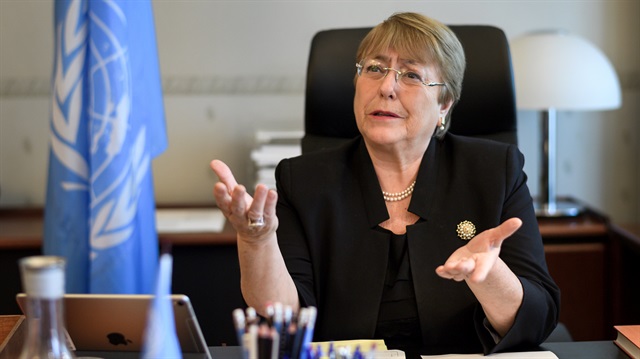
Michelle Bachelet
The UN's Human Right Council on Monday expressed concerns over "the ongoing military operations" and their impact on millions of civilians in Syria’s northwestern Idlib province.
In the keynote speech at the 39th session of the Human Rights Council in Geneva, UN High Commissioner for Human Rights Michelle Bachelet said: "We remind all parties to the conflict that they must adhere strictly to all relevant principles of international humanitarian law in the conduct of operations."
The impact of the conflicts on civilians should be minimized, humanitarian aid should be provided, and humanitarian corridors should be opened to ensure that the civilians safely leave conflict-affected areas, Bachelet added.
Opposition forces are waiting at the ready in Syria’s Idlib, where Russian and Syrian jets resumed intensive strikes as Damascus stepped up its assault on the opposition’s last major stronghold. The opposition is stationed in trenches close to areas where regime units are located, and also utilizes mostly self-made caves to protect themselves from air raids. These caves are extensive in length, are wide enough to fit vehicles, and boast various rooms and exit points.Opposition forms defense linesThe Syrian opposition has started to form defense lines in the Idlib and Hama countryside against the Assad regime and its allies. Trenches have been dug in line with defense lines at five different points, and shields made up of heavy weapons have also been formed.As the defense lines approach Idlib, precautionary measures increase: heavy weapons as well as more fighters are deployed. The last defense line has tunnels in order to ensure quick mobilization and enable reinforcements to be dispersed quickly.Regime forces have also been accelerating preparations and firing toward opposition zones. These forces have also been deployed to highpoints of the Idlib countryside, and use the air advantage to frequently launch mortar bombs and rockets.The opposition forces are on red alert on the defense lines. The fighters remain on duty and monitor the regime forces. The opposition has emphasized that they are ready to prevent attacks and that they will not allow a field operation to take place.Last opposition enclaveOpposition fighters and civilians who oppose the rule of President Bashar al-Assad fled to Idlib as the regime and its allies drove them out of other parts of Syria. Damascus, backed by allies Russia and Iran, has been preparing a major assault to recover Idlib and adjacent areas of the northwest.Before the war, Idlib had a population of 1.5 million but this figure has more than doubled. Located near the Turkish border, Idlib is home to more than 3 million Syrians, many of whom fled from other cities following attacks by regime forces.Idlib is of huge importance as it is the only city under opposition control in Syria. As for the strategic window, it neighbors Turkey in northwest and is next to Aleppo in the south, Aleppo's Afrin district in the northeast, Hama in south and Latakia in the northwest.For the Syrian opposition, it is their "last fortress." Also, the biggest armed groups fighting against the Assad regime are located in Idlib.Fall of Daraa makes Idlib all the more crucialThe Syrian regime and its allies most recently captured Daraa following a brutal offensive. Daraa, which is located at the intersection of Jordan, the occupied Golan region and Lebanon -- was declared a de-escalation zone in July 2017, when a trilateral cease-fire agreement was reached, with the U.S., Russia and Jordan as guarantors.However, Assad's forces, alongside Russia, began a ruthless offensive against the Daraa province on June 19 with daily bombing and shelling. The elderly, children and women were not safe from the attacks, and as a result, hundreds of thousands of civilians fled the area.After the fall of Daraa, the regime and its allies started mobilizing to attack Idlib. By claiming that Hayat Tahrir al-Sham, an armed anti-regime group that is a dominant force in Idlib, is a terrorist organization, the Assad regime bolstered efforts to legitimize a military offensive.Assad regime, Russia shell school in Syria’s Idlib, wound four childrenTurkey tells 50,000 FSA fighters to be ready for deployment as tensions rise in IdlibSyrian, Russian airstrikes target IdlibRussian and Syrian warplanes bombed Idlib during a trilateral summit between the leaders of Turkey, Russia and Iran to discuss the very matter of Idlib. Turkey and Western powers have warned of a bloodbath if a major Russian-backed bombing campaign is launched in the heavily populated northwestern province that borders Turkey.The bombing targets areas within a distance of 50 to 100 kilometers to the city center, and dozens, including children, have been killed while hundreds have been wounded. Hama has also been targeted by the intensive strikes.Video: Turkey deploys military vehicles to SyriaOpposition strikes backThe opposition, which is targeted by the regime and its allies, occasionally responds to the attacks with heavy weapons. The opposition struck back with rockets targeting regime forces stationed in Micenzerat, Sheikh Hadid, Hammamiyed and Sikelbiye.Opposition groups in IdlibOn May, 14 opposition groups fighting against the Assad regime united under the banner of "National Liberation Front." Faylaq al-Sham, the Nasr Army, Free Idlib Army, 1st Beach Division, 2nd Beach Division, 1st Firqah, Distinguished Army, Shuda al-Islam Dareyya, Al-Hurriyah Brigade, 23rd Firqah, Syrian Liberation Front, Jaish al-Ahrar and Shukuru Sham have formed the largest military establishment against the regime, consisting of more than 70,000 fighters.Hayat Tahrir al-Sham is the other dominant force in Idlib.After the Nusra Front, which was on the UN terrorism list, dissolved in early 2017, some 25,000 fighters formed Hayat Tahrir al-Sham. Despite the fact that many of its components left the group, it still controls Bab al-Hawa Border Crossing.Syria has been locked in a vicious civil war since early 2011 when the Assad regime cracked down on pro-democracy protests with unexpected ferocity.Since then, hundreds of thousands of people have been killed and more than 10 million others were displaced, according to UN officials.Galeri: Residents of Syria’s Idlib look to Turkey for security
Syrian opposition forces on red alert as Idlib offensive looms
"Accountability must be a corner-stone of the country's future," she said.
The Syrian regime has recently announced plans to launch a major military offensive in the area, which has long been controlled by various armed opposition groups.
The UN warned last week that such an offensive would lead to the "worst humanitarian catastrophe in the 21st century".
Located near the Turkish border, Idlib is home to more than 3 million Syrians, many of whom fled from other cities following attacks by regime forces.
Turkish Red Crescent, locally known as Kızılay, has sent 145 trucks loaded with humanitarian aid to northern part of Syria over the past month.The aid foundation delivered dry food, stationery, bread, medicine and clothes to needy people in countrysides of Idlib and Latakia cities.Speaking to Anadolu Agency, Hakan Sarı, head of border assistance operation, said they had been sending aid to the needy people since 2011, when the civil war started in the country.“Totally 145 trucks loaded with humanitarian aid have been sent to needy people particularly in Turkmendagi and Jabal al-Akrad regions of Idlib and Latakia countrysides within 30 days, thanks to our foundation and philanthropists,” Sarı said.The aid efforts will continue, he added.Syria has only just begun to emerge from a devastating civil war that began in 2011. Since then, hundreds of thousands of people have been killed in the conflict and millions more displaced, according to the UN.Turkey currently hosts nearly 3.5 million Syrian refugees, more than any other country in the world.Turkish aid officials fear mass migration from IdlibWhite Helmets: Syria's savior angelsIdlib offensive could trigger new wave of migration to Europe, Turkey
Turkish Red Crescent sends aid to Syria's Idlib, Latakia
Call to establish independent mechanism to probe Myanmar
Bachelet also commented on a recent UN report on Myanmar’s human rights violations and abuses.
She said, "This Council session will be apprised of the deeply shocking findings of the Independent International Fact-Finding Mission on Myanmar."
She referred to the report where the UN documented mass gang rapes, killings -- including of infants and children -- brutal beatings, and disappearances committed by Myanmar state forces.
Turkey alone hosts half of Syrian refugees abroad, making it the country with the highest number of asylum seekers in the world with 4.5 million currently living there, according to recent data. Of the 4.5 million refugee population in Turkey, 3.5 million are Syrian refugees who fled the raging civil war in their country, which placed a heavy burden on Ankara as it shielded Europe from an even worse migration crisis.During the Tehran summit last week, Turkish President Recep Tayyip Erdoğan said Turkey has reached its capacity in taking in refugees, signaling Ankara’s reluctance to admit more migrants in the event of an influx from Syria’s Idlib region.The president of Turkey, Russia and Iran met to discuss the fate of Idlib as rival factions there prepared for what could be the Syrian conflict’s last great battle.In his remarks in Tehran, Erdoğan said any attack on Idlib would result in a disaster and that millions of civilians there would be moving toward the Turkish border.Video: Airstrikes kill five civilians in Syria’s IdlibThe Syrian regime has recently announced plans to launch a major military offensive in the area, which has long been controlled by various armed opposition groups.The UN warned earlier this week that such an offensive would lead to the "worst humanitarian catastrophe in the 21st century."Turkey home to 4.5 million refugeesWhile Turkey hosts the largest number of refugees overall at 4.5 million, neighboring Lebanon is home to the highest percentage of refugees per capita. Coming in second and third place, Pakistan and Lebanon each host 1.6 and 1.1 million refugees, respectively.Assad regime, Russia shell school in Syria’s Idlib, wound four childrenTurkey tells 50,000 FSA fighters to be ready for deployment as tensions rise in IdlibUS hosts 271,000 refugeesMeanwhile, with its population of over 300 million, the U.S. only hosts 271,000 refugees compared to Jordan, Egypt and Sweden which each host 650,000 226,000 and 169,000 people, respectively.Over 30,000 Syrians in camps As thousands of Syrian continue to return to their country following Turkish operations that cleared their towns and cities from terror elements, 40 camps were set up by Turkish NGOs in Syria that currently house 30,000 refugees.In recent days, Turkey has ramped up its preparations to meet the needs of additional refugees as it braces for a possible wave of a mass migration in the case of an attack against Idlib.Footage shows White Helmets rescuers targeted in IdlibTurkey hosts half of Syrian refugeesWith 6.1 million externally displaced Syrians in diaspora, Turkey alone hosts over 3.5 million, more than double the number of refugees than the whole of the EU.Idlib attack to trigger migration wave of 2 million refugeesDue to its proximity to the Turkish border and relative security throughout the civil war, the population of Syria’s northwestern Idlib province has swelled to 4 million after evacuation deals brokered with the regime forced hundreds of thousands of Syrian opposition fighters and their families to leave their hometowns, turning the previously sparsely populated region into a sanctuary for those opposing Assad. Close to a million of Idlib’s population lives in close to 200 camps at ground zero near the Turkish border. A possible attack against Idlib would trigger a wave of mass migration towards Turkey’s Hatay, which is a major source of concern for Turkey. In addition to risking the lives of hundreds of thousands of civilians in Idlib, an offensive will trigger a migration wave of 2 million refugees bound for Turkey and Europe, which could see terrorist elements attempting to cross the borders among those seeking asylum, possibly compounding security concerns across the continent.Turkey has been a main route for irregular migrants trying to cross into Europe, especially since 2011 when the Syrian civil war began.
Turkey welcomes half of the world’s Syrian refugees
In the report issued by the UN Independent International Fact-Finding Mission on Myanmar, UN investigators said the violations may have constituted crimes against humanity.
Bachelet called on member states at the council to establish an "independent international mechanism" for Myanmar to collect, consolidate, preserve, and analyze evidence of the most serious international crimes in order to expedite fair and independent trials in national and international courts.
The commissioner added: "This mechanism would also complement and support the preliminary examination of the ICC [International Criminal Court] Prosecutor."
Last week, ICC ruled it could investigate Myanmar for the alleged deportation of Rohingya to Bangladesh as a possible crime against humanity.
The unprecedented decision could expose the country’s politicians and army generals to charges.
The 39th Human Rights Council is held between Sept. 10-28 at the UN headquarters in Geneva.
The council will discuss human rights violations in Syria, Yemen, the occupied Palestinian territory, South Sudan, Somalia, Libya, as well as in the Democratic Republic of Congo.
The three-week session will be carried out with the participation of 25 independent human rights experts, groups and mechanisms.