

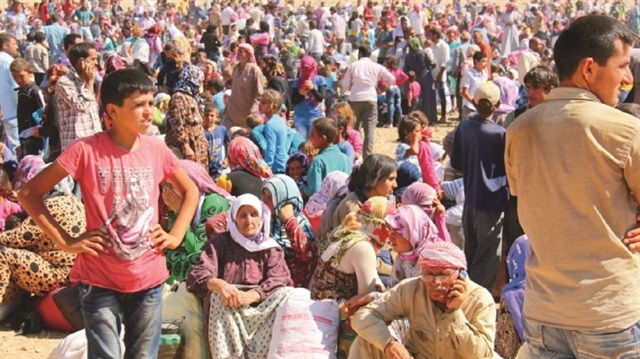
File photo
Turkey alone hosts half of Syrian refugees abroad, making it the country with the highest number of asylum seekers in the world with 4.5 million currently living there, according to recent data.
Of the 4.5 million refugee population in Turkey, 3.5 million are Syrian refugees who fled the raging civil war in their country, which placed a heavy burden on Ankara as it shielded Europe from an even worse migration crisis.
During the Tehran summit last week, Turkish President Recep Tayyip Erdoğan said Turkey has reached its capacity in taking in refugees, signaling Ankara’s reluctance to admit more migrants in the event of an influx from Syria’s Idlib region.
The president of Turkey, Russia and Iran met to discuss the fate of Idlib as rival factions there prepared for what could be the Syrian conflict’s last great battle.
In his remarks in Tehran, Erdoğan said any attack on Idlib would result in a disaster and that millions of civilians there would be moving toward the Turkish border.
Five civilians were killed and seven others injured in airstrikes carried out by Syrian regime forces and Russian warplanes in Syria's northwestern Idlib province on Saturday, according to the White Helmets civil defense agency.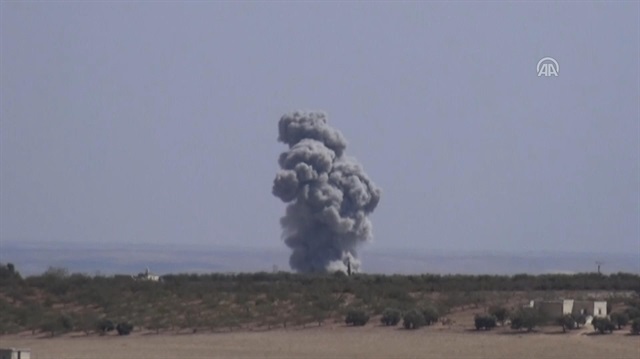
Airstrikes kill five civilians in Syria’s Idlib
The Syrian regime has recently announced plans to launch a major military offensive in the area, which has long been controlled by various armed opposition groups.
The UN warned earlier this week that such an offensive would lead to the "worst humanitarian catastrophe in the 21st century."
Turkey home to 4.5 million refugees
While Turkey hosts the largest number of refugees overall at 4.5 million, neighboring Lebanon is home to the highest percentage of refugees per capita.
Coming in second and third place, Pakistan and Lebanon each host 1.6 and 1.1 million refugees, respectively.
The Syrian regime and Russia on Monday shelled a school and wounded four children in Jarjnaz village of Syria’s Idlib, the country's last major opposition-held stronghold.According to a statement issued by civil defense group The White Helmets, Since Monday morning, a total of 17 civilians, the majority of whom are women and childre, were injured in Syrian regime airstrikes.A total of 29 civilians were killed and 71 others were injured in Idlib and Hama over the past nine days as result of intensified aerial bombardment by the Syrian regime and Russia.Syrian opposition forces on red alert as Idlib offensive loomsTurkey tells 50,000 FSA fighters to be ready for deployment as tensions rise in IdlibAccording to opposition sources, ongoing aerial bombardment since the morning hours has targeted the towns of al-Habit, Jarjanaz, Heesh, al-Tamanea in southern Idlib, and al-Lataminah in the adjacent Hama province.The Syrian regime has recently announced plans to launch a major military offensive in the area, which has long been controlled by various armed opposition groups.The UN warned earlier this week that such an offensive would lead to the "worst humanitarian catastrophe in the 21st century."#NEWS Air and artillery strikes against civilian infrastructure and rebel positions in #Idlib continue.Pictures from today.In the morning, a school was shelled with artillery, injuring 4 children in it.#Syria pic.twitter.com/A8oiXGXlEL— Julian Röpcke (@JulianRoepcke) 10 Eylül 2018 
Assad regime, Russia shell school in Syria’s Idlib, wound four children
As the Assad regime and Russian warplanes viciously attack the last opposition-held stronghold of Syria’s Idlib, Turkey ramped up its military reinforcements in northern Syria and instructed over 50,000 Free Syrian Army (FSA) fighters stationed in Afrin, Azaz, Jarabulus, al-Bab and al-Rai to “be ready for military deployment.”The number of Turkish soldiers dispatched to northern Syria exceeded 30,000 in the areas within the scope of the Euphrates Shield and Olive Branch operations and Idlib. The Turkish army also doubled its armored vehicles and tanks deployed at the Syrian border and dispatched missile platforms, artillery batteries at strategic points.Turkish forces are present at 12 points from Idlib's north to south, which are currently being fortified with cement walls and bulletproof watch towers against a regime attack.The Syrian regime has recently announced plans to launch a major military offensive in the area, which has long been controlled by various armed opposition groups.The UN warned earlier this week that such an offensive would lead to the "worst humanitarian catastrophe in the 21st century."Video: Turkey deploys military vehicles to SyriaFifty thousand opposition fighters ready for a major battle Turkey also requested that the Free Syrian army report and list their number of troops, weapons and ammunition. The FSA currently has 30,000 troops under the banner of the “Syrian National Army” in the areas within the scope of the Euphrates Shield and Olive Branch operations and will transfer 20,000 of them to Idlib. The National Front for Liberation, which was formed in May in northwestern Idlib and includes eleven opposition groups, has also a total of 30,000 fighters. The formation includes the following groups: Sham Legion, Jaysh al-Nasr, Free Idlib Army, 1st Costal Division, 2nd Costal Division, 1st Division, 2nd Army, Army of Elites, Shuhada al-Islam Darayya, al-Hurriyat Brigade, and 23rd Division.These groups have been operating in Idlib and the northern part of Hama under the banner of the Free Syrian Army.Turkish minister warns of mass migration from IdlibArab media highlights Erdoğan’s efforts for IdlibRussia and Assad regime target civiliansRussia and Assad regime have escalated their attacks on Syria’s Idlib and shelled 58 separated points in the last two days alone.At least 29 people, the majority of whom are civilians, were killed in land and air strikes in the towns of Idlib’s Jisr al-Shughur, Sahel Al-Gab and Morek.Located near the Turkish border, Idlib is home to more than 3 million Syrians, many of whom fled from other cities following attacks by regime forces.Erdoğan says Idlib assault would be ‘a grave massacre’“We won’t watch from the sidelines”“An attack on Syria's Idlib, the last opposition-held stronghold, would be a grave massacre,” Turkish President Erdoğan said ahead of the Tehran summit that was held as a part of the Astana process, which aims to find a lasting solution to the turmoil in Syria.Stressing the vicious attacks of the Assad regime and Russia, Erdoğan also underlined that “Turkey won’t watch the killings of tens of thousands of innocent people from the sidelines.”The presidents of Iran, Russia and Turkey gathered in Iran's capital Tehran on Friday to discuss the fate of the opposition-held province of Idlib.
Turkey tells 50,000 FSA fighters to be ready for deployment as tensions rise in Idlib
US hosts 271,000 refugees
Meanwhile, with its population of over 300 million, the U.S. only hosts 271,000 refugees compared to Jordan, Egypt and Sweden which each host 650,000 226,000 and 169,000 people, respectively.
Over 30,000 Syrians in camps
As thousands of Syrian continue to return to their country following Turkish operations that cleared their towns and cities from terror elements, 40 camps were set up by Turkish NGOs in Syria that currently house 30,000 refugees.
In recent days, Turkey has ramped up its preparations to meet the needs of additional refugees as it braces for a possible wave of a mass migration in the case of an attack against Idlib.
A footage showed Russian and regime jets targeting teams of the White Helmets while rescuing civilians in Syria’s northwestern Idlib province.The video showed a team of the White Helmets, a local civil defense agency, while extinguishing a fire that broke out after an airstrike in Khan Sheykhun.Anas Diab, a civil defense member, was injured while capturing the video and pleaded for help by others around him when another strike hit the area near him.Diab was later hospitalized after being dragged out of the area with the help of civilians.The White Helmets have saved the lives of tens of thousands of civilians after attacks by the Bashar al-Assad regime and allies.Established in 2013, the civil defense agency consists of more than 3,000 members.The teams of the civil defense agency, which was nominated for the 2016 Nobel Peace Prize, carry out search and rescue efforts, while giving municipality services to the people at the same time.They also inform the people in the region about the mines, improvised explosives and clearance of unexploded bombs.Until now, they have rescued at least 115,000 civilians from the debris of bombardment by regime forces and allies.The White Helmets, which work devotedly to save the lives of Syrian people, have lost 255 workers until today.They also include 230 volunteer female workers.In 2013, the White Helmets teams were trained by Turkey’s Search and Rescue Association, AKUT.
Footage shows White Helmets rescuers targeted in Idlib
Turkey hosts half of Syrian refugees
With 6.1 million externally displaced Syrians in diaspora, Turkey alone hosts over 3.5 million, more than double the number of refugees than the whole of the EU.
Idlib attack to trigger migration wave of 2 million refugees
Due to its proximity to the Turkish border and relative security throughout the civil war, the population of Syria’s northwestern Idlib province has swelled to 4 million after evacuation deals brokered with the regime forced hundreds of thousands of Syrian opposition fighters and their families to leave their hometowns, turning the previously sparsely populated region into a sanctuary for those opposing Assad.
Close to a million of Idlib’s population lives in close to 200 camps at ground zero near the Turkish border.
A possible attack against Idlib would trigger a wave of mass migration towards Turkey’s Hatay, which is a major source of concern for Turkey.
In addition to risking the lives of hundreds of thousands of civilians in Idlib, an offensive will trigger a migration wave of 2 million refugees bound for Turkey and Europe, which could see terrorist elements attempting to cross the borders among those seeking asylum, possibly compounding security concerns across the continent.
Turkey has been a main route for irregular migrants trying to cross into Europe, especially since 2011 when the Syrian civil war began.