

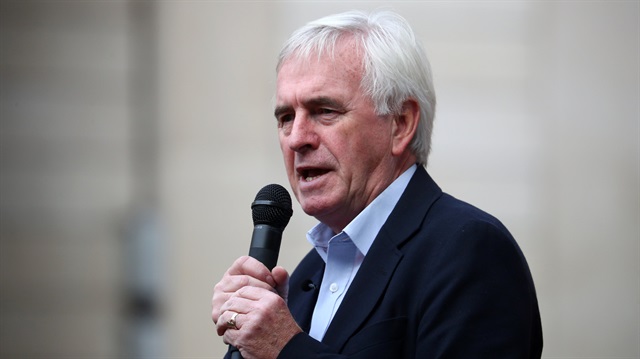
The Labour Party's John McDonnell
Britain's opposition Labour Party would keep the option for a second vote on any Brexit deal struck with the European Union on the table but it would prefer a national election to sort out the issue, its finance spokesman said on Monday.
"We believe general election is the best solution because people can then have a wide-ranging debate and also then choose the team that would then do the negotiations," John McDonnell told Sky News.
"If we can't get a general election, we've kept the option of People's Vote on the table and that's what we'll go for, but I'd much prefer a general election," he said, adding a second vote would be on the deal itself rather than leaving the EU because the party would respect the outcome of the 2016 referendum.
Britain said on Saturday it would not capitulate in Brexit talks and again urged its EU partners to engage with its proposals, as ministers in Paris and Berlin suggested the next move in the negotiations should come from London.British Prime Minister Theresa May on Friday demanded new proposals and respect from European Union leaders, saying after a summit in Austria that talks had hit an impasse - a position her foreign minister reinforced on Saturday, even if that meant leaving the bloc next March without a deal."If the EU's view is that just by saying no to every proposal made by the United Kingdom, we will eventually capitulate and end up either with a Norway option or indeed staying in the EU... then they've profoundly misjudged he British people," Jeremy Hunt told BBC radio."We may be polite, but we have a bottom line. And so they need to engage with us now in seriousness."May's defiant statement was welcomed on Saturday by many in the British press that had seen the Salzburg summit as a failure for her. The Daily Express said it was "May's finest hour".France sees Brexit deal possible, but must prepare for 'no deal'DIGGING INBut initial reactions from across the English Channel suggested France and Germany were digging in too.EU leaders and May have said they want to get a deal agreed in October, to be finalised in November.In Paris, Minister for European Affairs Nathalie Loiseau said that, while France still believed a good Brexit deal was possible, it must also prepare for a 'no deal' outcome.Britain's vote to leave "cannot lead to the EU going bust," she said on France Info radio. "...That's the message we have tried to send for several months now to our British counterparts, who may have thought we were going to say 'yes' to whatever deal they came up with."In Berlin, German Deputy Foreign Minister Michael Roth said the other 27 EU states were striving to achieve reasonable solutions. "The blame game against the EU is therefore more than unfair. We can't solve the problems that are arising on the island (Britain) due to Brexit," he said on Twitter.In London, the Telegraph reported that May faced the prospect of ministerial resignations next week if she failed to come up with an alternative to the "Chequers" Brexit plan that she presented in Austria.After May's Friday statement, European Council President Donald Tusk said that the results of the EU's analysis of that plan had been known to Britain for many weeks. But Hunt said there was a difference between rhetoric and substance."On the substance of the Chequers proposals, we have not had a detailed response," he said, adding that EU proposals for the Irish border would mean that it was impossible "to leave the EU intact as one country".Hunt also said Britain's economy would be able to withstand a no-deal Brexit, saying it was "absolutely right" that many Britons were now content to leave the EU without a deal.Around 52 percent of Britons voted to leave the EU in a referendum in 2016 and 48 percent to stay."Even in a situation where we aren't able to come to an agreement, we would be trading on World Trade Organisation terms. It would be bumpy, it would be difficult, but we would find a way to survive and prosper as a country," Hunt said."We've had far bigger challenges in our history. But it's not our desired outcome."In Berlin, magazine Der Spiegel said Germany's government expected the impact of a no-deal Brexit on its labour market to be "relatively small". It cited a government response to a request for information from the far-left Linke party.
Britain tells EU to engage seriously on Brexit, EU demurs
France still believes that a good deal on Brexit is possible but the country must prepare for the possibility of Britain and the European Union failing to reach an agreement on its divorce from the bloc, a minister said on Saturday."Let's imagine we don't reach an agreement. What we say is we must prepare for that," Nathalie Loiseau, minister for European affairs, told France Info radio. May says Brexit talks have hit impasse, EU must produce alternative plansBrexit talks stall as EU rejects Chequers plan
France sees Brexit deal possible, but must prepare for 'no deal'
British Prime Minister Theresa May said on Friday the European Union must come up with an alternative to her Brexit proposals, saying talks had reached an impasse after bloc's leaders had rejected her plans without explaining why.At a summit in Austria on Thursday, EU leaders said they would push for a Brexit deal next month but rejected May's "Chequers" plan, saying she need to give ground on trade and arrangements for the UK border with Ireland."It's not acceptable to simply reject the other side's proposals without a detailed explanation and counter proposals," May said in a televised statement."So we now need to hear from the EU what the real issues are, what their alternative is, so that we can discuss them. Until we do, we cannot make progress."Brexit talks stall as EU rejects Chequers planMay said she could not agree to any deal which treated Northern Ireland differently to the rest of the United Kingdom.The EU insists that there can be no hard border between the British province and the Irish Republic, with Northern Ireland remaining in the bloc's customs union or effectively establishing a border in the Irish Sea if no alternative deal is reached.May cited Britons' vote in 2016 to leave the EU. "I will not overturn the result of the referendum nor will I break up my country," she said. "We need serious engagement on resolving the two main problems in the negotiations and we stand ready."Earlier, her Brexit Secretary Dominic Raab said some EU leaders had shown unstatesmanlike behaviour in Salzburg."We've already compromised hugely with the Chequers proposals. We've engaged and we want to hear more about what the real critique of it is and we've got no other credible alternatives on the table," Raab told the BBC."What we're not going to do is be salami sliced throughout this negotiation in a typical style that the EU engages in without movement on the other side.""YOUR BREXIT'S BROKEN"For the British media, the message from Salzburg was clear."Your Brexit's broken," the Daily Mirror newspaper said.Newspapers led their front pages with a Reuters picture showing May, dressed in a red jacket, standing apparently aloof and alone from a mass of suited male EU leaders.Few diplomats expected any breakthrough from the Salzburg summit as the EU has repeatedly made clear that May must rework the Chequers proposals.The tone of some of their comments, particularly the irony of European Council President Donald Tusk, left May exposed at home as she heads into what is expected to be a tumultuous annual conference of her Conservative Party from Sept. 30. 
May says Brexit talks have hit impasse, EU must produce alternative plans
With just over six months left before the UK exits the European Union, uncertainty is high, with the terms of a new relationship between the two sides still being negotiated.Talks between EU leaders and British Prime Minister Theresa May on reaching a deal have had their high and low points since the UK triggered divorce proceedings from the bloc in March 2017, but neither side has been completely satisfied with the progress made.May, who is quite keen to strike a deal with EU leaders before the end of this year, has been accused of making too many concessions to European negotiators -- not only by those who voted to leave the union but also by some members of her cabinet, who are also unhappy with the latest British proposal dubbed Chequers, named after the prime minister's country retreat.The Chequers plan caused an immediate stir in May’s cabinet and prompted two key officials to resign -- Foreign Secretary Boris Johnson and Brexit Secretary David Davis. In the House of Commons, meanwhile, the number of Tory MPs who are against the latest plan to adopt a common rulebook with the EU as part of Chequers is on the rise.Merkel urges swift progress in Brexit talksUK PM May says October too soon for Brexit dealSalzburg summitMay’s Chequers plan hit a new low this week when it was openly rejected by EU officials and leaders of some member countries at an informal summit in Salzburg, Austria.May told the summit the UK would not seek to delay Brexit or hold a second referendum and asked the EU to be more flexible in future talks over her plan, which she presented to the EU for the first time.She underlined that Britain would not agree to any extension for negotiations and that a deal should be reached or the UK would leave the EU without one on March 29, 2019.At a heated press conference, May said there is a “willingness for a deal", but “let nobody be in any doubt that we are preparing for no deal”.Both the UK and the EU would like to see a deal signed before the end of the year, as it would leave probably just enough time for it to be ratified in the House of Commons and by the parliaments of the bloc’s 27 member countries before the exit date."We all recognize that time is short, but delaying or extending these negotiations is not an option,” May told EU leaders in Salzburg."I know that for many of you, Brexit is not something you want. But it's important to be clear: there will be no second referendum in the UK."The public has delivered its verdict, and I as prime minister will deliver upon that - the UK will leave on the 29th of March next year…I believe I have put forward serious and workable proposals. We will of course not agree on every detail, but hopefully you will respond in kind."The onus is now on all of us to get this deal done."EU leaders keep up pressure on May to take Brexit deal Irish BorderThe border between the Republic of Ireland and Northern Ireland will become the only land border between the UK and EU after Brexit.Since the 1998 Belfast Agreement, there has been an invisible border between the two sides.But no one would like to see a hard border there with checkpoints and customs officers due to sensitivities in the region, and a solution that would work for the UK, the EU, Ireland and Northern Ireland – all of whom prefer the status quo – must be found.May’s proposal under her Chequers plan is to adopt a common rulebook for goods and services and keep the standards within the UK the same with the EU’s so trade is not disturbed and it would not necessitate any checks on the border.She has rejected a solution where checks could be done away from the border on both sides, saying it would still be a hard border.Irish foreign min says intensified talks needed to reach Brexit dealEU's Tusk says will call special Brexit summit mid-NovemberUnder pressureNow that the Salzburg summit is over with no support for May’s Chequers plan, the negotiators are expected to work on a deal that is acceptable for both the UK and the EU.At home, the already heavy pressure on May will continue to build as she defends the government’s Brexit White Paper at the Conservative Party Conference from Sept. 30-Oct. 3.Surely her Brexit team will again look to the Chequers plan for solutions to sticking points. But it is unclear whether she can make more concessions to EU demands, especially their insistence that she accept a “backstop” plan that would come into play if all options fail but which many think would damage the UK’s integrity as it aims to keep Northern Ireland in the customs union under EU rules.A Brexit deal could still be within reach with more flexibility from all sides, in what May described as ‘negotiation tactics’, and the next opportunity will be at the European Council Summit in October.If progress can be made there, the EU will call an emergency Brexit summit in November. Otherwise, there will be a "no deal" scenario at the end of next March.
Brexit talks stall as EU rejects Chequers plan