

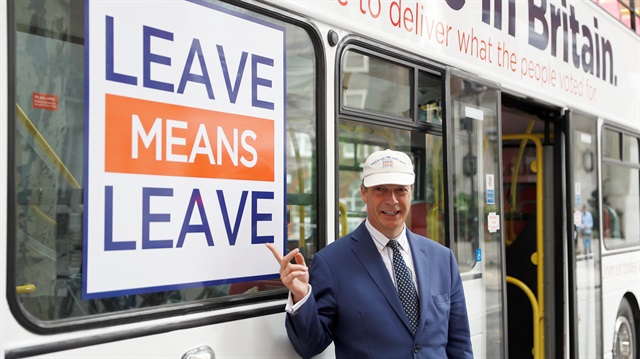
File photo: Nigel Farage poses for pictures as he launches Leave Means Leave's campaign against Britain's Prime Minister Theresa May's Chequers Brexit plan, in central London, Britain, September 20, 2018.
With just over six months left before the UK exits the European Union, uncertainty is high, with the terms of a new relationship between the two sides still being negotiated.
Talks between EU leaders and British Prime Minister Theresa May on reaching a deal have had their high and low points since the UK triggered divorce proceedings from the bloc in March 2017, but neither side has been completely satisfied with the progress made.
May, who is quite keen to strike a deal with EU leaders before the end of this year, has been accused of making too many concessions to European negotiators -- not only by those who voted to leave the union but also by some members of her cabinet, who are also unhappy with the latest British proposal dubbed Chequers, named after the prime minister's country retreat.
The Chequers plan caused an immediate stir in May’s cabinet and prompted two key officials to resign -- Foreign Secretary Boris Johnson and Brexit Secretary David Davis. In the House of Commons, meanwhile, the number of Tory MPs who are against the latest plan to adopt a common rulebook with the EU as part of Chequers is on the rise.
German Chancellor Angela Merkel on Thursday called for swift progress in talks between the EU and the U.K. to finalize a Brexit deal in November.Speaking after an informal summit of EU leaders in Austrian city of Salzburg, Merkel said the leaders have discussed the latest developments in the Brexit negotiations with the U.K.“It was clear today that we need substantial progress by October, so that we could finalize everything in November,” she said.Macron calls May's Chequers plan 'unacceptable,' expects new proposals in OctMerkel underlined the importance of overcoming differences on the issues of security, cooperation in foreign policy and future trade relations between the U.K. and the EU.“Here, we all agreed that there can be no compromises on the issues of the EU’s Single Market. Michel Barnier would continue negotiations on this basis,” she stressed.The leaders were briefed by EU chief negotiator Michel Barnier on Thursday, a day after British Prime Minister Theresa May met the leaders from the remaining 27 EU states.UK PM May says October too soon for Brexit dealEU leaders keep up pressure on May to take Brexit deal
Merkel urges swift progress in Brexit talks
British Prime Minister Theresa May has indicated that she believes October is too soon to reach agreement on a deal with the European Union on the Irish backstop issue, BBC political editor Laura Kuenssberg said on Twitter.Kuenssberg was retweeting and commenting on a tweet from RTE Europe Editor Tony Connelly, which quoted sources saying that May had told Irish Prime Minister Leo Varadkar that a deal would not be reached in time for a European Council meeting in October.EU leaders keep up pressure on May to take Brexit dealIrish foreign min says intensified talks needed to reach Brexit deal
UK PM May says October too soon for Brexit deal
Salzburg summit
May’s Chequers plan hit a new low this week when it was openly rejected by EU officials and leaders of some member countries at an informal summit in Salzburg, Austria.
May told the summit the UK would not seek to delay Brexit or hold a second referendum and asked the EU to be more flexible in future talks over her plan, which she presented to the EU for the first time.
She underlined that Britain would not agree to any extension for negotiations and that a deal should be reached or the UK would leave the EU without one on March 29, 2019.
At a heated press conference, May said there is a “willingness for a deal", but “let nobody be in any doubt that we are preparing for no deal”.
Both the UK and the EU would like to see a deal signed before the end of the year, as it would leave probably just enough time for it to be ratified in the House of Commons and by the parliaments of the bloc’s 27 member countries before the exit date.
"We all recognize that time is short, but delaying or extending these negotiations is not an option,” May told EU leaders in Salzburg.
"I know that for many of you, Brexit is not something you want. But it's important to be clear: there will be no second referendum in the UK.
"The public has delivered its verdict, and I as prime minister will deliver upon that - the UK will leave on the 29th of March next year…I believe I have put forward serious and workable proposals. We will of course not agree on every detail, but hopefully you will respond in kind.
"The onus is now on all of us to get this deal done."
EU leaders lined up on Thursday to tell Theresa May she needs to give guarantees on the Irish border before they will grant her the Brexit deal the prime minister wants to avoid Britain crashing out of the bloc.Arriving for a second day of summitry in Austria, May's European Union peers rammed home their message on her plea for them to ease up on a "backstop" plan dealing with the border between the British province of Northern Ireland and EU member state Ireland.The backstop would keep Northern Ireland under EU economic oversight if London and Brussels cannot agree a trade pact to keep UK-EU borders open, an idea that May and a small party in the province that props up her minority government oppose."We have very clear principles regarding the integrity of the single market and regarding precisely the Irish border," French President Emmanuel Macron told reporters at the summit in Salzburg. "We need a UK proposal precisely preserving this backstop in the framework of a withdrawal agreement."Irish foreign min says intensified talks needed to reach Brexit dealIrish Prime Minister Leo Varadkar had his own early morning meeting with May, after she had asked the summit over dinner the previous night not to ask her effectively to divide the United Kingdom. But Varadkar warned that Dublin was gearing up for the talks to collapse without a deal if London refuses to budge."We're ready for that eventuality, should it occur. But I think we need to double our efforts over the next couple of weeks to make sure that we have a deal," he said.Leaders had listened politely to May for a few minutes around the summit dinner table, laid in the Salzburg theatre used in the finale of the "The Sound of Music" film. EU chief executive Jean-Claude Juncker said: "It was interesting, it was polite, it was not aggressive."She is doing her job."After dining on Wiener Schnitzel and wrangling for four hours over Europe's migrant problem, May was given the floor and tried to win over her 27 peers by asking them what they would do if they were asked to agree a "legal separation" of their countries.EU's Tusk says will call special Brexit summit mid-NovemberShe maintains that the backstop would divide Northern Ireland from the rest of the United Kingdom in terms of customs after Brexit day in March.Maintaining a united front that refuses to let May bypass the talks run by EU negotiator Michel Barnier, the 27 leaders did not respond to her. They will discuss the issue among themselves over lunch on Thursday, setting what Barnier hopes can be a path to a final deal in two months."GET THE DEAL DONE""I believe that I have put forward serious and workable proposals," May told the summit, according to a senior British government source. "We will of course not agree on every detail, but I hope that you will respond in kind."The onus is now on all of us to get this deal done."UK minister says new Brexit vote possible if parliament rejects May's planFor now, however, May faces criticism of her "soft Brexit" approach at her Conservative Party conference in 10 days and there as little sign of either side giving way.One of her party allies called her "Chequers" proposal for a close trade relationship with the EU that would ease the problem of the Irish border "delusional" and "dead as a dodo"."At this stage, it's a standstill. There is no progress," Lithuanian President Dalia Grybauskaite told Reuters.A senior EU diplomat said May seemed to be edging toward compromise, offering new proposals on how to avoid differing economic regulations disrupting trade and speaking of a "middle way".Former Brexit minister says Eu exit talks will need a 'reset'With barely six months until Britain leaves the EU, there is pressure on both sides as any failure to strike a deal to tie up legal loose ends brings the risk of serious disruption. "You can hear very clearly the clock ticking in the room," said the diplomat. "And that’s starting to have a psychological effect.”EU officials again said Britain had to move its own position over how to avoid erecting border posts on the Irish border, which will become Britain's only land frontier with the EU, as well as on future economic cooperation after Brexit day.A government source suggested Britain would come up with other proposals on Northern Ireland "in due course", but May has so far been reluctant to move from her Chequers plan, hashed out at her official country home in July. 
EU leaders keep up pressure on May to take Brexit deal
Irish Border
The border between the Republic of Ireland and Northern Ireland will become the only land border between the UK and EU after Brexit.
Since the 1998 Belfast Agreement, there has been an invisible border between the two sides.
But no one would like to see a hard border there with checkpoints and customs officers due to sensitivities in the region, and a solution that would work for the UK, the EU, Ireland and Northern Ireland – all of whom prefer the status quo – must be found.
May’s proposal under her Chequers plan is to adopt a common rulebook for goods and services and keep the standards within the UK the same with the EU’s so trade is not disturbed and it would not necessitate any checks on the border.
She has rejected a solution where checks could be done away from the border on both sides, saying it would still be a hard border.
Ireland's Foreign Minister said on Thursday that he believed a Brexit deal will be reached but that it will require an intensification of negotiations that has not happened to date.Simon Coveney was speaking as he launched the government's new 'Getting Ireland Brexit Ready' campaign, aimed at gearing the country up for all Brexit outcomes in what he said will be a more visible public campaign."This stepping up of our preparedness is going to be more visible from now on, but this should not be interpreted as a reflection of the state of play in the negotiations or in any way prejudge the outcome," Coveney told a news conference. EU's Tusk says will call special Brexit summit mid-NovemberUK minister says new Brexit vote possible if parliament rejects May's plan
Irish foreign min says intensified talks needed to reach Brexit deal
European Council President Donald Tusk said on Wednesday he would call an extra Brexit summit of European Union leaders around mid-November to finalise a deal with Britain.Tusk told a news conference before chairing a summit of all 28 EU leaders in the Austrian city of Salzburg later on Wednesday:"The Brexit negotiations are entering their decisive phase. Various scenarios are still possible today but I'd like to stress that some of Prime Minister May's proposals from Chequers indicated positive evolution in the UK's approach."Prominent British Conservative distances himself from Steve BannonUK minister says new Brexit vote possible if parliament rejects May's planTusk said that went for the UK's readiness to work closely with the EU on security and foreign policy after Brexit but stressed that Chequers proposals from premier Theresa May for the future Irish border and economic cooperation between the EU and Britain "will need to reworked and further negotiated"."Today there is perhaps more hope but there is surely less and less time," Tusk added. "Every day that is left we must use for talks. I'd like to finalise them still this autumn," he said. He would propose that the EU leaders hold another extra summit on Brexit around mid-November.
EU's Tusk says will call special Brexit summit mid-November
Under pressure
Now that the Salzburg summit is over with no support for May’s Chequers plan, the negotiators are expected to work on a deal that is acceptable for both the UK and the EU.
At home, the already heavy pressure on May will continue to build as she defends the government’s Brexit White Paper at the Conservative Party Conference from Sept. 30-Oct. 3.
Surely her Brexit team will again look to the Chequers plan for solutions to sticking points. But it is unclear whether she can make more concessions to EU demands, especially their insistence that she accept a “backstop” plan that would come into play if all options fail but which many think would damage the UK’s integrity as it aims to keep Northern Ireland in the customs union under EU rules.
A Brexit deal could still be within reach with more flexibility from all sides, in what May described as ‘negotiation tactics’, and the next opportunity will be at the European Council Summit in October.
If progress can be made there, the EU will call an emergency Brexit summit in November. Otherwise, there will be a "no deal" scenario at the end of next March.