

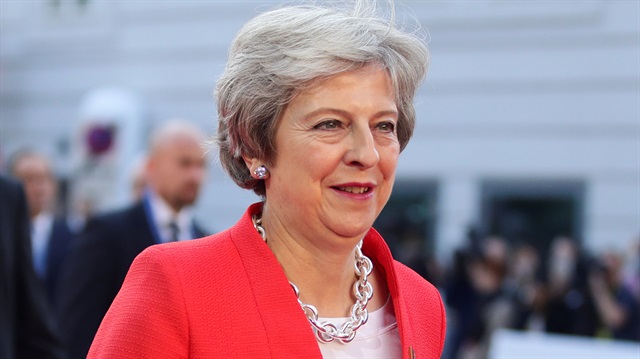
Britain's Prime Minister Theresa May
EU leaders lined up on Thursday to tell Theresa May she needs to give guarantees on the Irish border before they will grant her the Brexit deal the prime minister wants to avoid Britain crashing out of the bloc.
Arriving for a second day of summitry in Austria, May's European Union peers rammed home their message on her plea for them to ease up on a "backstop" plan dealing with the border between the British province of Northern Ireland and EU member state Ireland.
The backstop would keep Northern Ireland under EU economic oversight if London and Brussels cannot agree a trade pact to keep UK-EU borders open, an idea that May and a small party in the province that props up her minority government oppose.
"We have very clear principles regarding the integrity of the single market and regarding precisely the Irish border," French President Emmanuel Macron told reporters at the summit in Salzburg. "We need a UK proposal precisely preserving this backstop in the framework of a withdrawal agreement."
Ireland's Foreign Minister said on Thursday that he believed a Brexit deal will be reached but that it will require an intensification of negotiations that has not happened to date.Simon Coveney was speaking as he launched the government's new 'Getting Ireland Brexit Ready' campaign, aimed at gearing the country up for all Brexit outcomes in what he said will be a more visible public campaign."This stepping up of our preparedness is going to be more visible from now on, but this should not be interpreted as a reflection of the state of play in the negotiations or in any way prejudge the outcome," Coveney told a news conference. EU's Tusk says will call special Brexit summit mid-NovemberUK minister says new Brexit vote possible if parliament rejects May's plan
Irish foreign min says intensified talks needed to reach Brexit deal
Irish Prime Minister Leo Varadkar had his own early morning meeting with May, after she had asked the summit over dinner the previous night not to ask her effectively to divide the United Kingdom. But Varadkar warned that Dublin was gearing up for the talks to collapse without a deal if London refuses to budge.
"We're ready for that eventuality, should it occur. But I think we need to double our efforts over the next couple of weeks to make sure that we have a deal," he said.
Leaders had listened politely to May for a few minutes around the summit dinner table, laid in the Salzburg theatre used in the finale of the "The Sound of Music" film. EU chief executive Jean-Claude Juncker said: "It was interesting, it was polite, it was not aggressive.
"She is doing her job."
After dining on Wiener Schnitzel and wrangling for four hours over Europe's migrant problem, May was given the floor and tried to win over her 27 peers by asking them what they would do if they were asked to agree a "legal separation" of their countries.
European Council President Donald Tusk said on Wednesday he would call an extra Brexit summit of European Union leaders around mid-November to finalise a deal with Britain.Tusk told a news conference before chairing a summit of all 28 EU leaders in the Austrian city of Salzburg later on Wednesday:"The Brexit negotiations are entering their decisive phase. Various scenarios are still possible today but I'd like to stress that some of Prime Minister May's proposals from Chequers indicated positive evolution in the UK's approach."Prominent British Conservative distances himself from Steve BannonUK minister says new Brexit vote possible if parliament rejects May's planTusk said that went for the UK's readiness to work closely with the EU on security and foreign policy after Brexit but stressed that Chequers proposals from premier Theresa May for the future Irish border and economic cooperation between the EU and Britain "will need to reworked and further negotiated"."Today there is perhaps more hope but there is surely less and less time," Tusk added. "Every day that is left we must use for talks. I'd like to finalise them still this autumn," he said. He would propose that the EU leaders hold another extra summit on Brexit around mid-November.
EU's Tusk says will call special Brexit summit mid-November
She maintains that the backstop would divide Northern Ireland from the rest of the United Kingdom in terms of customs after Brexit day in March.
Maintaining a united front that refuses to let May bypass the talks run by EU negotiator Michel Barnier, the 27 leaders did not respond to her. They will discuss the issue among themselves over lunch on Thursday, setting what Barnier hopes can be a path to a final deal in two months.
"GET THE DEAL DONE"
"I believe that I have put forward serious and workable proposals," May told the summit, according to a senior British government source. "We will of course not agree on every detail, but I hope that you will respond in kind.
"The onus is now on all of us to get this deal done."
Britain could hold a second referendum on its European Union membership if lawmakers reject Prime Minister Theresa May's plan, a government minister said on Wednesday, as pro-EU campaigners set out how parliament could force a new vote.Britain's narrow 2016 vote to exit the EU still divides public opinion with less than seven months until the country is due to leave the bloc. Prime Minister Theresa May is struggling to win support at home and in Brussels for her exit plan.May has rejected the idea of a second referendum on leaving the EU, but one of her ministers said it could still happen if her negotiating strategy is rejected.UK inflation jumps unexpectedly to hit 6-month high in August"Those to the right of the party - the pro-Brexit wing - will be very concerned that if that deal doesn't prevail, they'll end up in the situation where we could have a second referendum and we could end up not leaving the EU altogether," said Mel Stride, a minister in Britain's finance ministry."There is a danger of that happening," he added.Stride's comments were contained within remarks setting out why he thought eurosceptic and pro-EU factions of May's party would ultimately come together to approve a deal with Brussels. He also argued that pro-EU lawmakers would back the outcome of negotiations to avoid leaving the bloc without any deal.Bank of England's Haldane says firms' Brexit worries up sharplyIn a report co-authored by the man who drafted the EU treaty clause Britain is using to exit the bloc, the People's Vote campaign said parliament would have a series of opportunities to encourage or force the government to hold a referendum."The die is not irrevocably cast, there is still time," said John Kerr, who wrote the Article 50 exit clause of the EU's Lisbon Treaty that May used in March 2017 to set a two-year countdown running on Britain's departure.The campaign cited polling data from YouGov showing more people would back a second vote than oppose one. Most opinion polls show a slight shift away from voting for Brexit, but overall opinion remains basically split down the middle.New EU terms still mean unacceptable Irish sea border: N.Ireland's DUPThe report set out six scenarios under which parliament could fight the government - ranging from technical procedures that would turn a planned vote in parliament on approving her deal into a one calling for a public vote, to the collapse of her government and a new election.All rely to some extent on May, who does not have an outright majority in parliament, failing to win over sceptical lawmakers within her own party."The combination of parliament having meaningful votes, together with the government’s lack of a reliable majority, means that MPs (Members of Parliament) will play a central role in scrutinising any deal and could yet reject it," the report said.Former Brexit minister says Eu exit talks will need a 'reset'The government has agreed to let lawmakers vote on whether to accept any deal May is able to negotiate with Brussels. But her negotiating plan is unpopular within her divided party, and it is not clear that she will be able to win a vote on it.Nevertheless, May said that if her deal is rejected by parliament, Britain will leave the bloc without any deal - an outcome that many economists, including the International Monetary Fund, say would damage the economy.Some pro-Brexit lawmakers argue that the dangers of leaving without a deal are being hyped up to generate fear, while both May's government and the EU have published no-deal contingency plans to try to mitigate any impact.
UK minister says new Brexit vote possible if parliament rejects May's plan
For now, however, May faces criticism of her "soft Brexit" approach at her Conservative Party conference in 10 days and there as little sign of either side giving way.
One of her party allies called her "Chequers" proposal for a close trade relationship with the EU that would ease the problem of the Irish border "delusional" and "dead as a dodo".
"At this stage, it's a standstill. There is no progress," Lithuanian President Dalia Grybauskaite told Reuters.
A senior EU diplomat said May seemed to be edging toward compromise, offering new proposals on how to avoid differing economic regulations disrupting trade and speaking of a "middle way".
Negotiations on Britain's exit from the European Union between Prime Minister Theresa May and the EU will require a "reset", said former Brexit minister David Davis, who resigned earlier this year in disagreement with May's proposals."I think we'll get to a point where she will not be able to accept what they offer, they will not be able to accept what she offers and they will have to have some kind of reset," Davis told BBC radio on Wednesday.Davis reiterated that he would not vote against May's current plans on the future relationship between London and Brussels. 
Former Brexit minister says Eu exit talks will need a 'reset'
With barely six months until Britain leaves the EU, there is pressure on both sides as any failure to strike a deal to tie up legal loose ends brings the risk of serious disruption. "You can hear very clearly the clock ticking in the room," said the diplomat. "And that’s starting to have a psychological effect.”
EU officials again said Britain had to move its own position over how to avoid erecting border posts on the Irish border, which will become Britain's only land frontier with the EU, as well as on future economic cooperation after Brexit day.
A government source suggested Britain would come up with other proposals on Northern Ireland "in due course", but May has so far been reluctant to move from her Chequers plan, hashed out at her official country home in July.