

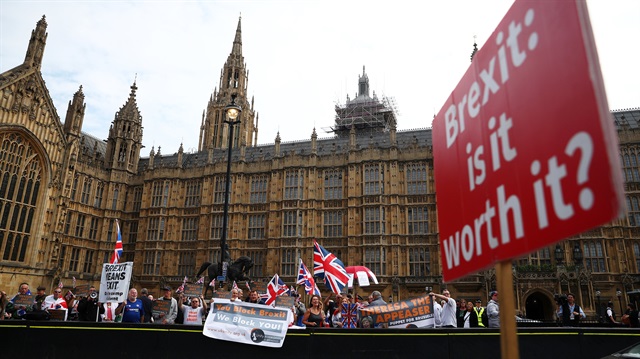
Pro and anti Brexit protesters demonstrate on opposite sides of the road outside the Houses of Parliament in London, Britain, September 5, 2018.
Britain could hold a second referendum on its European Union membership if lawmakers reject Prime Minister Theresa May's plan, a government minister said on Wednesday, as pro-EU campaigners set out how parliament could force a new vote.
Britain's narrow 2016 vote to exit the EU still divides public opinion with less than seven months until the country is due to leave the bloc. Prime Minister Theresa May is struggling to win support at home and in Brussels for her exit plan.
May has rejected the idea of a second referendum on leaving the EU, but one of her ministers said it could still happen if her negotiating strategy is rejected.
British inflation jumped unexpectedly to a six-month high in August, pushed up by bigger-than-usual seasonal increases in sea and air fares and higher theatre admission prices, official data showed on Wednesday. Consumer price inflation rose at an annual rate of 2.7 percent in August, compared with 2.5 percent in July, the Office for National Statistics said, above all forecasts in a Reuters poll of economists that had pointed to a fall to 2.4 percent. The ONS also said British house prices rose at the weakest annual rate in nearly five years, dragged down by the biggest drop in London house prices since 2009. Wednesday's figures are likely to surprise Bank of England officials who last month raised interest rates for the second time since the financial crisis and signalled only a gradual rise in borrowing costs in the coming years. Last week the BoE said it expected inflation to cool to 2.4 percent in August. The rise in inflation in August could present a setback to the modest recovery in real-terms wage growth that has helped to support economic growth this year. The fall in the value of the pound in August on renewed concerns about Brexit deprived consumers of the benefit of a fall in oil prices in annual terms, the ONS figures showed. "Consumers paid more for theatre shows, sea fares and new autumn clothing last month," ONS statistician Mike Hardie said. The BoE expects inflation will drift down to just above its 2 percent target in two years' time as it gradually raises borrowing costs. Consumer price inflation hit a five-year high of 3.1 percent in November, when the inflationary effect of the pound's tumble after Brexit vote in June 2016 reached its peak. The ONS said house prices in July rose by an annual 3.1 percent across the United Kingdom as a whole compared with 3.2 percent in June -- the weakest increase since August 2013. House prices in London alone fell 0.7 percent year-on-year in July, the biggest drop since September 2009. Bank of England's Haldane says firms' Brexit worries up sharply
UK inflation jumps unexpectedly to hit 6-month high in August
"Those to the right of the party - the pro-Brexit wing - will be very concerned that if that deal doesn't prevail, they'll end up in the situation where we could have a second referendum and we could end up not leaving the EU altogether," said Mel Stride, a minister in Britain's finance ministry.
"There is a danger of that happening," he added.
Stride's comments were contained within remarks setting out why he thought eurosceptic and pro-EU factions of May's party would ultimately come together to approve a deal with Brussels. He also argued that pro-EU lawmakers would back the outcome of negotiations to avoid leaving the bloc without any deal.
British businesses are more worried about Brexit uncertainty than was the case a few months ago, Bank of England chief economist Andy Haldane said on Wednesday."While mentions of Brexit have fallen from their referendum peak, it is notable that they have picked up sharply over the past few months, with measures of uncertainty following suit," Haldane said in a speech at Estonia's central bank.Haldane was referring to an analysis of businesses conversations with its network of regional staff.Last month the BoE raised interest rates to 0.75 percent, only its second increase since before the financial crisis more than a decade ago.Economists polled by Reuters do not expect the BoE to raise rates again until after Britain leaves the European Union in March next year.The bulk of Haldane's speech focused on how central bank communication could win public trust at a time of widespread distrust of traditional institutions.He defended the central bank's policy of 'forward guidance' on interest rates, which he said had given households and businesses a useful steer, even if some financial market participants found it lacking."Pricing interest rates in financial markets was not the main purpose of forward guidance in the first place," he said. "By allaying fears about too-rapid a rise in rates, it is likely to have encouraged spending and supported the economy," he added. UK Brexit minister sees no alternative to Irish border planBrexit deal possible if EU market integrity kept: EU's BarnierJaguar Land Rover to cut output at UK car plant after warnings on BrexitUK PM May's spokesman: We are confident of reaching Brexit deal
Bank of England's Haldane says firms' Brexit worries up sharply
In a report co-authored by the man who drafted the EU treaty clause Britain is using to exit the bloc, the People's Vote campaign said parliament would have a series of opportunities to encourage or force the government to hold a referendum.
"The die is not irrevocably cast, there is still time," said John Kerr, who wrote the Article 50 exit clause of the EU's Lisbon Treaty that May used in March 2017 to set a two-year countdown running on Britain's departure.
The campaign cited polling data from YouGov showing more people would back a second vote than oppose one. Most opinion polls show a slight shift away from voting for Brexit, but overall opinion remains basically split down the middle.
A new EU proposal to operate checks on goods along the Britain-Northern Ireland sea route will still mean an unacceptable border between the two, the deputy leader of the Northern Irish party backing Britain's minority government said on Wednesday."So Michel Barnier says he can do different kinds of checks between Northern Ireland and the rest of the UK as if that makes it more palatable. The fundamental point is that internal U.K. checks are only needed if it is intended to separate Northern Ireland from Great Britain," the Democratic Unionist Party's (DUP) Nigel Dodds said in a statement."Despite the talk of 'improvements' the backstop being insisted upon by the EU... still means a border down the Irish Sea although with different kinds of checks. The fact is that both Theresa May and the Labour Party have said no British Prime Minister could accept such a concept." Former Brexit minister says Eu exit talks will need a 'reset'
New EU terms still mean unacceptable Irish sea border: N.Ireland's DUP
The report set out six scenarios under which parliament could fight the government - ranging from technical procedures that would turn a planned vote in parliament on approving her deal into a one calling for a public vote, to the collapse of her government and a new election.
All rely to some extent on May, who does not have an outright majority in parliament, failing to win over sceptical lawmakers within her own party.
"The combination of parliament having meaningful votes, together with the government’s lack of a reliable majority, means that MPs (Members of Parliament) will play a central role in scrutinising any deal and could yet reject it," the report said.
Negotiations on Britain's exit from the European Union between Prime Minister Theresa May and the EU will require a "reset", said former Brexit minister David Davis, who resigned earlier this year in disagreement with May's proposals."I think we'll get to a point where she will not be able to accept what they offer, they will not be able to accept what she offers and they will have to have some kind of reset," Davis told BBC radio on Wednesday.Davis reiterated that he would not vote against May's current plans on the future relationship between London and Brussels. 
Former Brexit minister says Eu exit talks will need a 'reset'
The government has agreed to let lawmakers vote on whether to accept any deal May is able to negotiate with Brussels. But her negotiating plan is unpopular within her divided party, and it is not clear that she will be able to win a vote on it.
Nevertheless, May said that if her deal is rejected by parliament, Britain will leave the bloc without any deal - an outcome that many economists, including the International Monetary Fund, say would damage the economy.
Some pro-Brexit lawmakers argue that the dangers of leaving without a deal are being hyped up to generate fear, while both May's government and the EU have published no-deal contingency plans to try to mitigate any impact.